You turn on the faucet, sealing the flow so pressure pushes water into the hose’s reinforced inner tube. The rubber and fiber layers resist expansion, keeping a tight diameter while the threaded end and rubber gasket form a watertight joint. As water travels, the hose elongates slightly, but the fiber web maintains shape and prevents kinks. Nozzles at the end control the orifice, converting pressure into a jet, mist, or spray. Keep going and you’ll uncover how to diagnose pressure loss, maintain fittings, and choose the right reel.
How a Garden Hose Holds Water Pressure
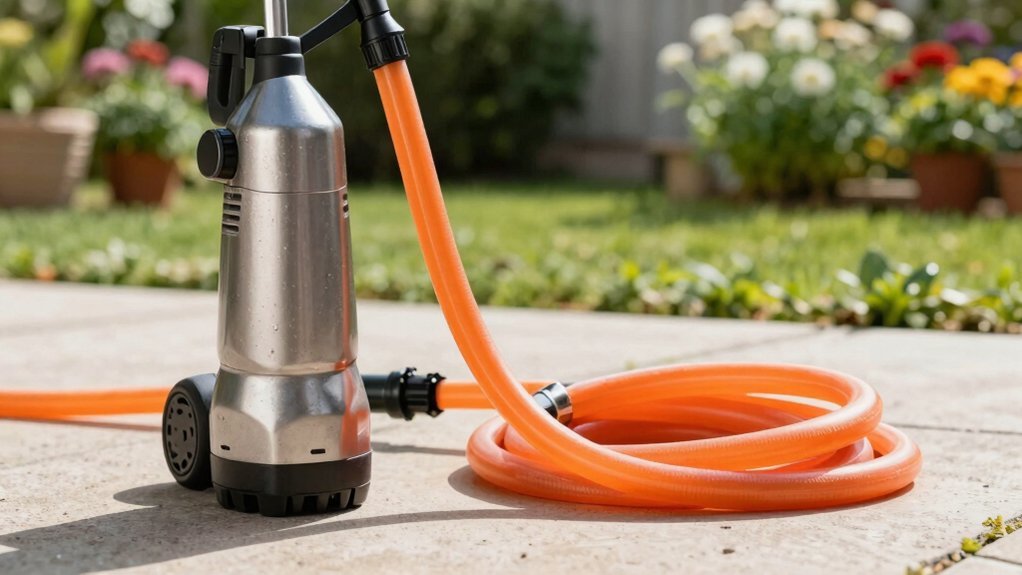
When you connect a hose to a faucet, the sealed end creates back‑pressure that forces the water to stay inside, and the hose’s reinforced rubber or fiber layers keep that pressure from expanding or rupturing. You then rely on water pressure capacity that matches typical home supplies of 40‑80 PSI. Material engineering considerations dictate that rubber or fiber blends must sustain at least three times the normal pressure, so a hose rated for 125 PSI burst strength can safely handle spikes up to 375 PSI. Reinforced layers prevent expansion, while the inner wall’s low porosity retains pressure along the length. Diameter and tight fittings further preserve pressure, and the design resists kinks that would otherwise disrupt flow. This systematic construction guarantees the hose holds pressure without failure. The Trotec pump can boost low‑pressure water to a usable flow for distant garden irrigation. For light cleaning tasks, a hose‑connected pressure washer can be effective when the flow rate is sufficient for the job. The diameter‑pressure relationship shows that larger hose diameters reduce friction loss, allowing higher gallons per minute at the same PSI. Selecting the proper hose diameter is essential for matching flow needs, and a 5/8 inch hose is ideal for heavy‑duty irrigation on large lawns.
Why Garden Hoses Lose Pressure and How to Diagnose It?
Even with a hose built to hold pressure, real‑world use often introduces factors that bleed off that pressure. First, check water supply issues: attach a gauge to the faucet, compare the reading to the manufacturer’s rating, and note any low or fluctuating values. Next, examine external degradation factors; look for UV‑cracked sections, weather‑worn fittings, and worn washers. Then, trace the hose for kinks or twists caused by tight coiling or dragging around obstacles; straighten any bends to restore flow. Inspect the length and diameter: longer, narrow hoses increase friction and reduce pressure, so trim excess or upgrade to a larger bore. friction loss grows with hose length, so using a shorter or wider hose can significantly improve pressure. Finally, clear clogs by flushing the interior and nozzle, and tighten or replace any leaky connections. This systematic diagnosis isolates the cause and restores ideal pressure. Most residential hoses operate effectively between 40 and 80 psi for optimal performance. long hose runs can be managed by selecting a larger‑diameter hose to offset pressure drop.
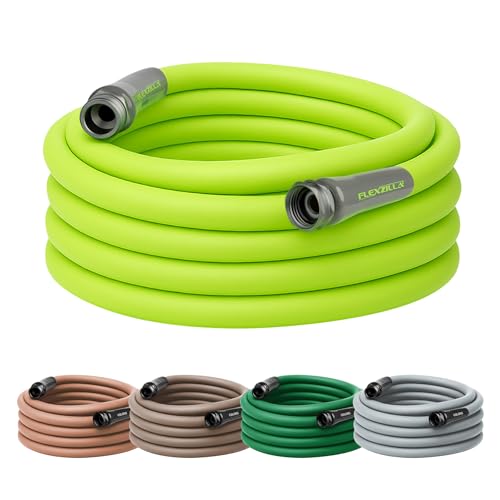
AWARD-WINNING: HGTV, USA Today and Best Reviews voted Best Overall Garden Hose

High-Pressure Performance: Guitrees Heavy Duty Rubber Garden Hose handles working pressures up to 200psi and bursts above 1000psi, ensuring a reliable water source for your gardening, agriculture, and construction needs.

60% LARGER INNER DIAMETER: The 1" extra-large inner diameter design delivers significantly higher water flow. Engineered for demanding irrigation, pumping, and commercial applications, this heavy duty hose provides faster, higher-volume water delivery for farm irrigation and pool filling – effectively reducing time on heavy-duty tasks
How Threaded Ends and Gaskets Prevent Leaks?
A threaded end paired with a rubber gasket creates a watertight joint by compressing the gasket between male and female threads, so any water that tries to escape is blocked by the sealed interface. You align the 3/4‑inch GHT male thread with the female connector, then apply ideal tightening methods: use a wrench to turn clockwise until you feel firm resistance, avoiding overtightening that could strip threads. The rubber gasket, sized for the connector, compresses under pressure, sealing the interface. Monitor gasket deterioration factors such as UV exposure, freezing cycles, and repeated tightening, which reduce elasticity and permit leaks. If threads are stripped, wrap 2–3 layers of PTFE tape clockwise before tightening. Replace worn gaskets with fresh ones, clean threads, and re‑test under pressure to confirm a leak‑free connection. Using Teflon tape can also help seal threaded connections and prevent leaks. For optimal sealing on metal fittings, apply multiple thin layers of PTFE tape to fill thread gaps evenly. Understanding standard hose thread sizes helps ensure compatibility across fittings. Selecting the correct garden hose thread size prevents mismatched connections and reduces the risk of leaks.
How Fiber Web Reinforcement Gives Hoses Strength and Flexibility?
The sealed joint created by a threaded end and gasket eliminates leaks, but the hose’s ability to stay intact under pressure relies on its internal reinforcement. In a fiber reinforcement design, continuous polyester fibers are circularly woven around the EPDM core, creating axial and hoop strength that resists burst and kinking. Diagonal fiber angles maintain a neutral response, preventing diameter change when pressure spikes. Reinforcement configuration advantages emerge from layered synthetic yarns, which add adaptability to harsh conditions and abrasion resistance. Braided structures use specific wire thickness and pitch to balance flexibility with pressure rating, allowing tight bends without linear expansion. This systematic layering yields a hose that end 150 psi at 70 °F, stays kink‑free up to 50 ft, and operates from –5 °C to +65 °C. Fabric reinforcement also contributes to overall hose durability. Selecting the proper hose length is essential for maintaining pressure, as longer hoses can cause a pressure drop that reduces cleaning efficiency. Proper hose length also helps avoid excess water waste when watering large garden areas.
How Garden Hose Nozzles Shape Water Flow (Mist to Jet)?
Three primary nozzle designs—jet, mist, and cone—control water flow by altering orifice size, internal geometry, and fluid dynamics. You’ll notice jet nozzles shrink the effective area, boosting pressure and producing a high‑velocity stream that can clean or reach distant soil. Mist nozzles use very small openings and impingement at 70‑90° to atomize water into a fine fog, ideal for humidity‑loving plants. Cone nozzles—full‑cone, hollow‑cone, or spiral—rely on internal vanes or discs that spin the liquid, shaping droplets into even or concentric patterns. Modern dial and adjustable nozzles let you select from customizable spray patterns, while recent nozzle design innovation adds multiple orifices and variable‑angle exits, expanding the range from mist to jet without changing the hose. The effective flow rate determines how far water can travel under a given pressure. Understanding sprinkler pressure helps you match nozzle choice to your irrigation needs. Selecting the right nozzle type is critical for spray uniformity and minimizing waste. This transformation follows the principle that a nozzle converts pressure energy into kinetic energy, as described by Bernoulli’s equation.

One VIKING High Pressure Hose Nozzle for Water Hose with extra rubber washer

One VIKING Heavy Duty High Pressure Water Hose Nozzle with extra rubber washer

DURABLE GARDEN HOSE NOZZLES:This hose nozzle heavy duty is made of impact resistant ABS Plastic+TPR with a rubber coating making it very durable.ABS plastic with its resistance to corrosion ensures that spray holes of this metal hose nozzle will not rust,not leak.
What Happens Inside a Stretchable Hose When You Turn the Water On?
When you flip the faucet on, water pressure immediately inflates the elastic inner tube, forcing the hose to elongate up to three times its original length. The inner latex or TPC layer expands radially, while the woven polyester or nylon sheath guides the stretch, preventing kinks. As pressure builds, the tube fills with water, creating smooth curves and swivels that align with the outlet. This rapid expansion follows pressure dynamics: higher pressure yields longer reach and greater flow, whereas insufficient pressure stalls lengthening. Simultaneously, the outer fabric tightens, preparing contraction mechanisms for shutdown. The system self‑drains once pressure drops, squeezing water out and collapsing the hose back to its compact state without manual coiling. The hose expands significantly when water is turned on. Longer hoses can experience pressure loss that reduces overall performance. Expandable hoses often trade durability for convenience, making them best suited for occasional light‑use watering.
When Should You Use a Manual Reel vs. an Automatic One?
Choosing between a manual and an automatic hose reel hinges on your workflow, terrain, and budget. If you work on uneven ground, need to swap hose lengths, or prioritize durability, you should weigh manual reel installation considerations such as sturdy mounting brackets, material strength, and easy detachment for multiple water sources. Manual reels excel in industrial settings, rough terrain, and cost‑sensitive projects, offering full control over retraction speed and no power dependence. Conversely, automatic reel suitability factors include space‑saving wall mounts, smart scheduling, injury prevention, and rapid deployment for large lawns or busy homeowners. Evaluate the frequency of use, physical strain, and desire for programmable watering to decide which system aligns with your operational needs. Proper hose winding technique helps prevent kinks and uneven winding, extending the life of the reel. Using plumber’s tape on the connector threads ensures a leak‑free seal. The hose’s pressure rating determines its ability to withstand water force without bursting.

Long-Lasting, Leak-Free Performance: The retractable garden hose reel features a reinforced metal shaft that resists pressure, aging, and wear far better than plastic ones; This durable core prevents internal leaks and keeps water flowing smoothly- no cracks, no drips, just years of dependable use

Any Length Lock:Lock the 83 FT hybrid hose (78 FT retractable + 5 FT lead) at any length. This retractable garden hose lets you pull only what you need—it stays put. No dragging excess hose. Every corner of your garden is covered
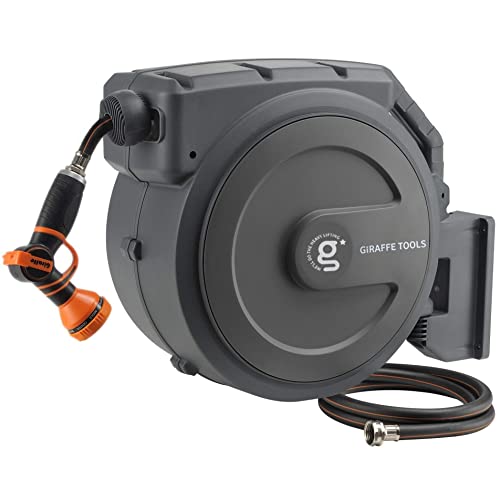
Any Length Lock:Lock the 135 FT hybrid hose (130 FT retractable + 5 FT lead) at any length. This retractable garden hose lets you pull only what you need—it stays put. No dragging excess hose. Every corner of your garden is covered
Fix Kinks, Leaks, and Pressure Loss in Your Garden Hose
Switching from deciding between manual and automatic reels, you now need to address the inevitable kinks, leaks, and pressure loss that appear with regular use. Begin with basic hose storage techniques: coil the hose in large circular loops, use a reel or hanger, and keep loops wide to avoid tight bends. When a kink forms, apply effective kink removal methods—lay the hose flat in sunlight, run warm water through it, and gently massage the section. For small holes, pressure‑test the hose, locate the puncture, and apply a compatible patch kit. Larger splits require a hose mender sized to the hose diameter. Finally, inspect fittings for looseness, clear clogged nozzles, and verify that no blockages impede pressure‑driven flow. The hose material is designed to withstand water pressure, so pressure tolerance helps prevent bursts during high‑flow use. Regularly checking for high water pressure can also reduce the risk of sudden hose failure.

GARDEN HOSE REPAIR CONNECTOR SET: Package include 2 female hose repair connector, 2 male hose repair connector, 4 zinc alloy clamps with stainless steel screws and extra 4 garden hose washers

【Complete Hose Repair Kit】Includes 3 Set repair fittings, 6 rubber washers (3 extras), and 1 hex wrench for quick garden hose repair. Measure your hose inside diameter before purchase to confirm compatibility

【Package Including】Fit for 3/4" or 5/8'' hose fittings, contains 5 female and 5 male hose repair connector with 10 clamp, and extra garden hose rubber gasket. Note: please choose correct hose size before order.
Pick Hose Material for Your Terrain and Maintain Longevity
If your garden’s terrain varies—from sandy beds to rocky borders—the hose material you select must match those conditions while resisting wear over time. First, assess hose lifespan considerations: vinyl offers low cost and light weight but cracks after one season under heavy use; rubber provides durability and temperature resilience, suitable for large beds; polyurethane combines UV resistance, kink‑free flow, and multi‑year longevity; reinforced hybrids deliver abrasion resistance and lighter weight than pure rubber. Match diameter to task—1/2″ for delicate borders, 5/8″‑3/4″ for high‑flow cleanup. Choose a model with appropriate reinforcement for mud or rocks, such as Dramm ColorStorm. Finally, implement seasonal hose storage: drain, coil tightly, and keep in a cool, shaded area to preserve material integrity and extend service life. Thin hose wall can lead to early failure if the hose is constantly bent beyond its minimum bend radius.

Extremely Flexible - Extreme all-weather flexibility

DOUBLE UV PROTECTION FOR LONGER-LASTING PERFORMANCE: Our Premium Pocket Hose Ballistic features 2X the UV protection to help shield the hose from sun exposure and keep it performing and looking like new, season after season

Durable Garden Hose: Made of 304 stainless steel and multi-layer flexible inner tube, its structure is stronger than traditional rubber water pipes. Also it can withstand dog bite, dragging through wall edges and ground and will not break, crack or leak