You’ll see the pressure drop as soon as you add length because friction loss rises linearly with each foot of hose. A 50‑ft hose can lose about half the pressure a 100‑ft hose retains, and the longer the tube the slower the water must travel, increasing resistance. Larger diameters help: a 3/4‑inch hose delivers roughly three times the flow of a 1/2‑inch at the same pressure. Elevation changes also subtract 0.433 psi per foot of rise. If you keep reading, you’ll uncover how to size and install hoses to minimize these losses.
How Each Additional Foot of Hose Reduces Water Pressure
Each extra foot of hose adds friction, which directly cuts the water pressure and flow. When you measure flow rate at 45 PSI, a 25‑foot baseline delivers 24 GPM, but adding 25 feet drops output by roughly 25 % across diameters. A 1/2‑inch hose falls from 13 GPM at 50 feet to 9.8 GPM at 75 feet, while a 3/4‑inch hose slides from 38 GPM to 28.5 GPM over the same interval. Per‑foot loss compounds; four 25‑foot sections reduce flow by 75 % from the baseline. To mitigate this, pressure maintenance strategies include using larger‑diameter hoses and keeping lengths under 50 feet. Precise flow rate measurement confirms that each added foot incrementally erodes pressure, demanding data‑driven sizing decisions. Longer hoses increase system resistance, which can further diminish injector performance. Understanding flow dynamics helps you choose the optimal hose for your garden. The hose’s flexible tubing also contributes to Bernoulli’s principle by allowing pressure variations to translate into changes in flow speed.
Why Garden Hose Friction Loss Grows With Length
Because friction between water and the hose wall increases with every additional foot, the pressure loss grows linearly with length. You’ll see that a 50 ft hose drops half the pressure of a 100 ft hose because the contact area doubles, and each extra foot adds the same incremental resistance. The loss follows the equation ΔP ≈ f · L, where f reflects hose material characteristics and the roughness of the inner surface. Water speed rises when you force a given flow through a longer, constrained tube, amplifying hose water interactions and boosting frictional drag. Even at constant 60 psi, a 100 ft run of 1/2‑inch hose loses roughly 1 psi per foot, while a 3/4‑inch hose suffers less because the larger cross‑section reduces velocity and thus friction. Selecting the appropriate hose diameter is crucial because a larger flow rate reduces friction loss over long distances. For high‑pressure washers, keeping the hose length below the recommended maximum helps maintain optimal performance. This principle also explains why a hose‑connected pressure washer can still be useful for light cleaning tasks when the hose is short and the nozzle is optimized for low‑pressure applications.
How Hose Diameter Reduces Garden Hose Pressure Loss
When you increase a hose’s inner diameter, the cross‑sectional area grows with the square of the diameter, so for a given flow rate the water velocity drops proportionally. This velocity reduction directly lowers the impact of friction, because Darcy‑Weisbach loss varies with velocity squared. For example, a 3/4‑inch hose at 60 psi delivers 22 GPM, whereas a 1/2‑inch hose delivers only 8 GPM; the larger hose’s velocity is roughly one‑third, cutting friction loss by about 75 %. Flow conservation (A·V = constant) shows that doubling diameter from ½‑inch to 1‑inch more than doubles flow, reaching 37 GPM and further suppressing pressure loss. In practice, selecting a 5/8‑inch or 3/4‑inch hose for typical garden taps maximizes flow while minimizing friction‑induced pressure drop. The area increase from a 1‑inch to a 4‑inch pipe is 1600 % compared to the 1‑inch pipe. Longer hoses also benefit from larger diameters because they maintain adequate pressure over greater distances. Properly matching thread types ensures a leak‑free connection throughout the system. Maintaining your garden hose within the optimal 40‑80 psi range helps prevent excessive wear and ensures consistent performance.
Gravity‑Induced Pressure Drop From Elevation Changes
If you lift a garden hose a few feet, the water pressure at the nozzle drops by roughly 0.433 psi per foot of elevation gain, because each 2.31 ft of rise consumes 1 psi of head. Gravity acts against uphill flow, so a 10‑ft rise removes about 4.3 psi, while a 10‑ft descent adds the same amount. The net pressure change equals the elevation difference between source and nozzle, independent of hose length. Geographic location impacts because higher‑altitude sources start with lower atmospheric pressure, amplifying the loss per foot. Seasonal water level changes in reservoirs shift the effective head: a rainy season raises the water surface, increasing the initial pressure but also the elevation‑induced drop when you lift the hose. Use the hydraulic grade line to combine pressure and elevation heads for accurate predictions. Elevation determines the baseline pressure available in the system. Understanding municipal water supply dynamics helps you anticipate how source pressure variations affect overall sprinkler performance. Modern sprinkler heads are designed to maintain consistent flow despite minor pressure fluctuations, leveraging nozzle geometry to optimize spray patterns. The nozzle’s conversion of pressure energy into kinetic energy follows continuity and Bernoulli’s equation, explaining why velocity increases as pressure drops.
Typical Pressure Loss Values for Common Garden Hose Sizes
A typical 5/16‑inch garden hose loses about 16 psi per 100 ft at a modest 0.05 GPM flow, whereas a 3/8‑inch hose drops only 5 psi over the same distance, and a 1/2‑inch hose falls roughly 2 psi. You’ll notice that pressure loss scales linearly with length, so a 50‑ft run halves those drops. Larger diameters cut friction dramatically; a 5/8‑inch hose delivers 12 GPM at 50 psi over 100 ft, while a 3/4‑inch hose reaches 20 GPM under identical pressure. When you stay within the maximum allowable pressure of your tap, choosing a wider hose maximizes ideal flow efficiency, because the reduced pressure loss preserves both pressure and volume across the length you need. Friction loss increases with pipe length and decreases with larger pipe diameter. Adding a booster pump can restore pressure when multiple hoses are linked beyond the typical three‑to‑four limit. Understanding the thread seal differences helps ensure compatible fittings and prevent leaks. Selecting the correct garden hose thread size is essential for a leak‑free connection.
How to Calculate Garden Hose Pressure Loss Yourself?
You can estimate the pressure drop of any garden hose by applying the basic friction‑loss relationship: ΔP = (L × K) × (Q / D)², where ΔP is the pressure loss (psi), L the hose length (ft), K the coefficient from a friction‑loss chart for the hose material, Q the flow rate (GPM), and D the inside diameter (in). Choose K from a chart that matches your hose material and flow regime; for a 1/2‑inch hose at 10 GPM, K≈1 psi/ft. Plug in L, Q, and D, then square the Q/D term. Add coupling losses (≈5 % of hose loss per coupling set). Use a calibrated gauge to verify getting accurate pressure measurements and watch for minimizing flow turbulence, which can inflate the calculated loss. This method yields a precise, data‑driven estimate for any hose configuration. Typical nozzle pressures range from 30 to 80 psi depending on water source, nozzle type, and hose length. Remember that longer hoses increase friction loss and may require a larger diameter or higher source pressure to maintain performance. Proper storage during cold weather prevents freezing damage that can exacerbate pressure loss.
Ways to Minimize Pressure Loss on Long Hose Runs
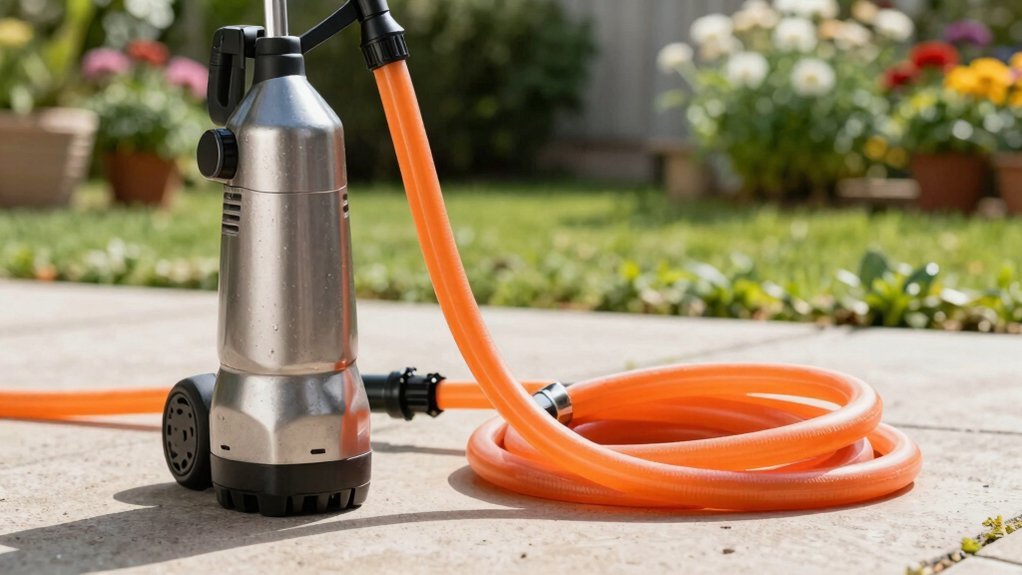
The pressure‑loss equation you just used shows that every extra foot of hose adds a predictable psi drop, so the next logical step is to cut that loss by eliminating the causes. First, apply proper storage techniques: coil the hose on a reel or hang it straight to avoid kinks and twists that create turbulent flow and add friction. Second, practice consistent hose maintenance: straighten the hose before each use, inspect for abrasions, and replace kink‑resistant sections promptly. Third, trim excess length; a 100‑ft run loses roughly 0.5 psi per foot, so cutting 20 ft restores 10 psi. Fourth, install a pressure regulator or a garden pump at the source to stabilize flow. Finally, use brass fittings and insulated connectors to prevent leaks and cold‑weather blockages. Adding a pump like the Trotec TGP1000ES can dramatically boost pressure for long runs. A pressure tank can also smooth out flow and protect the system from water hammer. Cleaning the nozzle regularly prevents blockage and helps maintain optimal pressure. Choosing a hose with a higher pressure rating ensures it can safely handle the washer’s output without bursting.
Pick the Best Hose Length and Diameter for Your Garden
Because garden size and layout dictate water‑delivery needs, you should match hose length and diameter to the farthest point you must reach while minimizing friction loss. Measure the longest distance from spigot to the farthest planting zone, then add a small margin; a 500‑2,000 sq ft lawn typically works with a 50‑ft hose, while a 2,000‑5,000 sq ft area needs 75‑100 ft. Choose a 1/2‑inch hose for light tasks, 5/8‑inch for most gardens, and 3/4‑inch for heavy‑duty watering; larger diameters increase flow and compensate for longer runs, ensuring an adequate water supply. Use uniform hose connections when joining two shorter lengths to maintain consistent pressure and avoid leaks. Avoid excess length that hampers maneuverability and adds unnecessary friction. Longer hoses increase friction loss.