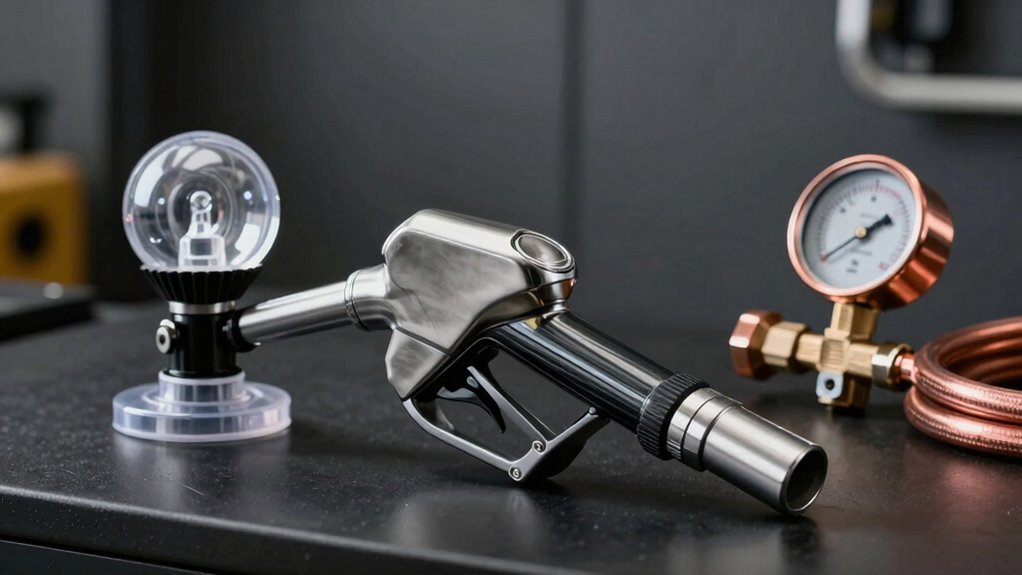
You’ll find that a standard diesel nozzle, about 15⁄16 in. wide, can’t physically enter a gasoline filler neck, which is restricted to roughly 13⁄16 in., so the built‑in size mismatch blocks accidental diesel fueling in most modern gas tanks. Modern pumps also use lock rings, splash guards, and auto‑shut‑ sensors that stop flow if the wrong nozzle is forced. If you ever mis‑fuel, drain the tank, flush the system, and replace the filter to avoid engine damage—continue for detailed recovery steps.
Diesel vs. Gasoline Nozzle Size and Shape
Because diesel and gasoline nozzles differ fundamentally in diameter and geometry, they are engineered to fit only their respective tank openings. You’ll notice the diesel nozzle measures roughly 24 mm, while the gasoline nozzle is about 21 mm. This 3 mm difference prevents a diesel nozzle from entering a gasoline filler pipe, which is sized for the smaller gauge. Diesel filler pipes are large‑diameter, often found at truck stops, whereas gasoline pipes are small‑diameter at passenger stations. The design eliminates nozzle incompatibility issues by matching each nozzle to its intended pipe. Regional nozzle size variations add complexity: in the USA, three diesel nozzle sizes exist—smallest matches gasoline size, medium serves passenger diesel pumps, and large requires adapters for light trucks. These variations maintain strict fuel segregation. Diesel fuel will damage a gasoline engine more than gasoline will harm a diesel engine. Proper nozzle selection also supports water efficiency by ensuring consistent flow rates and pressure compatibility. Understanding the role of a nozzle in fluid control helps prevent cross‑contamination and equipment damage. The conversion of pressure energy to kinetic energy in a nozzle follows Bernoulli’s principle.
Why Modern Gas Tanks Physically Block Diesel Nozzles
You’ll notice that modern gasoline filler necks incorporate a built‑in restrictor that’s deliberately smaller than a diesel nozzle’s tip. The restrictor limits the opening to roughly 13/16 inch (≈20.8 mm), while a diesel spout measures 15/16 inch (≈23.8 mm). This 3‑4 mm diameter mismatch creates a physical barrier that prevents diesel nozzle incompatibility. Engineers design the inlet geometry to be incompatible with larger diesel tips, a poka‑yoke approach that blocks insertion before any fuel contacts the tank. The size restriction also aids spill prevention by stopping fuel flow if a larger nozzle somehow engages the automatic shut‑off. Material‑resistant, corrosion‑proof restrictors remain effective throughout the vehicle’s life, ensuring consistent safety across all modern passenger vehicles. Incorrect nozzle size can also trigger the pump’s auto‑shutoff, further protecting the vehicle from accidental diesel filling. Selecting the proper nozzle is essential for achieving the desired spray pattern and pressure rating for each cleaning task. Nozzle friction also influences the pressure loss and spray efficiency, mirroring the considerations discussed for sprinkler and washer nozzles.
When a Gas Nozzle Fits a Diesel Tank – Modern Safeguards
One of the most common scenarios today is a gasoline nozzle slipping into a diesel filler, and modern safeguards address it through multiple engineered layers. You first encounter nozzle configuration quality: diesel spouts are 15/16 in. wide, while unleaded tips are 13/16 in. to 15/16 in., and anti‑siphon guards reject mismatched diameters. Next, automatic shut‑off features—venturi ports, pressure sensors, FlowLock, and dual poppet valves—detect overfill and stop flow instantly, preventing excess gasoline from entering the tank. Spill‑prevention tech adds lock rings, splash guards, and back‑check valves that seal the nozzle once fuel reaches the preset level. Finally, grounding paths, vapor‑recovery systems, and certified fuel‑type blocks reinforce refueling procedural safety, ensuring that even if a gas nozzle fits a diesel tank, the system aborts the transaction before damage occurs. Understanding thread pitch differences helps select the proper adapter for each fuel type. Selecting the correct hose fitting size further prevents cross‑type fuel contamination.

Flow Rate: 15 GPM; Maximum Working Pressure: up to 50 PSI
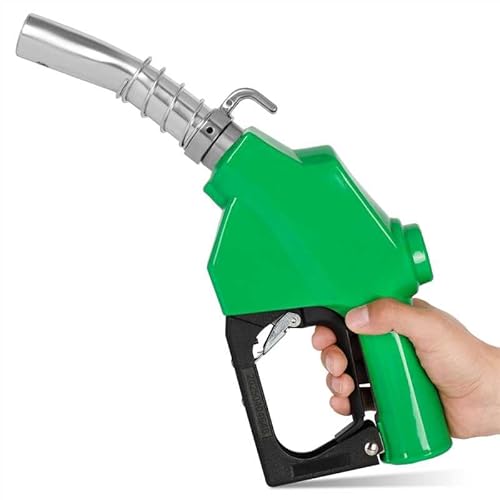
【100% SATISFACTION GUARANTEED】:This fuel nozzle comes with a one-year warranty. If you are dissatisfied with your purchase for any reason, please contact us via “Order History > Contact Seller,” and we will respond within 24 hours to provide a solution.

VEVOR 1 Inch NPT Automatic Fuel Nozzle, Max Flow Rate 21.6 GPM, Auto Shut Off Diesel Gas Pump Nozzle with 3-Speed Trigger Lock & 1-3/16 in (OD=30.1 mm) Spout for Gasoline, Diesel, Kerosene, Green
What Happens to a Gas Engine If You Fill It With Diesel (and Vice‑versa)?
Even with modern nozzle safeguards, the moment diesel finds its way into a gasoline engine, the mismatch in fuel properties triggers immediate malfunction. Diesel’s higher viscosity clogs injectors and spark plugs, so the fuel pump struggles with the dense diesel‑gasoline mixture. You’ll notice rough idling, misfiring, and a dark exhaust plume as unburned diesel burns incompletely, causing catalytic converter damage. The engine may crank then stall, or run briefly on residual gasoline before seizing. Conversely, filling a diesel engine with gasoline introduces a volatile fuel that ignites too early, leading to pre‑ignition, severe knocking, and possible seizure. In both cases, diesel fuel mixture contamination compromises combustion efficiency, drops octane rating, and mandates immediate towing, tank drainage, and full system flush to avoid costly repairs. The 1996 Ford Crown Victoria’s V8 experienced a 260 lb‑ft torque boost when a 31.8 % diesel blend was used. This rapid conversion of thermal energy to kinetic energy in the nozzle is driven by steam expansion which accelerates the fluid and increases pressure drop. Understanding momentum change helps predict the resulting thrust forces on the nozzle. The area‑velocity relationship in a diverging nozzle explains how the flow accelerates as the cross‑sectional area expands.
How to Choose the Correct Nozzle and Avoid Mis‑fueling
Choosing the right nozzle hinges on recognizing that mechanical incompatibility is the first line of defense against mis‑fueling. First, verify nozzle compatibility standards: diesel dispensers use medium‑diameter pipes that will not enter a gasoline filler neck, while gasoline pumps employ small‑diameter nozzles that may fit many diesel openings. Second, read fuel pump labeling before you insert any nozzle; federal law mandates clear printed identification of diesel versus gasoline. Third, ignore color cues—green, black, or red nozzles are not standardized and can mislead. Fourth, confirm the pump side: single‑pump stations often place diesel and gasoline nozzles side‑by‑side, so double‑check the label on the selected nozzle. Finally, if a large‑diameter truck‑stop diesel nozzle appears, recognize that an adapter is required for passenger‑car tanks, and avoid using it without proper equipment. Also, ensure the hose you connect can handle the pressure rating of the washer, as a high‑pressure hose is essential for safety and performance. Selecting the proper nozzle also depends on matching the spray pattern to the intended application to achieve optimal coverage. A nozzle’s design converts static pressure into kinetic energy, illustrating Bernoulli’s principle in everyday fuel dispensing.

Item Package Dimension: 6.38L x 2.36W x 2.32H inches

Unit is designed to Original Equipment (OE) fit, form and function requirements accomplished by leveraging Spectra Premium's OE fuel system design expertise

DEPENDABLE & DURABLE NOZZLE: Engineered with rugged cast-aluminum construction to withstand the most demanding applications, every fuel fill nozzle includes a one-year warranty.
Step‑by‑Step Recovery if You Put the Wrong Fuel in Your Tank
If you realize you’ve put the wrong fuel in your tank, stop immediately, keep the ignition off, and move the vehicle to a safe spot without starting the engine. First, assess the situation: note any Dashboard warning indicators and recall Common misfueling causes such as similar nozzle size or hurried pump selection. Do not activate electrics; keep the ignition off to prevent the fuel pump from circulating contaminated fuel. Notify station staff, then push the car to a neutral, secure forecourt area. Call a breakdown service for professional fuel removal. The specialist will drain the tank, purge lines, replace the filter, and flush the system. After clearance, add the correct fuel volume, prime the pump by turning the ignition on without cranking for 5‑10 seconds, repeat 3‑6 times, and verify that no warning lights reappear before driving. The mixture was found to contain roughly 30 % petrol according to hydrometer testing. Safety mechanisms often trigger an automatic shut‑off when fuel pressure drops too low. Sprinkler systems can remain active for several minutes depending on heat and fire size. Standard sprinklers typically activate at 155 °F (68 °C) when exposed to sufficient heat.

FITS FOR POULAN CHAINSAW PARTS, 530037793 Air Filter Replace Part # 530-037793, 530037793, Primer Bulb Replaces Parts # Poulan Craftman 530071835, 530047213; Wal-bro 188-513, 188-513-1, 188-518, 188-518-1.

OEM Echo Part Number: 90097Y

【4AN NITROUS PURGE KIT】 Designed for 4AN nitrous systems, this purge valve kit helps vent trapped gas from the feed line before activation, allowing liquid nitrous to reach the solenoid more efficiently.