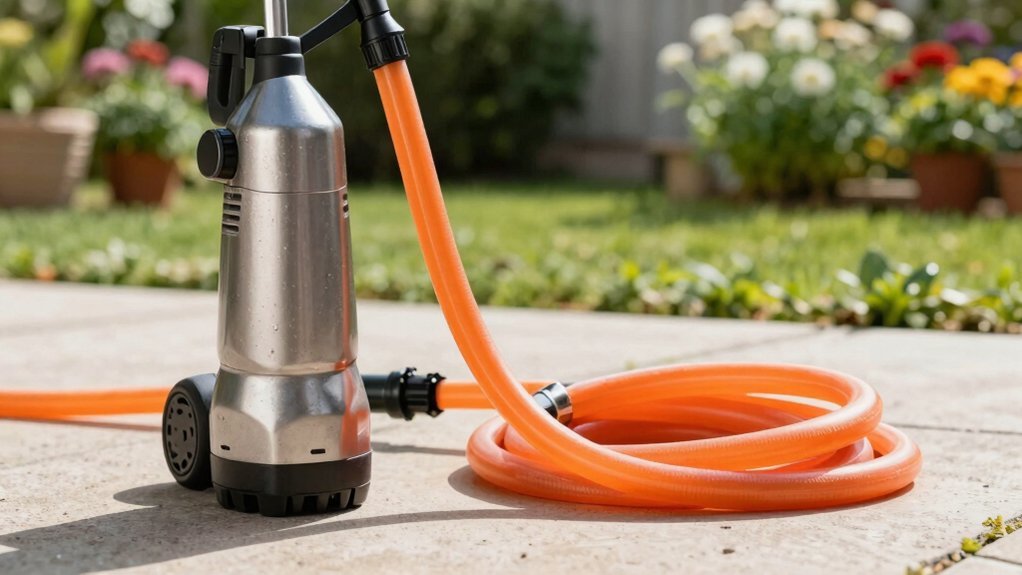
A garden hose typically comes in ½‑inch, 5/8‑inch, or ¾‑inch diameters, and each size dictates how much water you’ll get. A ½‑inch hose is light‑duty, perfect for flower beds or short runs, while a 5/8‑inch hose balances flow and weight for everyday watering and car washes. A ¾‑inch hose delivers the most volume, ideal for pressure washers or large lawns. Matching the hose size to your faucet’s PSI and the task’s length keeps pressure steady and prevents kinking, and the next sections will show you how to pick the right length and material for your yard.
Understanding Hose Width (Diameter) and Its Impact on Flow
Any garden hose’s diameter determines how much water it can deliver, so understanding that relationship is key to choosing the right size for your tasks. You’ll notice that a 1/2‑inch hose moves the least water, ideal for short, light‑duty watering, while a 5/8‑inch hose gives a balanced flow for everyday sprinklers and car washes. A 3/4‑inch hose pushes the most volume, perfect for pressure washers or large lawns. To keep hose width maintenance simple, store hoses coiled and avoid sharp bends that can crush the wall thickness. When you’re laying out a line, use a hose reel or guide to prevent kinking; a smooth curve maintains flow and protects the inner lining. Regularly inspect for wear, replace cracked sections, and you’ll preserve excellent performance. The inside diameter directly determines the amount of water flow a hose can provide. A higher water pressure can significantly increase gallons per minute, especially in larger‑diameter hoses. Maintaining a pressure of 50‑60 psi helps ensure consistent flow without over‑stress on the hose. Understanding pressure rating helps you match the hose to your water source and avoid bursts.
Choosing the Right Diameter for Your Water Pressure (Garden Hose Size)
When you match a hose’s diameter to your water pressure, you’ll keep flow steady and avoid costly pressure loss. Start by checking your faucet’s PSI; 40‑60 PSI works fine with a 5/8‑inch hose, while 80 PSI may need a 3/4‑inch hose to preserve pressure over long runs. If you often water a large garden or run a pressure washer, choose the wider size to offset friction loss. For occasional light tasks, a 1/2‑inch hose saves weight and storage space. Factor in water hardness effects—hard water can clog narrower interiors faster, so a larger diameter reduces buildup. Finally, weigh usage frequency considerations: high‑use setups benefit from the durability of a 5/8‑inch hose, while low‑use scenarios can stick with 1/2‑inch. Longer hoses significantly reduce water flow rate. Friction loss increases with hose length, so longer runs can cause noticeable pressure drops. Selecting the appropriate hose length is crucial because excessive length can cause pressure loss that diminishes the performance of a pressure washer. Understanding water consumption cost helps you gauge the expense of running your hose for extended periods.

Ultra-Lightweight & Durable Hybrid Garden Hose: Crafted with advanced PVC and rubber-polymer hybrid technology, Our 25 feet heavy duty garden hose is lighter than traditional heavy-duty water hoses yet incredibly durable, to meet your daily garden requirements.The middle woven layer ensures non-fading, abrasion-resistan, perfect for daily gardening, commercial tasks, and outdoor use.
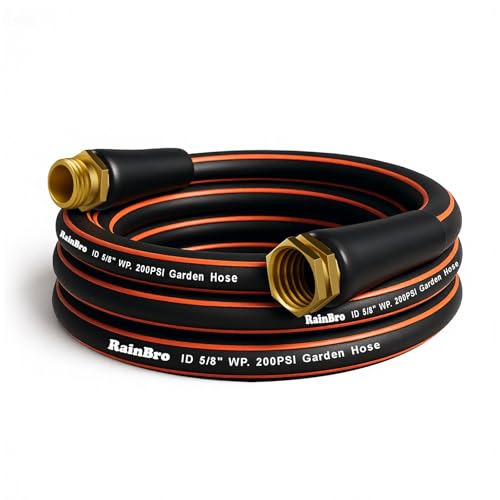
Designed for garden watering use: This 10ft. rubber garden hose features a 5/8'' inner diameter for optimal water flow, paired with durable 3/4'' GHT brass fittings for leak-proof connections.
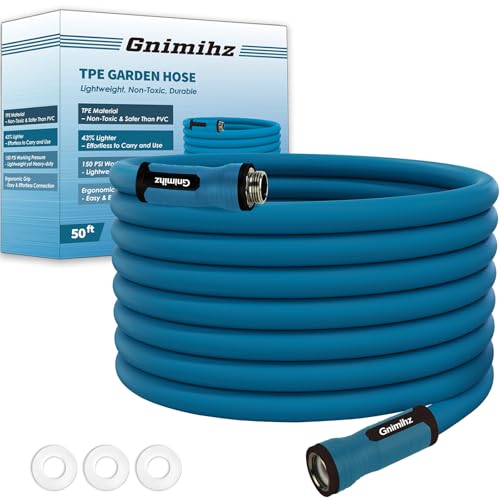
[ Stand Out from the Crowd ] Unlike ordinary hoses made of PVC or hybrid polymers, this Gnimihz 5/8-inch water hose is crafted with premium TPE material—and the difference is night and day. Lightweight like fabric/expandable hoses, with high water flow & durability of a traditional heavy duty 5/8-inch rubber hose.
1/2‑Inch Garden Hose: Light‑Duty Uses
A 1‑inch garden hose is perfect for light‑duty tasks like watering flower beds, feeding seedlings, or creating a simple soaker hose. To build a low‑pressure irrigation line, drill 1/8‑inch or 1/4‑inch holes every six inches on one side, cap the ends with brass or plastic, and lay it along rows. The slow seepage reduces evaporation and leaf wetting, protecting delicate plants. Because the hose material resists chemicals, you can run diluted fertilizers without degrading the wall. For tree protection, cut sections, thread wire through, and stake them to shield bark. Use short pieces as pest traps or garage buffers, securing them with screws for added safety. This DIY setup stays inexpensive, flexible, and durable. The system relies on water pressure differentials to push water through the perforations efficiently. Properly matching hose diameter to the sprinkler system capacity maximizes uniform water distribution across the garden.

Durable: The water pipe shell is made of sturdy polyester fabric, which is leakproof and puncture-proof and has a long service life. The interior is made of high-quality PVC material and can withstand burst pressures of 600 psi

3-PLY REINFORCED DURABILITY – Braided construction provides strength, flexibility, and long-lasting performance while resisting wear and tear

NON-Expandable, Kink-Resistant Garden Hose: This non-expandable garden hose maintains a fixed length during use, avoiding sudden expansion or contraction. Designed to resist kinks under normal use, the hose can be gently stretched while the swivel fittings rotate to help release minor twists.
5/8‑Inch Garden Hose: Versatile Everyday Choice
Nearly every homeowner’s garden hose is a 5/8‑inch model, and for good reason: it delivers enough water for typical chores without the bulk of larger diameters. You’ll find it on most spigots, and its 3/4‑inch GHT coupling fits standard taps. The hose balances flow and pressure, giving roughly 6 gpm at 100 ft and 9.8 gpm on a 25‑ft reel at 50 psi. That performance makes it perfect for common uses like garden watering, car washing, and light cleaning. Its outside diameter stays between 0.77 and 1.0 inch, keeping the hose lightweight and easy to coil. Overall value shines because it handles medium‑length runs up to 100 ft without excessive weight, offering a versatile, everyday solution. The most common garden hose size is 5/8 inch, which aligns with the majority of residential hose specifications. Choosing the correct thread type ensures a leak‑free connection with your sprinkler system. Properly sealing the connection with plumber’s tape helps prevent leaks and maintain consistent water pressure. Understanding the tapered NPT seal mechanism can prevent mismatched fittings and costly repairs.

AWARD-WINNING: HGTV, USA Today and Best Reviews voted Best Overall Garden Hose
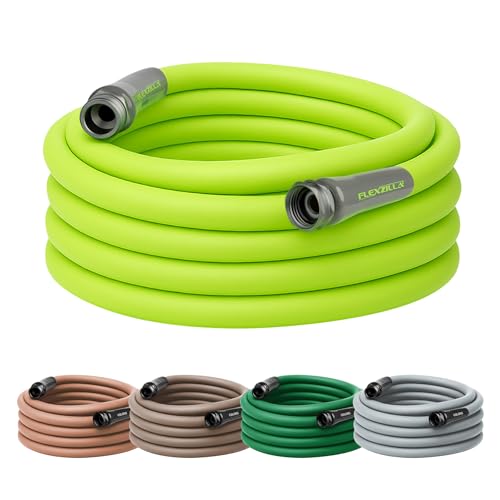
AWARD-WINNING: HGTV, USA Today and Best Reviews voted Best Overall Garden Hose

50% More Lightweight - Assures effortless handling
3/4‑Inch Garden Hose: Heavy‑Duty Performance
One‑inch garden hoses deliver heavy‑duty performance for tasks that demand higher flow and pressure. Their 25.4 mm inner diameter and 5 mm wall thickness let you handle up to 300 PSI working pressure and 650 PSI burst pressure, ideal for commercial applications like nurseries, automotive washes, and agricultural irrigation. Choose EPDM rubber with spiral yarn reinforcement for flexibility from –50 °F to +190 °F and hot‑water tolerance up to 212 °F. A 50‑ft length weighs 33.25 lb and pushes 7.6 gpm at 70 PSI, giving roughly 17 % more flow than a 5/8‑inch hose. Connect with 1‑inch NPSH brass male and swivel female couplings, or use a 1″ × ¾″ reducer for standard spigots. Premium rubber models include a 10‑year limited warranty coverage, ensuring long‑term reliability. When pairing with a pressure washer, verify that the hose’s pressure rating meets or exceeds the washer’s maximum output, as using an under‑rated hose can cause burst failure and safety hazards. Selecting the correct fitting material is essential for maintaining a leak‑free connection under high pressure. Understanding the ¾‑inch GHT standard helps ensure compatibility with most residential spigots.

High-Pressure Performance: Guitrees Heavy Duty Rubber Garden Hose handles working pressures up to 200psi and bursts above 1000psi, ensuring a reliable water source for your gardening, agriculture, and construction needs.

1-INCH EXTRA-LARGE DESIGN: Our Aeromixer 50 ft hose water features a 1-inch extra-large design, ideal for efficient water flow in demanding irrigation, pumping, and commercial or agricultural tasks. Our 50 feet garden hose allows for fast, high-volume water movement, making it an excellent choice for anyone needing a 50 ft water hose for outside use. With its heavy-duty performance, our garden hose 50 ft ensures quick task completion, improving overall productivity while saving time.

1-INCH EXTRA-LARGE DESIGN: Our Aeromixer 100 ft garden hose features a 1 inch garden hose design for efficient high-flow water transfer in irrigation, pumping, and outdoor watering tasks. This heavy duty water hose supports fast, high-volume movement for commercial garden hose and water hose for garden applications. Includes a Brass Ball Valve, Brass Adapter Set for standard 3/4" spigots to support flexible outdoor hose connections and improved water flow control.
How Hose Length Affects Pressure and Flow (Garden Hose Size)
Ever wonder why a 100‑foot hose feels sluggish compared to a 25‑foot one? Length adds friction, so water slows and pressure drops as it travels. To enhance water input, keep hose runs under 50 feet when you can; beyond that, friction climbs sharply, especially in narrow ½‑inch lines. If you need a longer reach, choose a larger diameter—¾‑inch or 2‑inch—to mitigate flow problems, because bigger cores reduce wall contact and preserve GPM. For example, a 100‑foot ¾‑inch hose at 60 psi still delivers 22 GPM, while a ½‑inch of the same length drops to 8 GPM. Remember, elevation, fittings, and hose smoothness also affect loss, so plan your layout to balance length and diameter for consistent pressure. Longer hoses increase resistance, which can hinder chemical injector performance. Understanding Bernoulli’s principle helps explain how pressure and velocity interact in the hose. Check for kinks and blockages before installing a new hose to ensure optimal flow. A garden hose pressure washer can still be useful for light cleaning tasks when paired with the right nozzle.
Selecting the Ideal Length for Your Yard’s Shape and Size
How do you match a hose to your yard’s shape and size? First, measure from the spigot to the farthest planting bed, accounting for terrain and hand‑reach. Add a few feet to avoid stretching. For a balcony or patio, a 25‑foot expandable hose fits, meets seasonal usage needs, and eases storage space considerations because it collapses when not in use. Medium gardens benefit from a 50‑foot hose; it balances weight and maneuverability while covering driveways and flower rows. Large yards often require 75‑100‑foot lengths, but you can join two shorter hoses to reduce bulk. Choose a length that comfortably reaches every zone without excess weight, ensuring easy handling throughout the year. The spray distance can be extended by selecting a high‑pressure nozzle and maintaining a low‑angle spray. Incorporating a decorative hose reel can turn the hose into a stylish garden feature while keeping it tidy. Understanding drum tension helps prevent kinks and uneven winding when using a reel.
Pressure Compatibility: Matching Diameter to Faucet PSI?
Now that you’ve chosen the right length, you need to pair your hose diameter with the faucet’s PSI to keep water pressure steady. A ¾‑inch hose handles up to 150 PSI, giving high pressure capacity and minimal loss on long runs. For typical 45 PSI homes, a 5/8‑inch hose delivers 24 GPM, while a ¾‑inch hose pushes 38 GPM—use the larger size when you need strong flow uphill or over 75 feet. If your faucet reads lower PSI, a ½‑inch hose can maintain steady flow for basic watering. Always verify plumbing compatibility: the hose’s rating must meet or exceed the faucet’s pressure to avoid bursts. Upgrade diameter before increasing pressure for better efficiency on extended runs.
Material Types and Their Effect on Hose Size Performance
One key factor that influences how a hose performs at a given diameter is the material it’s made from. PVC offers lightweight maneuverability for 1/2‑inch or 5/8‑inch gardens, but its durability concerns arise in extreme climate suitability, limiting heavy‑flow use. Rubber hoses handle higher pressures and temperatures, making them ideal for 5/8‑inch to 3/4‑inch heavy‑duty tasks, though their weight reduces portability. Reinforced hoses use multi‑layered textile or mesh to boost strength and kink resistance across diameters, providing excellent durability and all‑weather performance, especially for 3/4‑inch high‑volume work. Polyurethane stays supple, resists UV, and maintains flow in any weather, perfect for 5/8‑inch home use. Stainless steel resists corrosion and feels light up to 5/8‑inch, but becomes rigid in cold and isn’t suited for hot water.

Outdoor hose is made of double-reinforced, commercial grade rubber and vinyl with a rugged, abrasion-resistant red cover that won’t mar surfaces

PVC tubing size: 3/4" ID,10ft; wall thickness: 2.5mm(come with 2 hose clamps); temperature range : 23°F to 149°F; working pressure: 200PSI.

Heavy-Duty & Lightweight Water Hose: This garden hose features a 3/4-inch diameter and a lightweight, flexible construction of reinforced PVC and rubber. It is built with corrosion-resistant brass/aluminum fittings for durable, heavy-duty performance in demanding tasks, offering greater abrasion resistance and a longer service life than conventional hoses.
Which Hose Size Is Right for Your Project? – Quick Decision Guide
Choosing the right hose diameter starts with matching the size to your project’s water‑flow needs and space constraints. First, coordinate hose size with water requirements: a 1/2‑inch hose works for small gardens, balconies, or pet‑watering stations, offering low pressure and easy maneuverability over 25‑50 ft. For average yards, pick the versatile 5/8‑inch hose; it balances flow and flexibility, fits standard North‑American threads, and covers 50 ft comfortably. Large lawns or heavy cleaning demand a 3/4‑inch hose, delivering 15‑25 GPM and handling uphill pushes on 75‑100 ft runs. Match length to the area—shorter for patios, longer for expansive lawns—to avoid pressure loss. By coordinating hose size and water requirements, you’ll achieve efficient, hassle‑free watering.