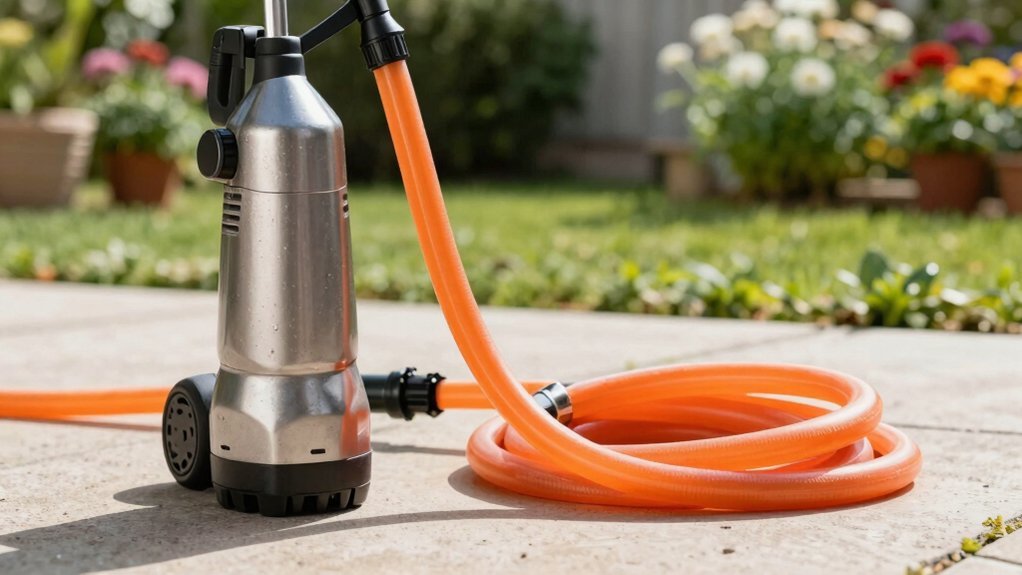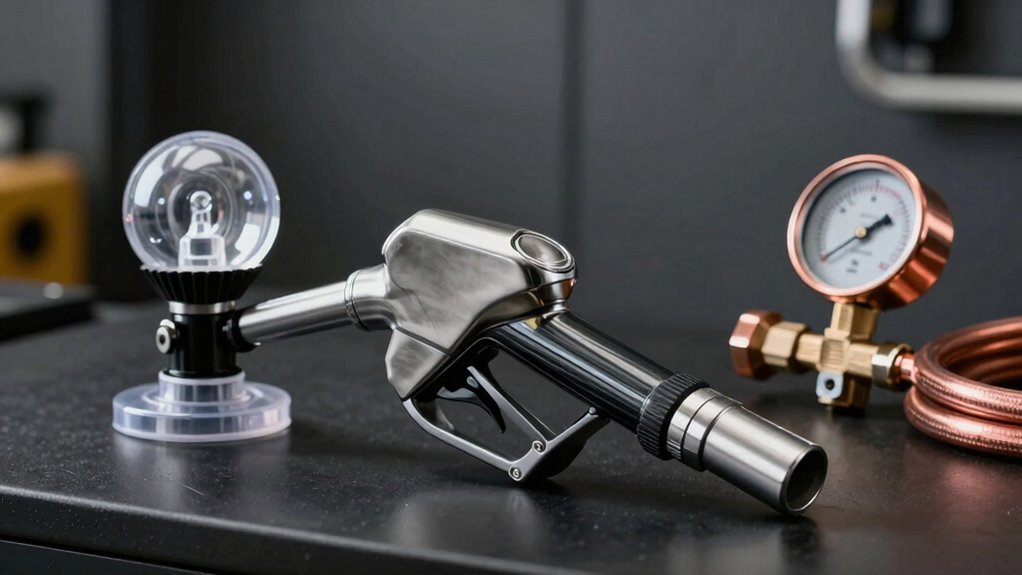
Turbo nozzles give you a 360° high‑pressure spray that shaves cleaning time on hard pathways and stone pavers, but the aggressive spin can chip fragile mortar and damage delicate plants or paint. Regular nozzles emit a fine mist, keeping pressure low (30‑80 psi) and protecting tender foliage, flower beds, and soft soils while still handling light‑duty cleaning. Choose turbo for hard surfaces and rapid grime removal; pick standard for precision, plant safety, and painted surfaces. Keep reading to uncover how to match nozzle angle and pressure to each garden task.
Can Turbo Nozzles Clean Your Hard Garden Surfaces Faster?
Ever wondered how much quicker a turbo nozzle can tackle your garden’s hard surfaces? You’ll notice the rotating jet’s zero‑degree tip delivers a concentrated, high‑pressure spray that shatters grime on concrete, brick, and stone. The triple‑head, 360‑degree rotation spreads the impact across a wider area, cutting cleaning time by roughly 175 % compared with a standard nozzle. For DIY projects, the quick‑connect fittings let you swap tips without tools, and the stainless‑steel body tolerates up to 4500 PSI, keeping performance steady at 4000 PSI. However, the aggressive spin can chip fragile mortar, so you must assess the effects on pavement integrity before using it on delicate surfaces. When the substrate is robust, the turbo nozzle’s speed and power make it a practical choice for heavy‑duty garden maintenance. Understanding fog nozzle design helps you choose the right spray pattern for efficient cleaning. Selecting the proper nozzle tip size in degrees ensures the water pressure is balanced with flow to protect the deck material. The nozzle’s design directly influences spray uniformity and droplet size, which are critical for achieving desired coverage and minimizing waste.
Why Standard Nozzles Protect Delicate Plants and Paint?
Because standard nozzles emit a fine mist rather than a high‑velocity jet, they keep delicate plants and painted surfaces safe from mechanical damage. You’ll notice that the low‑pressure droplet stream mimics natural rainfall, delivering uniform moisture without snapping tender stems. The fine mist guarantees delicate leaf protection, while the gentle impact prevents soil disturbance mitigation, keeping topsoil intact and avoiding erosion on slopes. Adjustable spray patterns let you target propagation zones and painted fences with precise flow rates, reducing runoff and evaporation. By limiting force to 0.5–10 L/min, the system avoids compaction and pooling, preserving root zones and paint finishes. This technical approach maximizes water efficiency and minimizes physical stress on vulnerable garden elements. Selecting the appropriate nozzle size and spray pattern for each plant type enhances water distribution and promotes healthier growth. Typical garden hose nozzles operate within a pressure range of 30 to 80 psi, allowing gardeners to match nozzle performance to specific tasks. Understanding the relationship between spray angle and coverage area helps fine‑tune irrigation for varied plant densities.
Pressure & Coverage: 0° Turbo vs. 40° Standard
When you compare a 0° turbo nozzle to a 40° standard tip, the biggest difference lies in how pressure translates into coverage. The turbo spins a zero‑degree stream in a 4‑to‑8‑inch circle at 3,000 rpm, converting full machine PSI into a concentrated jet that can handle 4,000‑4,500 PSI in durable models. Its hydrokinetic action creates an effective 20° cleaning angle, halving cleaning time on concrete or brick. However, the high pressure stresses the ceramic component, so exceeding its rating threatens nozzle safety and can shorten nozzle lifespan.
The 40° standard tip spreads a milder spray, capping force around 500 PSI for delicate tasks. Its broader angle yields even distribution across larger surfaces, preserving delicate plants and paint while maintaining nozzle safety. Though less aggressive, it still tolerates up to 4,000 PSI without compromising nozzle lifespan, making it ideal for light‑duty rinsing.
The transformation of pressure into kinetic energy in a nozzle follows the continuity principle and Bernoulli’s equation, illustrating how fluid velocity increases as pressure drops.
A nozzle converts pressure into speed, demonstrating that it does not create pressure but redistributes it.
Turbo nozzle can improve efficiency for experienced users.Nozzles shape fluid flow to achieve specific spray patterns.
Pick the Right Nozzle Angle for Garden Jobs
Which nozzle angle you choose determines whether garden cleaning is swift and safe or slow and damaging. A 0° red tip concentrates impact, making it perfect for heavy duty cleaning tasks like rust on concrete or stubborn paint on metal. For light duty rinsing needs, a 40° wide‑angle spreads water gently, protecting delicate foliage and soft stone. Turbo nozzles spin the 0° tip in a 25°‑40° arc, delivering 0° force across a broader path, cutting cleaning time in half while still handling tough grime on decks and fences. Use a 15° yellow nozzle for moderate jobs such as mold on hard surfaces; avoid 0° or turbo on wood and cars to prevent gouging. Match angle size to surface hardness for ideal efficiency. Selecting the correct nozzle also helps stay within the pressure washer’s recommended pressure range for safety and performance. Understanding the energy conversion process in turbine nozzles highlights how pressure drop translates into high‑velocity streams. The momentum‑change equation can be used to estimate the thrust generated by different nozzle angles.
Garden‑Specific Maintenance for Turbo & Standard Nozzles
If you’re working in the garden, keeping both turbo and standard nozzles clean, dry, and properly stored is essential for reliable performance and longevity. For garden nozzle cleaning, pin‑remove debris from each tip before every use, then run the specialized cleaning tool to clear clogs. After spraying, flush the spinning jet area on the turbo and rinse non‑spinning jets on the regular nozzle to prevent residue build‑up. Conduct a pressure test by spraying near the target, confirming that the nozzle matches pump flow and operating pressure—this avoids core cracking. For proper nozzle storage, disconnect and dry each unit completely, label the size, and place the turbo in a moisture‑free spot away from impacts, while the regular nozzle goes in a protective case, shielded from sunlight and organized by angle type. This routine minimizes wear and guarantees consistent garden performance. Regularly inspect the nozzle for significant wear to catch cracks before they affect flow. Remember to vent the can before any cleaning to prevent accidental spray. Selecting the right nozzle also depends on the spray pattern required for the specific plant type.
Which Nozzle Should You Buy for Your Garden?
Choosing the right garden nozzle hinges on the surfaces you’ll clean and the speed you expect. If you mostly tackle hard pathways, stone pavers, or brick edging, a turbo nozzle delivers a rotating 25° spray that covers more area quickly, cutting lawn vs. flower bed maintenance time in half. For delicate lawns, flower beds, or painted wooden decks, a regular nozzle with color‑coded angles (0°, 15°, 25°, 40°) offers precise control and lower pressure, protecting tender foliage. Turbo models excel at deep grime removal and can aid effective pest control strategies by blasting stubborn insects from rugged surfaces. Regular tips, however, let you target soft soils and ornamental plants without risking damage, making them ideal for mixed‑surface gardens. The cheap turbo nozzle’s plastic internal fitting may wear out faster than the expensive version. Proper irrigation planning also considers water pressure to ensure uniform coverage across different plant types. When pairing a hose with a pressure washer, verify that the hose’s pressure rating matches the washer’s output to avoid bursts. Selecting a nozzle material such as stainless steel can further improve durability and corrosion resistance.