You control water flow by choosing a nozzle that matches your pressure and coverage needs. Fixed‑arc nozzles give 45°, 90° or 360° spray at 30‑50 PSI, while adjustable‑arc models let you fine‑tune the radius and angle. Rotary and full‑cone nozzles deliver low‑precipitation or high‑flow patterns for compact soil or dust control. For hoses and pressure washers, the or size dictates droplet speed and drift; larger droplets stay on target, smaller ones evaporate. Adjust the radius and arc screws to set throw distance and spray width, and keep the nozzle clean for ideal performance—continue to explore how these tweaks improve efficiency.
How Sprinkler Nozzle Types Shape Water Flow and Coverage
A sprinkler nozzle’s shape determines how water spreads, so choosing the right type directly controls flow and coverage. Fixed‑arc nozzles lock you into 360°, 90°, or 45° angles, delivering predictable fan patterns ideal for sidewalks and streets at 30‑50 PSI. Adjustable‑arc models let you trim the arc from 360° down to 45° and shrink radius by roughly 30 % or 2 ft, useful for irregular driveways, though their pattern predictability drops. Rotary nozzles spin, emitting droplets at 0.25‑0.5 in/hr, cutting water use by 30 % and mimicking rain to limit runoff. Full‑cone nozzles generate solid cones from 15° to 170°, handling high flow rates for washing or dust control. Follow nozzle maintenance guidelines: clean screens, check for clogging, and verify pressure to preserve spray pattern adjustability and system efficiency. To achieve steady, uniform flow, a nozzle must maintain consistent pressure and minimize turbulence through proper geometry and flow resistance design. This transformation follows Bernoulli’s principle, where pressure energy converts to kinetic energy, increasing velocity while reducing static pressure. Understanding the role of a nozzle vs. valve clarifies why the device shapes flow rather than simply stopping or starting it.

ADJUSTABLE SPRAY PATTERN FROM 0–360°: Quickly set the arc to match any area — from narrow strips to full circles. No tools needed, just twist and go.

PRECISION ADJUSTABLE ARC, 0° TO 360°: Set exact spray angles for any landscape layout, from tight corners to full circle zones, with simple top adjustment

PRECISION ARC CONTROL FROM 0° TO 360°: Get pinpoint accuracy for any zone shape or edge. Whether you're watering a narrow walkway or full lawn circle, fine-tuned arc settings ensure no water is wasted.
How Pop‑Up and Oscillating Sprinklers Operate
When water pressure builds, the pop‑up riser shoots up from its underground housing, the spring and wiper seal keeping the stem sealed and debris‑free until the pressure drops and the spring pulls it back flush with the lawn. The rising stem aligns its clutch mechanism, letting you rotate the top ring to set precise nozzle spray patterns—90°, 180°, or 360°—and lock the direction. As pressure subsides, the spring retracts the stem, the wiper seal blocks debris, and the head sits flush, ready for the next cycle. For oscillating heads, a motor‑driven arm swings the nozzle, creating a sweeping arc that covers larger areas while maintaining uniform flow. Troubleshooting nozzle issues starts with checking pressure, inspecting the mesh filter for clogs, and verifying the spring’s tension before adjusting arc or flow settings. The rotating stem distributes water evenly across the spray arc. Proper sprinkler head spacing ensures uniform coverage and conserves water. Accurate zone flow calculation helps balance water distribution across the entire irrigation system.

Approved for sale/meets pressure regulation legislation requirements in: CA, CO, HI, VT, MA, ME, NY, OR, RI, WA, and Washington DC

Smart Irrigation Starts Here - The Rain Bird 1804VAN 1800 Series Pack of 4 features 4-inch pop-up sprinkler heads with a fixed spray, variable arc nozzle and 1/2 in. female threaded inlet, made in the USA and built for precise irrigation in lawns, garden beds, and landscaped areas in residential and professional systems.

Smart Irrigation Starts Here - The Rain Bird 1806VAN 1800 Series Pack of 5 features 6-inch pop-up sprinkler heads with a fixed spray, variable arc nozzle and 1/2 in. female threaded inlet, made in the USA and built for precise irrigation in lawns, garden beds, and landscaped areas in residential and professional systems.
Choose the Right Nozzle Type for Your Landscape and Soil
Once the pop‑up or oscillating head is set, the next step is matching the nozzle to your landscape’s layout and soil characteristics. Choose a flat‑fan nozzle for precise weed control between rows, or a cone nozzle for circular ring watering around plants. If soil is compacted, a rotary nozzle with a low precipitation rate prevents runoff; a high‑efficiency model handles elevation changes. Coarse‑droplet nozzles reduce drift on soil‑applied herbicides, while hollow‑cone nozzles deliver fine contact spray. Consider factors influencing nozzle durability—metal or brass construction resists harsh use. Nozzle versatility for landscape applications lets you switch between mist, stream, or jet patterns, optimizing coverage, infiltration, and waste reduction. Proper calibration ensures the spray pattern matches the intended application rate. Selecting the appropriate nozzle also depends on water pressure to achieve uniform distribution across the garden. The nozzle design directly influences spray uniformity and droplet size, which are critical for minimizing waste. Understanding nozzle flow rate helps ensure the system operates within its pressure rating and avoids leaks.

COMPATIBLE WITH HUNTER AND OTHER SPRAY BODY MODELS: Designed for use with Hunter spray bodies and other standard female-threaded sprinkler heads. Easy to install with a secure, leak-free connection and no special tools required.

PRECISION COVERAGE FOR COMPLEX LANDSCAPES: The MP Rotator sprinkler delivers an adjustable arc from 90 to 210 degrees and a radius of 13 to 21 feet, giving you pinpoint control across curved, narrow, or irregular zones—no overspray, no waste.

Low precipitation rate of approximately 0.4 in/hr — lowest in the industry
Adjust Throw Distance and Arc With Radius and Angle Screws
Ever wondered how a tiny screw can reshape your sprinkler’s reach? You can shrink or extend the radius by turning the center screw clockwise for a shorter throw and counter‑clockwise for a longer one. Hunter, Rain Bird, and Orbit models all use this method, with Rain Bird limiting reduction to 25 % and Orbit’s diffuser screw offering similar cuts. For arc, rotate the collar or stem on K‑Rain, Rain Bird, or Orbit nozzles; clockwise motion narrows the sweep, counter‑clockwise widens it up to a full 360°. Perform adjustments with water flowing at normal pressure, hold the nozzle steady, and verify by running a zone. These nozzle adjustment limits and spray pattern adjustment options let you fine‑tune coverage without replacing hardware. The diffuser screw is located in front of the nozzle on the spray assembly, and turning it clockwise reduces the throw distance by up to 25 % adjustable throw. Properly setting the sprinkler height based on ceiling clearance helps ensure optimal coverage and compliance with fire safety standards. Adjusting the head depth according to soil type can further improve water distribution efficiency. Understanding maximum ceiling height requirements is essential for meeting fire protection regulations.

TOOL-FREE INSTALLATION AND BROAD COMPATIBILITY: Fits most pop up sprinkler bodies for fast no-tool replacement delivering instant upgrades to your irrigation system.

1.GIANNEER Sprinkler Tool Set: Combination of sprinkler head adjustment tool and rotor tool, can meet the needs of lawn irrigation sprinkler maintenance!

8 ft. half-circle pattern MPR nozzle; Lower water flow allows more spray heads per zone
Why Droplet Size Matters for High‑Efficiency and Matched‑Precipitation Nozzles
Because droplet size directly controls how efficiently water and chemicals reach the target, selecting the right size is essential for high‑efficiency and matched‑precipitation nozzles. You’ll notice that larger droplets reduce the number of particles exponentially—doubling size cuts count by eight—so you need less volume for the same coverage. This directly supports the drift management role: droplets under 100 µm evaporate or drift, while medium‑to‑coarse droplets stay on target. Matched‑precipitation designs keep droplet distribution uniform across the spray pattern, ensuring consistent coverage and distribution even as boom height or speed changes. Pre‑orifice low‑drift nozzles lower internal pressure, producing slower, larger droplets that minimize rebound and maintain uniformity across pressures. Proper nozzle size selection is crucial for achieving the desired droplet range. Understanding flow‑rate calculations helps you match nozzle specifications to pressure and coverage goals. Selecting the appropriate nozzle shape can further optimize flow speed and reduce energy consumption. The pressure loss caused by nozzle friction can be mitigated by choosing low‑roughness materials and regular maintenance.
Diagnose and Fix Common Nozzle Problems Quickly
Droplet size determines how efficiently water reaches its target, but even the perfect droplet distribution can’t help if the nozzle isn’t functioning. You diagnose problems by first observing spray shape, distance, and flow rate. Detecting nozzle wear patterns—such as uneven arcs, reduced radius, or irregular droplets—signals abrasion or mineral buildup. For fixing clogged hose nozzles, shut off water, remove the nozzle and filter, brush out debris with a small brush, and rinse thoroughly; replace the unit if mineral deposits remain. Address leaks by tightening fittings, inspecting seals, and swapping cracked risers. Low pressure warrants checking head count and GPM compatibility, while high pressure may require down‑sizing the nozzle. Align arcs with radius screws, and verify the nozzle matches the intended precipitation rate. Proper irrigation maintenance can improve water delivery efficiency. *If a spray pattern appears uneven, you can perform a low‑pressure test to identify clogging* sprinkler nozzle test. Inspect valve integrity to prevent insufficient water flow caused by a partially closed or malfunctioning control valve. Cracked seals often cause persistent leaks and should be replaced promptly.
Connect Nozzles to Hoses and Pressure Washers for Seamless Water Management
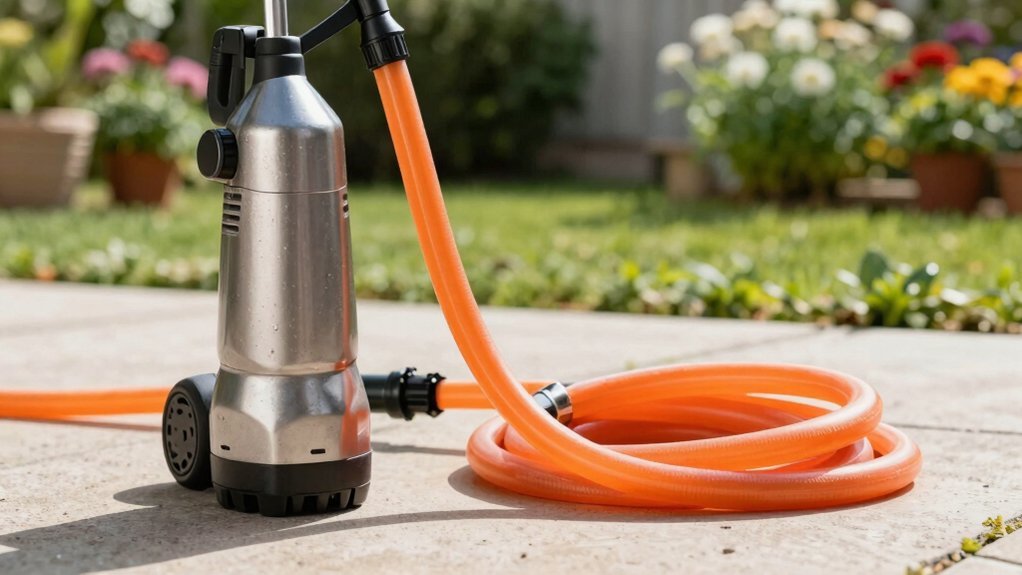
When you attach a nozzle to a garden hose or pressure washer, start by confirming that the hose’s diameter meets the minimum 1‑inch requirement; otherwise you’ll lose pressure and spray‑pattern consistency. Verify the hose wall thickness and material; thicker‑walled hoses hold quick‑connect fittings more securely. Use premium brass swivel connections with comfort‑grip technology to achieve secure hose to nozzle connections and prevent kinking. Insert the coupler key into the nipple, rotate clockwise between 3/4 and a full turn to open flow, and counter‑clockwise to close it. Align the key properly to avoid cross‑threading. Before attachment, flush both hose interior and nozzle base to remove soil and debris. Finally, monitor water pressure and flow throughout operation to maintain ideal performance. Garden hose pressure ratings are essential to match the washer’s output and avoid hose failure. Most residential hoses operate effectively between 40 and 80 psi for optimal watering.