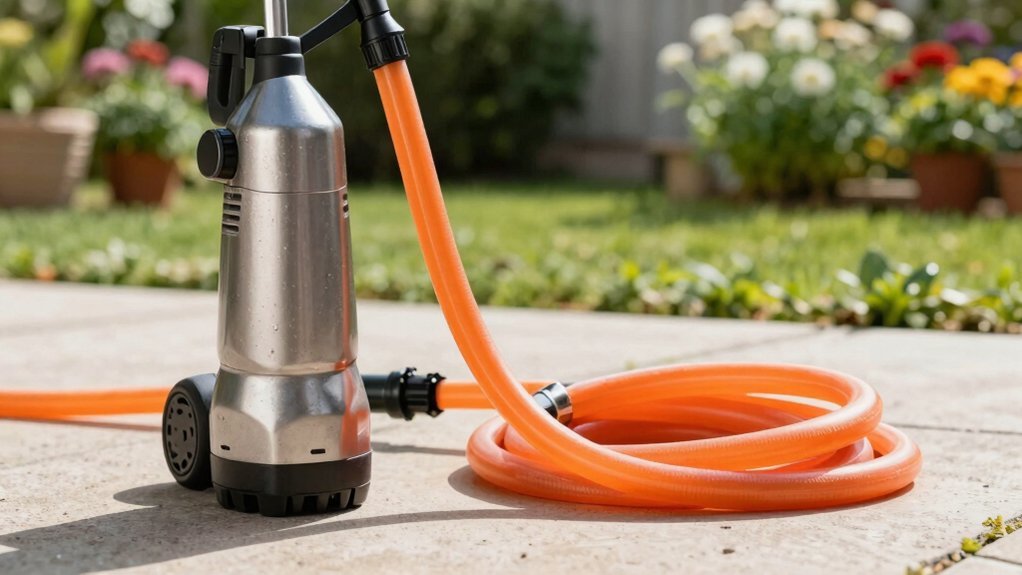
You’ll find that virtually every garden‑hose fitting uses the same 3/4‑inch GHT thread—1 1/16‑inch outer diameter with 11.5 TPI—so a brass, aluminum, or plastic nozzle will screw onto any hose regardless of its inner diameter. The thread size stays constant because the seal relies on the thread profile, not hose wall thickness, and a hand‑tightened connection is leak‑free. If you measure the OD and ID with a caliper you can avoid the occasional 0.01‑inch mismatch that causes drips, and the next sections explain material trade‑offs and how to spot non‑standard threads.
Why 3/4‑In GHT Threads Let Most Hose Fittings Swap Easily
Because the garden‑hose thread (GHT) standardizes on a 3/4‑inch designation, most hose fittings swap with minimal hassle. You’ll find the male GHT coupling’s outside diameter is 1 1/16 inches with 11.5 threads per inch, and the female swivel coupling matches this 3/4‑inch brass threading. The uniform thread profile lets you connect any GHT‑compatible nozzle, sprayer, or faucet without measuring or re‑threading. Manufacturers coat brass and stainless‑steel components with weather‑resistant coatings and corrosion‑proof materials, so the connection stays sealed despite UV exposure, rain, or chemicals. When you need to join to non‑GHT plumbing, a stainless‑steel adapter converts the male NPT to GHT, preserving the same 3/4‑inch interface while maintaining leak‑free performance. This standardization eliminates guesswork and speeds installation. Proper sealing also helps prevent leaks when connecting hoses. Selecting the correct thread size ensures compatibility across a wide range of garden irrigation accessories.
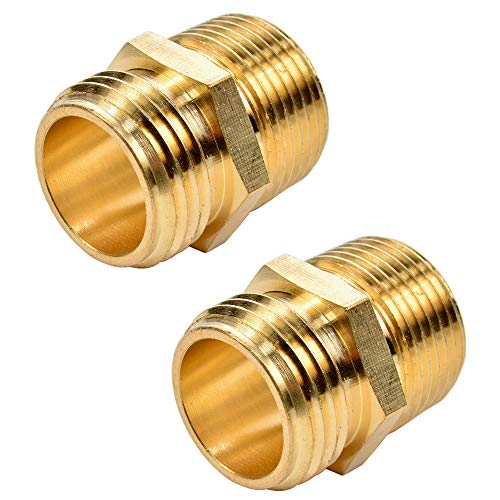
3/4" to 3/4" Male hose adapter, Adapter for connecting hose or fittings of different types

【Solid Brass Hose Quick Connect】This hose quick connectors are with solid brass construction, heavy duty and rust proof, lasts season-after-season

3/4" to 3/4" Male hose adapter, Adapter for connecting hose or fittings of different types
Why GHT Thread Size Stays the Same Even When Hose ID Varies?
While the 3/4‑inch GHT thread lets any hose fitting swap easily, the thread’s diameter never changes even when the hose’s internal size does. You benefit from thread uniformity reliability because the male end maintains a constant outer diameter of about 1 inch, and the pitch stays fixed at 11.5 TPI across 1/2‑inch, 5/8‑inch, and 3/4‑inch IDs. This standardized thread design advantages eliminate the need for adapters; a female GHT coupling accepts any male GHT regardless of hose ID. The straight, non‑tapered profile and NH designation guarantee that washer or O-ring sealing depends only on the thread, not the hose wall thickness. Consequently, you can hand‑tighten any fitting, expect a leak‑free connection, and enjoy interchangeable accessories throughout your garden system. Garden hose fittings are standardized across America, ensuring compatibility regardless of hose size. Selecting a hose based on its flow rate helps match water pressure to the task at hand. The tapered NPT design is intended for high‑pressure applications, making it unsuitable for flexible hose connections. A longer hose increases water volume delivered to the garden.
How to Measure OD & ID for a Leak‑Free Fit
When you need a leak‑free connection, start by measuring both the hose’s inner diameter (ID) and the fitting’s outer diameter (OD) with a calibrated tool such as a vernier caliper. Cut a clean edge on the hose, insert the caliper jaws, and close until they touch opposite walls; record the reading in inches. For the fitting, close the jaws around the male threads (OD) or inside the female threads (ID) and note the exact measurement. Compare the two values; even a 0.01‑inch mismatch can cause pressure‑induced leaks. Pay attention to common ID discrepancies between brands—some 1/2‑inch hoses read 0.700 in, others 0.710 in. Matching the numbers precisely guarantees snug pressure‑fit connections and eliminates leaks. Garden hose fittings often feature standardized thread types that simplify compatibility across different manufacturers. Properly sized hoses also ensure optimal flow rate for residential irrigation systems. Understanding GPM limits helps you select a hose size that meets your garden’s water demand.

Confirm Size First — Fits 3/8" (10mm) ID Hoses Only: Verify your hose inner diameter is 3/8 inch (10mm) before buying; not for 1/2" or other sizes. Clamps fit hose OD 0.51"-0.74" (13-19mm). Connector: 1.57" (40mm) long, 3/8" (10mm) OD

3/8" Hose Barb Fitting - The OD is 10mm, fit for hoses with 3/8 inch ID. The other end is standard 3/4" GHT FEMALE, easy to connect other outdoor watering and gardening systems.

Garden Hose Thread Materials: Brass, Aluminum, Steel, Plastic Compared
If you’re selecting a garden‑hose fitting, the material determines durability, corrosion resistance, and pressure tolerance. Brass, an alloy of copper and zinc, offers high crush resistance, handles higher pressures, and resists cross‑threading; its red‑brass variant excels in potable‑water applications but can dezincify in acidic or high‑chloride environments. Aluminum is lighter and cheaper, yet it bends easily and suffers galvanic corrosion when paired with brass, reducing its lifespan. Steel—including 304 or 316 stainless—provides superior corrosion resistance, especially in hard‑water or marine settings, but it’s rigid and unsuitable for hot water. Plastic fittings (acetal, PP, nylon) are lightweight and inexpensive, but they crack under high pressure and leak more often. Material cost considerations favor brass for a balance of price and durability, while stainless steel justifies its higher upfront cost in demanding conditions. Rubber hoses are more durable and longer‑lasting than vinyl hoses. Choosing a lead‑free hose further reduces health risks when using potable water. Selecting fittings with a higher kink resistance rating can significantly improve water flow consistency in windy or uneven terrain. Metal garden hoses also lasting‑term cost savings due to their resistance to kinks and weather, making the higher upfront investment worthwhile for frequent users.
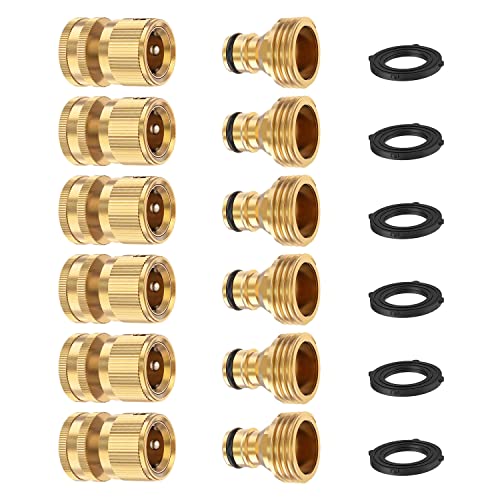
【 Premium Brass Construction】Made of high quality brass material. Durability & leak-free.
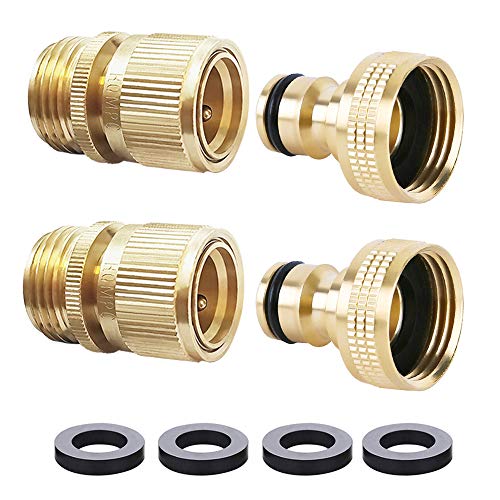
★【Standard 3/4 Inch GHT Garden Hose Quick Connect】-This garden hose quick connect sets including 2 brass female connectors + 2 brass male connectors+4 free washers.Use this hose quick connect fittings You can enjoy it work perfectly with any standard garden hose,faucets,hose bibs and watering devices.

Includes 2 pieces brass pipe with double male, 2 pieces brass connector with double female swivel and 4 extra garden hose washers.
Identifying Rare Non‑Standard Garden‑Hose Threads
The material you choose dictates durability, but it also determines whether the thread will match the ANSI ¾”-11.5 NH standard or deviate into a non‑standard profile. To spot rare non‑standard hose threads, start with a caliper check; a ¾” nominal should be exact, while flats or asymmetrical shoulders signal deviation. Examine the surface: smooth NH threads contrast with knurled or rolled NHR patterns. Look for ferrule expansion that pinches the hose—this indicates improvised hose connections rather than true GHT. Identify material differences; brass, aluminum, and plastic each have characteristic thread profiles, while coated steel may hide damage. When you encounter an irregular fitting, replace it with proper replacement thread components instead of forcing a mismatched joint. This prevents leaks and preserves pressure ratings. The GHT connection uses a 3/4‑inch thread that relies on an internal o‑ring for sealing. Proper pressure 40‑80 psi ensures optimal performance and reduces the risk of leaks. Selecting a hose with a compatible pressure rating helps maintain washer efficiency. Understanding the hose’s flow capacity is also crucial for matching the pressure washer’s performance.

GARDEN HOSE REPAIR CONNECTOR SET: Package include 2 female hose repair connector, 2 male hose repair connector, 4 zinc alloy clamps with stainless steel screws and extra 4 garden hose washers

End Female Hose Connector/Replacement/Mender For 5/8 inch or 3/4 inch hoses

Easy to use, garden hose connect and repair
Quick Fixes for Leaks When Threads Appear “the Same”
Even though the threads look identical, a tiny misalignment or surface defect can still cause a leak, so you’ll need a quick, reliable fix that doesn’t require a full replacement. First, inspect the female fitting’s rubber gasket; if it’s warped or worn, pull it out and snap in a fresh one. Then, wrap the male threads with six to seven turns of pipe tape, removing any old tape completely before re‑applying. Hand‑tighten to about 75 % of the final torque, then finish with a wrench. If the leak persists, try a hose clamp splice: cut the hose, insert a short copper tube, and secure both ends with clamps. This method works even when mixing hose coupling materials and uniform thread profile designs are present. Test the joint under water for two minutes; any drip means repeat the steps. Measure the hose’s outside diameter and subtract 1/8 inch to select the correct hose size. Properly matching the hose diameter ensures a seal that can handle typical garden water pressure. A lightweight vinyl hose of 50 feet typically weighs 5–7 pounds, making it easier to handle during repairs. Selecting the proper hose washer size helps maintain optimal flow and prevents future leaks.

End Female Hose Connector,Male Hose Connector/Replacement/Mender For 5/8 inch or 3/4 inch hoses

【Package Including】Fit for 3/4" or 5/8'' hose fittings, contains 5 female and 5 male hose repair connector with 10 clamp, and extra garden hose rubber gasket. Note: please choose correct hose size before order.

Complete Package Contents: 2 Set garden hose repair kit (2 male + 2 female), 4 pcs stainless tightening clamp, extra 2 pack garden hose washers