You’ll find a garden hose reel is a mechanical or spring‑loaded drum that stores the hose, keeps it straight, and protects it from UV and moisture. A manual crank winds the hose clockwise in even layers, while an automatic spring‑loaded model pulls the hose out, then retracts it with a ratchet‑type lock and controlled speed to avoid kinks. Brass swivel fittings transfer water from the stationary inlet to the rotating drum, maintaining a leak‑free flow. Proper hose size, pressure rating, and mounting material guarantee smooth operation and durability—continue for deeper details.
What Is a Garden Hose Reel?
When you need to store, organize, and protect a garden hose, a garden hose reel is the mechanical or automatic device that does exactly that. You’ll find a spindle or drum that coils the hose evenly, preventing kinks and premature wear. Proper installation aligns the swivel base so the reel rotates 360 °, eliminating tangles during use. Choose a wall‑mounted model for compact gardens, a cart for large lawns, or a pot‑style unit that adds decorative features such as resin‑cast patterns and brass accents. The hose coupling links the drum to the feeder hose, while a retractable guide distributes material uniformly. Weather‑resistant materials—stainless steel, aluminum, or high‑grade plastic—shield the hose from UV, moisture, and ground contact, extending its service life. Using a hose with an appropriate pressure rating ensures safe operation with a pressure washer. For optimal performance, maintain water pressure between 40 – 80 psi to prevent kinks and ensure consistent flow. Selecting the correct hose diameter is essential for achieving the desired gallons per minute flow rate.
How a Manual Reel Winds and Unwinds a Garden Hose
A garden hose reel’s manual crank lets you control every turn of the drum, so you can wind and unwind the hose with exact spacing and tension. You start by pushing the hose to one side of the drum, then turn the crank clockwise for a smooth cranking motion. Guide the free end with your hand, laying the first layer horizontally from side to side. When the first layer reaches the opposite edge, reverse direction for the second layer, keeping each winding in contact with the previous one. Alternate left‑right guidance for subsequent layers, applying proper layering techniques to avoid gaps and clumps. To unwind, rotate the crank counter‑clockwise, pulling the hose straight and maintaining even tension until the desired length is exposed. Use the appropriate hand to operate the crank, left‑handed or right‑handed. Properly securing the hose with a clamp helps maintain consistent pressure and prevents leaks. Ensure a tight seal by wrapping the connector threads with plumber’s tape before attaching the hose. Multiple hoses increase flow resistance, so consider pressure loss when planning your reel setup.

125-Foot Hose Storage Capacity: Designed to hold up to 125 feet of standard 5/8-inch gardening hose, meeting diverse needs such as large-area yard irrigation, watering intricate garden sections, and patio cleaning—eliminating the need for frequent hose changes or splicing.
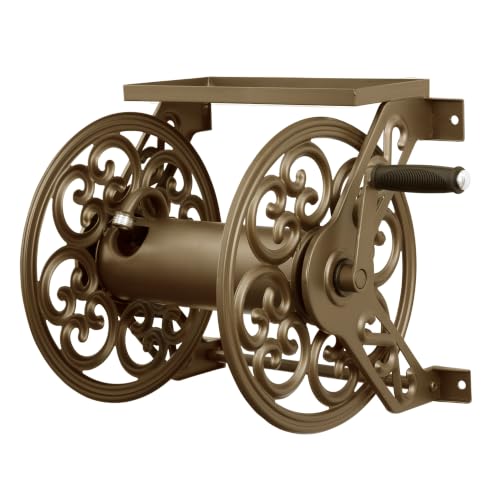
HOSE CAPACITY: Holds 125-feet of 5/8-inch garden hose (hose not included)

High quality material: New PVC material, wear-resistant, high temperature and high pressure resistance, health and environmental protection, simple design, both functional and ornamental, 5ft of inlet pipe with 45ft of outlet pipe.
How an Automatic (Spring‑Loaded) Reel Retracts a Garden Hose
Ever wondered how a spring‑loaded reel pulls a hose back with such smooth, controlled force? You engage the spring mechanism parameters by pulling the hose out; the steel coil stores energy as you rotate the drum clockwise. When you release the gentle tug, the ratchet‑type locking system quality disengages, allowing the coil to unwind counter‑clockwise and rewind the hose evenly. The lock holds the hose at any intermediate length, preventing accidental retraction. As the spring releases, the reel’s RollControl technology moderates speed, eliminating kinks and ensuring a steady pull. UV‑ and frost‑proof coatings protect the spring from environmental degradation, while the locking system’s incremental points give you precise length control without excess force. Using a larger‑diameter hose can help maintain pressure on longer runs, especially when dealing with elevation changes flow rate considerations. Longer hoses experience greater friction loss due to increased surface contact, which can reduce water pressure if not compensated for. Selecting the appropriate hose length based on pressure loss ensures optimal performance.

LESS FUSS, FEWER TOOLS – Skip the wall damage and tricky installations. With only a hammer, you can easily install this reel on your lawn (concrete mounting is also available). Its compact and stylish design blends seamlessly with any outdoor décor.

Lock Any Length: This retractable hose reel securely locks at any length up to 100FT. Easily water every corner of your yard, garden, or patio without dragging the entire reel—perfect for hassle-free outdoor watering.

Effortless Automatic Hose Retraction: The GARDENA Automatic Retractable Garden Hose Reel simplifies watering with an auto-retract hose reel design that locks at any length
What Parts Keep Water Flowing When the Reel Spins?
The spring‑loaded mechanism that retracts the hose also has to keep water moving, and that job falls to a tightly coordinated set of components. You rely on the hose adaptor to secure the garden hose at the entry point, preserving inlet/outlet integrity while the drum spins. The brass swivel transfers water from the stationary inlet to the rotating drum without twisting the line; its swivel seals and washers block leaks under pressure. Inlet and outlet connections use pressure‑rated washers and seals to maintain a continuous flow regardless of drum position. Reel supports keep the drum steady, preventing misalignment that could compromise the seals. Together, these parts form a leak‑proof, pressure‑resistant pathway that lets water flow smoothly as the reel rotates. The hose reel can be tied into the existing irrigation system using a 1‑inch PVC supply to provide convenient water access for the entire landscape. Understanding the thread NPT vs. GHT ensures proper adapter selection for a secure, leak‑free connection. ¾‑inch garden hose thread is the most common size for residential hose fittings.

360° Hose Swivel Design – The garden hose swivel adapter rotates freely, preventing twisting and kinking while keeping water flow smooth and uninterrupted

Prevents Hose Twisting – Live swivel rotates freely to reduce kinks.

Standard 3/4" GHT Thread: Made of drinking water-safe certified brass, with 3/4" GHT female thread on one end and male thread on the other. Ideal for RV drinking water systems & outdoor supply, safety-compliant, reliable and leak-proof.
Practical Tips for Extending, Retracting, and Maintaining Your Reel
Most users find that extending, retracting, and maintaining a garden‑hose reel becomes routine once they follow a few precise steps. To extend, pull gently until the automatic lock engages, then give a short extra tug and release to reach the full length; never exceed the “STOP” sticker. Before retracting, turn off the faucet, release sprayer pressure, and tug lightly to disengage the lock. Walk backward steadily, guiding the hose evenly to protect the spring. Clean the hose after each use and pressure‑wash the reel monthly; remove debris before retraction to avoid jams. Perform periodic reel lubrication on the axle and gears, inspect connections for leaks, and tighten mounting hardware. When wear appears, consider hose reel replacement options that match your pressure rating. The Gardinia system installs directly into the ground without digging, making it a true spring‑loaded solution. Regularly check the hose for UV damage to prevent premature cracking. Water can reach up to 140 °F when exposed to intense sun and high pressure. High water pressure can cause hose bursts, so using a pressure regulator is essential.

Unbeatable Stability: This waterhose holder features a triangular base and 4 lengthened ground stakes for firm anchoring in lawns, soil or soft ground, staying stable without easily tilting or wobbling even with a full, water-filled heavy hose.
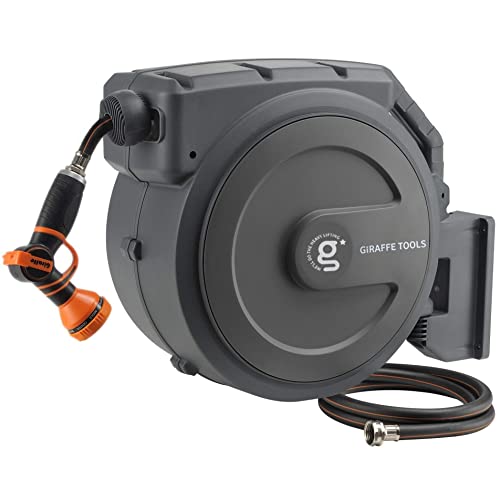
Any Length Lock:Lock the 135 FT hybrid hose (130 FT retractable + 5 FT lead) at any length. This retractable garden hose lets you pull only what you need—it stays put. No dragging excess hose. Every corner of your garden is covered

HOSE CAPACITY: Holds up to 125-feet of 5/8-inch hose (hose not included)
How to Choose the Right Garden Hose Reel for Your Yard
After mastering the steps for extending, retracting, and maintaining your hose, you’ll need to select a reel that matches your yard’s dimensions, hose specifications, and usage patterns. First, verify hose diameter requirements: 3/8″ works for light washdown, ½″ for moderate flow, and ¾″ for heavy‑duty cleaning; the reel’s spindle must accommodate the precise size to prevent pressure loss. Next, assess mounting location considerations: wall‑mounted units need a sturdy stud or anchor, while ground‑mounted reels require stakes or a concrete pad for stability. Choose material based on exposure—stainless steel or aluminium for rust‑prone zones, high‑grade plastic for budget‑friendly setups. Prioritize a swivel base, self‑winding mechanism, and brass swivels to guarantee smooth operation and leak‑free connections. The automatic rewind system provides a smooth, tangle‑free retraction, eliminating the workout‑like effort of manual winding. Selecting a hose with the appropriate pressure rating ensures the reel can handle the water force without bursting. Understanding garden hose thread compatibility helps prevent leaks when connecting hoses to sprinklers. Properly matching the hose’s flow rate to your irrigation needs can prevent both under‑watering and excessive pressure.

Durable Garden Hose Reel: Engineered with premium 304 stainless steel, this heavy-duty outdoor hose reel is built to resist rust, corrosion, and all weather conditions. It ensures long-lasting performance while keeping your garden hose neatly stored and easily accessible

HIGH MATERIAL QUALITY: JBscoop water hose hook is made of 304 Stainless Steel material, withstand harsh environments, sturdy and durable, good aspect, rust proof, easy to mount. Package include SS Screws, plugs and instructions

Large Capacity Hose Reel for Heavy-Duty Storage: This wall-mounted garden hose reel holds hoses up to 150 ft, 5/8 in (hose not included), and comes with a 5-ft lead hose, making it ideal for most home and garden needs. With sufficient length, it is suitable for watering garden or washing your car.