You measure a garden hose by its inner diameter, usable length, and the pressure it can handle. Diameter (½‑in, 5⁄8‑in, ¾‑in) sets the maximum flow—larger hoses move more water but need more pressure. Length matters because friction and elevation loss cut flow; a 100‑ft run can lose up to 75 % of the pressure of a 25‑ft hose. PSI tells you the water’s force; typical home spigots deliver 45‑80 PSI, but you’ll need at least 30‑50 PSI for sprinklers. Knowing these three specs lets you pick the right hose for any job, and the next sections show how they interact.
Define Garden Hose Size and Its Effect on Water Delivery
Three common garden‑hose diameters—½ in, 5⁄8 in, and ¾ in—determine how much water reaches your plants. You choose ½ in for light‑duty, short runs; it delivers about 7 GPM at 100 ft but loses pressure quickly. The 5⁄8 in size balances flow and pressure, giving 12 GPM at 100 ft and serving most household tasks. The ¾ in hose pushes 20 GPM at 100 ft, keeping pressure for long distances or uphill flow, ideal for large yards or filling pools. When selecting, weigh hose material durability against weight—heavier, larger‑diameter hoses tend to be more robust. Store seasonally in a dry, shaded spot to prevent cracking, and coil loosely to avoid kinks that could shorten lifespan. Ensure you match the hose’s thread type—GHT—to your sprinkler system to avoid leaks. For heavy‑duty irrigation, consider a 5/8 inch hose to maintain adequate flow over longer distances. Typical residential water pressure usually falls between 40 and 80 psi, with most homes operating around 50‑60 psi.
Measure Garden Hose Diameter and Length Accurately
Accurately measuring a garden hose’s inner diameter and length starts with disconnecting every fitting and straightening the hose fully. Use a vernier caliper or a tape measure to gauge the opening; if you only have the outside diameter, subtract the hose wall thickness to get the true inner size. Verify with a dowel: insert a 5/8‑inch piece, then measure the dowel’s cross‑section with a ruler. Check fitting tightness by ensuring the dowel slides snugly without excess play. For length, lay the hose straight, tape from end to end, and mark the start and finish points. Re‑measure any kinked sections, and record the exact usable feet, confirming standard lengths like 25, 50, 75, or 100 ft. The most common garden hose size is 5/8 inch and is widely used for residential watering. Ensure compatibility by confirming the hose uses the standard ¾‑inch garden hose thread (GHT) for its fittings. Remember that GHT threads are tapered for low‑pressure applications, unlike the high‑pressure NPT connections used in rigid plumbing. Selecting the appropriate hose length helps maintain sufficient water pressure for tasks such as sprinkler coverage.

Ultra-Lightweight & Durable Hybrid Garden Hose: Crafted with advanced PVC and rubber-polymer hybrid technology, Our 25 feet heavy duty garden hose is lighter than traditional heavy-duty water hoses yet incredibly durable, to meet your daily garden requirements.The middle woven layer ensures non-fading, abrasion-resistan, perfect for daily gardening, commercial tasks, and outdoor use.

LIGHTWEIGHT AND FLEXIBLE: Made of innovative rubber and polymer mixed materials, our water hose 50 ft is 30% lighter than traditional rubber hoses and super flexible to use
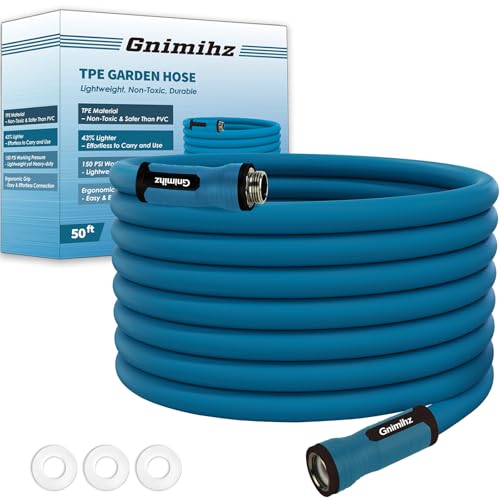
[ Stand Out from the Crowd ] Unlike ordinary hoses made of PVC or hybrid polymers, this Gnimihz 5/8-inch water hose is crafted with premium TPE material—and the difference is night and day. Lightweight like fabric/expandable hoses, with high water flow & durability of a traditional heavy duty 5/8-inch rubber hose.
Garden Hose Water Pressure: PSI Basics and Home Benchmarks
When you hook a garden hose up to a home spigot, the water pressure—measured in PSI (pounds per square inch)—determines how fast the water will flow and how effectively your sprinklers or drip emitters will work. Residential spigots typically deliver 45‑80 PSI, while municipal supplies average 30‑50 PSI. Measure static pressure by screwing a gauge onto the faucet, turning all other taps off, and reading the dial. Remember that each foot of elevation change costs about 0.433 PSI, and multiple active outlets will lower the pressure at the hose end. For ideal performance, adjust PSI for application: 10‑12 PSI for soaker hoses, 20‑40 PSI for drip irrigation, and 30‑50 PSI for sprinklers. Minimize pressure losses by fixing kinks, using proper fittings, and keeping hose length reasonable. The flow rate also depends on the hose’s internal diameter, as described by Bernoulli’s principle. A larger hose diameter can significantly increase flow, especially when combined with high water pressure.
Garden Hose Flow Rate: How Diameter, Length & Pressure Interact
A 50‑foot, 5/8‑inch hose delivering 24 GPM at 45 PSI illustrates how diameter, length, and pressure intertwine: larger diameters cut friction, longer runs add resistance, and higher PSI pushes more water through the same pipe. When you choose a ½‑inch hose, you’ll see about 13 GPM at 45 PSI, but a ¾‑inch version jumps to 38 GPM, boosting water distribution efficiency. Extending the hose to 100 ft halves the flow, so a 5/8‑inch line drops to 12 GPM, a 75 % loss compared with a 25‑ft run. To optimize flow rate, balance a wider diameter against length and maintain PSI near the tap’s static pressure. Avoid kinks and use a regulator to keep dynamic pressure stable, ensuring consistent performance. Friction loss increases with hose length and smaller diameter, further reducing pressure. Elevation changes can significantly affect water delivery, especially when moving water uphill.

Extreme Weather Performance: Remains flexible in temperatures ranging from 140°F down to -4°F, ensuring reliable use in various climates.

Commercial grade hot-water rubber hose withstands water temperatures of up to 190° F
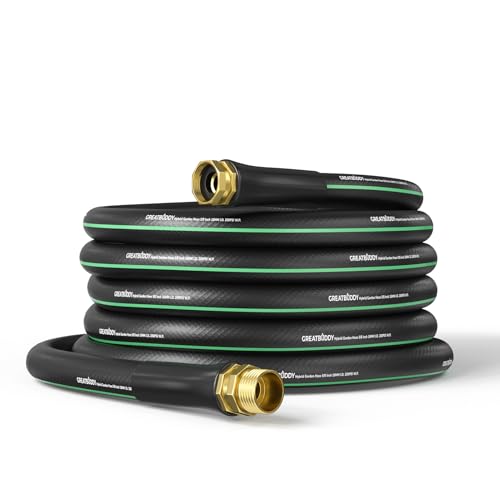
【Crush-Rebound Durability】The rubber-like hybrid polymer body resists flattening, unlike vinyl hoses; this water hose 50ft rebounds after being stepped on or rolled over to prevent bursts events and flooding, and greatly reduces kinks during use, while the 5/8-inch diameter maintains shape for consistent flow and easy handling.
Garden Hose Diameter Flow‑Rate Table (50 PSI)
The flow‑rate table at 50 PSI shows how hose diameter alone dictates the gallons‑per‑minute you’ll get over a 50‑ft run: a ½‑inch hose delivers about 14 GPM, a 5/8‑inch hose pushes 24 GPM, and a ¾‑inch hose reaches 40 GPM. When you pick a hose, use this table for preferred hose diameter selection and pressure drop mitigation. A ½‑inch line limits water volume, dropping to 13 GPM at 45 PSI and even lower if friction rises. The 5/8‑inch size bumps capacity to 24 GPM with modest pressure loss, ideal for typical garden tasks. The ¾‑inch option maximizes flow, delivering 38‑40 GPM while minimizing friction. Remember, longer runs double loss, so a 50‑ft segment outperforms a 100‑ft one across all diameters. Pressure loss increases with hose length, so selecting the shortest practical hose helps maintain washer performance. Adding more than three hoses in series can significantly reduce pressure, so consider a booster pump for longer distances. Metal hoses provide superior longevity and resistance to kinks, making them a worthwhile investment for frequent gardeners.

Excellent Performance: Our heavy duty garden hose features a 5/8-inch inner diameter and 3/4-inch brass connectors, crafted with a 5-layer braiding design. With a working pressure of 300 PSI and a burst pressure of 1000 PSI, rubber water hose meets various watering needs

AWARD-WINNING: HGTV, USA Today and Best Reviews voted Best Overall Garden Hose

Burst strength guarantees long hose life
Choose the Right Hose for Light‑Duty vs. Heavy‑Duty Jobs
Pick the hose that matches the job’s demand: a lightweight ½‑inch line works fine for small yards and short, low‑volume watering, while a robust ¾‑inch hose is needed for large properties, power‑washing, or any task that requires 15‑25 GPM over long runs. For light‑duty tasks, choose the ½‑inch hose; its light weight lets you maneuver easily, and its limited flow naturally supports water volume conservation techniques. When you need more water, step up to a 5/8‑inch or ¾‑inch model. The 5/8‑inch offers a balanced compromise for medium‑sized lawns and sprinklers, while the ¾‑inch delivers the heavy duty hose durability required for commercial‑grade cleaning, long‑run irrigation, and high‑flow power‑washing. Selecting a hose with an appropriate pressure rating ensures it can safely handle the washer’s output without bursting. Always verify the hose’s maximum working pressure before connecting it to a pressure washer. Hose‑connected pressure washers can still be effective for light cleaning when the hose’s flow rate is sufficient.
Why Long Hoses Lose Pressure – and What You Can Do About It
Even a modest 25‑foot hose can deliver full flow, but once you stretch it to 100 feet the pressure can collapse by up to 75 percent because friction inside the tube and any elevation gain constantly sap energy. The longer the hose, the greater the resistance, so volume flow reduction spikes—25 feet yields ~24 GPM, 100 feet drops to ~6 GPM. Smaller diameters amplify friction; a 0.29‑inch hose at 100 feet loses far more pressure than a 0.50‑inch one. Elevation adds gravity‑induced loss, about 22 PSI per 50 feet uphill. For pressure drop mitigation, choose a larger‑diameter, smooth‑interior hose, keep runs short, and avoid sharp bends or kinks. Replace worn sections promptly and use a booster pump if you must span long distances. Longer hoses increase resistance, which can impair a chemical injector’s ability to pull properly. Checking for kinks and blockages before use can prevent unnecessary pressure loss. Using a low‑flow nozzle can cut hourly water use by up to 50 percent. Properly securing hose connections with clamp fittings helps maintain consistent pressure throughout the system.

【Full Port High Flow Large Diameter Hose Splitter】IPOW garden hose splitter provides twice the water flow of a regular garden separator because it comes with a full port hose adapter. The water level post is 0.59 inches in diameter and the two outlet ports are 0.85 inches in diameter which make it more water flow.
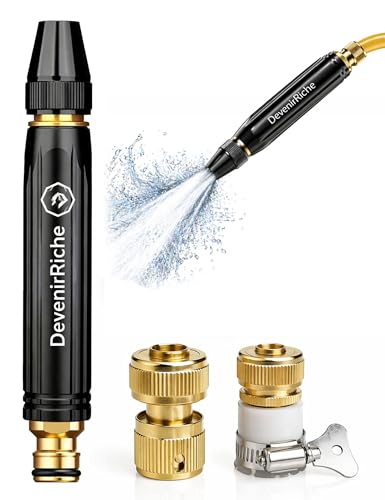
Versatile Applications: The Home High-Pressure Car Wash Water Gun with Booster Nozzle and Hose is perfect for a variety of tasks including car washing, watering plants, cleaning windows, and rinsing floors. Its multi-functional design makes it a must-have tool for every household

UNIVERSAL U.S. FIT & 2+4 VALUE SET: Get more value with our comprehensive set: 2 premium high-pressure nozzles and 4 easy-grip, tool-free hose clamps. The triple-barb tailpiece is precision-engineered to fit standard 1/2", 5/8", and 3/4" U.S. garden hoses, ensuring a secure, 100% leak-proof connection every time.