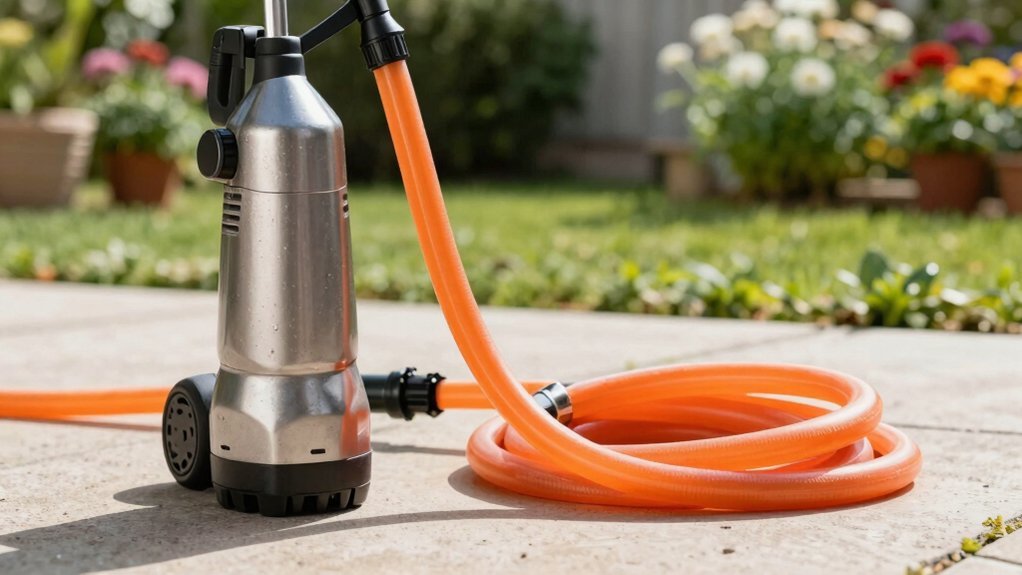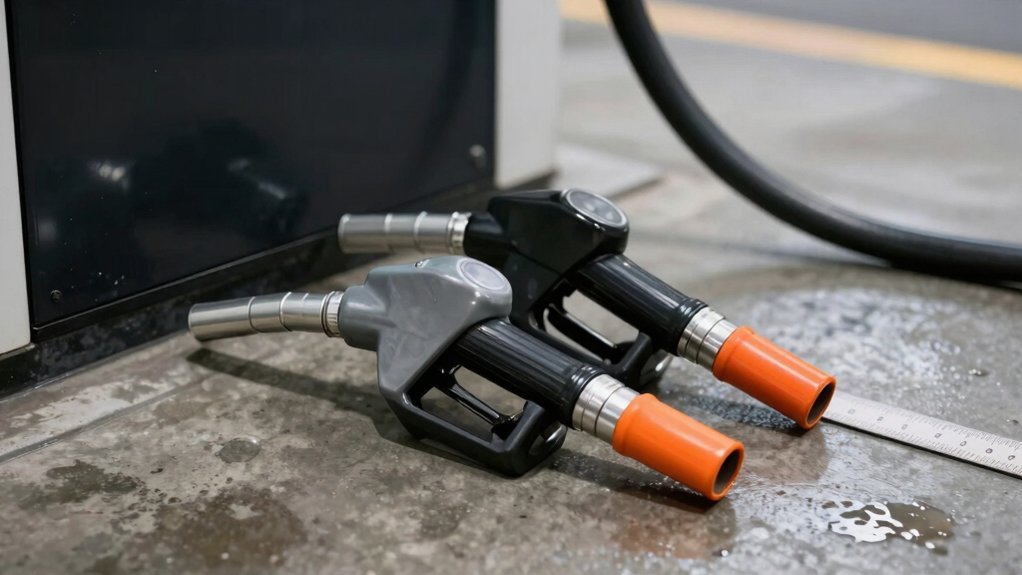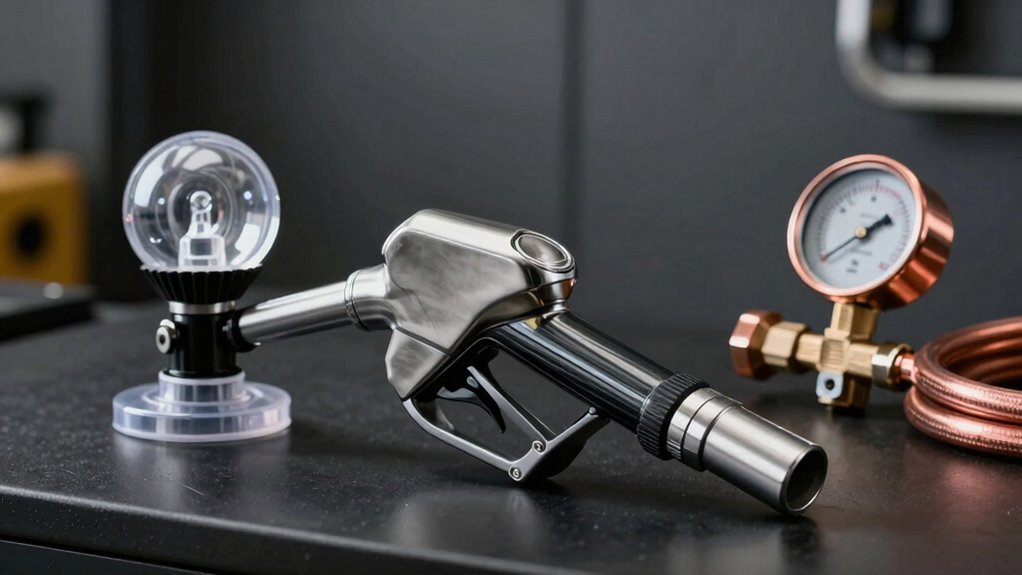
First, measure your lawn’s square footage and divide it by each sprinkler head’s effective coverage area to get a base head count. Then use the flow‑rate‑and‑pressure formula Q = N √(P/0.193) to check that your pump can supply enough gallons per minute for that many nozzles, adjusting for friction loss and elevation. For hoses and washers, match the nozzle orifice size and fan angle to the required pressure (150‑300 PSI for soft‑wash, 4000 + PSI for high‑pressure) and guarantee the total flow doesn’t exceed your pump’s capacity. If you follow these steps, the next sections will show you how to fine‑tune placement, overlap, and fan angles for ideal coverage.
How Many Sprinkler Heads Do I Need for My Lawn Size?
you size your lawn, first calculate its total square footage and then divide by the effective coverage area of a single sprinkler head—typically 225 sq ft for spray heads (15 ft radius) and up to 2,500 sq ft for rotary heads (35 ft radius). Next, assess lawn shape considerations: rectangular, flat zones favor spray heads spaced ≤15 ft, while irregular or sloped areas benefit from rotary heads that can span 15‑50 ft with overlapping arcs. Verify water pressure requirements: sprays operate at 20‑30 PSI, rotors need >30 PSI, and spacing must match the system’s PSI to avoid dry spots. Select pop‑up height based on vegetation—4‑inch for standard grass, 6‑inch for tall St. Augustine. Finally, confirm that each head’s coverage overlaps adjacent heads to guarantee uniform irrigation. Pipe diameter also influences flow capacity, ensuring each zone receives adequate water without excessive pressure loss. Properly designed systems can achieve up to a 30% reduction in water usage compared to outdated setups. Consider the spray radius when planning head placement to maximize uniform coverage.
How to Calculate Sprinkler Nozzle Count From Flow Rate and Pressure?
If you know the desired flow rate and the available pressure, you can determine how many sprinkler nozzles you’ll need by first calculating the flow each nozzle can deliver and then dividing the total required flow by that per‑nozzle value. Use the core formula Q = nozzle number × √(P/0.193) to compute per‑nozzle flow (Q) at the measured pressure (P in bar). Divide your system’s target flow (Q_total) by this Q to obtain nozzle count. Incorporate a nozzle selection strategy that matches nozzle number to pump capacity, avoiding undersized or oversized units that cause pressure variation effects. Adjust for friction loss, elevation, and fluid specific gravity if needed, then verify with a flow‑meter or bucket test. Specific gravity directly influences the required flow adjustments. Understanding nozzle flow dynamics helps optimize coverage and efficiency. Proper pipe sizing is crucial because system resistance can significantly reduce the effective pressure reaching each nozzle. Remember that a nozzle is not a valve and its role is to shape and direct the fluid rather than to block or regulate flow.
Which Nozzle Fan Angle Is Best for My Cleaning Task?
Choosing the right nozzle fan angle hinges on the material, dirt type, and desired coverage. For spot‑cleaning gum, graffiti, or marine growth, use a 0‑degree tip; its pencil‑thin stream concentrates pressure, but keep a safe distance to avoid surface damage. When you need a narrow, high‑pressure fan for unpainted masonry or metal, select a 15‑degree nozzle, which balances intensity with a modest spread. General‑purpose cleaning of decks, siding, or vehicles benefits from a 25‑degree fan, offering broad coverage without sacrificing command. Light‑duty tasks on windows or painted exteriors require a 40‑degree nozzle to provide a soft, wide spray. Proper nozzle selection also ensures optimal spray atomization and reduces fluid waste. Unloader pressure is relieved when flow is restricted, protecting the pump. Choosing suitable nozzle angle and customizing nozzle selection for application guarantees efficient, damage‑free cleaning. Selecting the correct nozzle can also improve cleaning efficiency by matching spray pattern to surface texture. Understanding nozzle pressure helps prevent over‑pressurizing delicate wood decks.
When Can a Single Quick‑Connect Tip Replace Several Sprinkler Heads?
Why settle for a maze of fixed heads when a single quick‑connect tip can handle the same area? You can replace 2‑4 heads by selecting a tip with adjustable patterns—full, half, quarter, or three‑quarter circles—and a multiple‑stream design that mimics the flow of several fixed nozzles. The O‑ring seal lets you mount the tip on threaded impact sprinklers or spikes, so you achieve lawn irrigation efficiency without extra inventory. Oscillating fan tips provide gentle coverage for fragile plants, while rotor tips on spikes cover large lawns with a single device. This customizable nozzle flexibility lets you shift from hose‑end caps to series connections, reducing setup time, cost, and space while maintaining even distribution. Using a swing joint connection can accommodate higher flow rates for larger lawns. Properly securing the hose to the sprinkler prevents kinks and maintains consistent pressure, which is essential for even water distribution. Pressure washer hoses must be rated for the maximum PSI of your system to avoid rupture. Selecting the appropriate nozzle size ensures optimal water flow and reduces waste.
Adjusting Sprinkler Nozzle Quantity for Soft‑Wash vs. High‑Pressure Cleaning
When you adjust the number of sprinkler nozzles, you directly influence the pressure‑to‑flow balance that distinguishes soft‑wash from high‑pressure cleaning. For soft‑wash, keep nozzle quantity low—typically one or two large‑orifice tips—to maintain 150‑300 PSI while delivering 6‑7 GPM. Adding a third nozzle drops PSI to roughly 1800 on a 4 GPM system, illustrating the nozzle quantity tradeoffs that favor flow volume over pressure. In high‑pressure cleaning, increase nozzle count with smaller orifices; a dual‑nozzle setup at 4000 PSI outperforms three‑nozzle configurations that fall to 1800 PSI. Remember that flow rate vs. pressure impact is linear: larger orifices boost flow but cut pressure, while tighter tips concentrate pressure but reduce total GPM. Use a nozzle chart to match pump capacity, desired PSI, and coverage area precisely. The spray pattern is determined by the nozzle’s orifice size and shape, affecting coverage uniformity and water distribution. Selecting the proper orifice size ensures optimal performance for each equipment type. This relationship is explained by Bernoulli’s principle which links pressure, velocity, and energy conversion in fluid flow.
Common Sprinkler Nozzle Mistakes and How to Avoid Them
If you install sprinkler heads too close or too far apart, you’ll create uneven coverage, overwatering, or underwatering that damages plants and spikes water bills. This mistake often stems from improper sprinkler maintenance and ignoring the maximum throw distance, which must stay within 25 % of the manufacturer’s rating.
Avoid mismatched nozzles by matching each zone’s precipitation rate; rotors, sprays, and bubblers require separate settings to prevent dry spots or runoff. Clean clogged nozzles each season: flush with a hose, replace worn parts, and inspect filters to maintain pattern integrity. Adjust radius and arc screws accurately; never reduce throwing distance beyond the 25 % limit, and keep pressure within 30 psi for sprays or 40‑65 psi for rotors. Finally, perform annual inspections to catch cracked seals, tilted heads, or valve failures before they cause inefficiency or plant damage. Proper pressure is essential for maintaining uniform distribution. Some sprinkler valves incorporate built‑in pressure regulators to ensure consistent flow across varying system pressures. Understanding flow dynamics helps designers size pipes and select nozzles that minimize friction loss and maximize coverage efficiency. Modern systems often include soil moisture sensors that shut off watering when the ground is already saturated.
Checklist: Matching Sprinkler Heads, Hose Flow, and Washer Nozzles
Because pressure, flow rate, and nozzle size are interdependent, you must confirm that each sprinkler head, hose segment, and pressure‑washer nozzle fits within the system’s total GPM and PSI budget before installation. First, measure static pressure with a faucet gauge; record the available PSI (30‑50). Next, calculate the GPM demand of every nozzle—e.g., a 3.0 rotor at 35 PSI consumes 3.11 GPM. Sum these values and compare to the hose’s capacity (5‑8 low‑flow heads). Guarantee the total does not exceed the zone’s GPM limit (typically 10 GPM). Apply sprinkler pattern design rules: allocate 5‑6 rotors or 8‑10 sprays per 15‑ft radius, maintaining overlap. Finally, perform ideal nozzle selection for the washer, matching its 3.0‑nozzle spec to the remaining headPM margin. The yard requires 12 zones to achieve full coverage. Proper pressure differential ensures water is delivered efficiently across the network. Understanding sprinkler head flow helps size the system accurately.
Troubleshooting Uneven Sprinkler Coverage or Pressure Loss
Even a slight drop in pressure or a misaligned head can turn a well‑designed irrigation zone into a patchwork of dry spots and oversaturated zones. First, inspect each head for obstructions; debris, mineral deposits, or insects can clog the nozzle and reduce flow. Clear any blockage and verify that the head pops up fully. Next, assess head alignment; soil settlement or lawn equipment may tilt the head, directing spray away from the target area. Adjust the head to a vertical position and re‑level the base. Then, measure pressure at the inlet and compare it to the manufacturer’s recommended range. If pressure fluctuates, install a pressure regulator to stabilize flow across the zone. Finally, confirm that all heads share the same precipitation rate and spacing to eliminate overlap or gaps.