Pick a nozzle whose spray angle and orifice size match your washer’s PSI and GPM. Use a 40° tip for gentle rinses on paint, windows, or fences; 25° for everyday decks, siding, and car washes; 15° for tough grime, mildew, or marine growth; and 0° for cutting‑edge jobs like tar, gum, or graffiti. Match the orifice (e.g., 0.012 in for high pressure, 0.032 in for low pressure) to the flow rate, and tighten the quick‑connect before each use. The next sections show how to avoid common sizing mistakes and keep your pump and nozzle in sync for peak performance.
Pressure Washer Nozzle Sizing: Angle & Pressure Basics
When you pick a pressure‑washer nozzle, the spray angle determines how the pressure is distributed: narrow angles (0°‑15°) concentrate force on a small spot, while wider angles (25°‑40°) spread it over a larger area. First, check pressure washer compatibility; the nozzle’s orifice size must match the machine’s PSI and GPM rating. Then, apply application specific nozzle selection: use 0° or 15° for stubborn grime, 25° for general cleaning, and 40° for delicate surfaces. Remember that spray angle alone doesn’t change output pressure—only the pattern. Start with a broader angle, then narrow only if additional power is needed. This approach guarantees safety, efficiency, and ideal cleaning results. For optimal results, consider the nozzle flow rate when matching the nozzle to the car’s surface type. Understanding nozzle diameter helps you balance flow rate and coverage for the best finish. The nozzle inches per hour calculation links pressure, flow, and or size to achieve desired water coverage.

【Pressure Washer Nozzle Tips】Pressure up to 4500 PSI, 1/4-inch quick connect, 2.5 orifice size, 2.5GPM, adjusts 5 different cleaning angles.

Wide Application: Power washer pivot adapter is designed to use between wand and nozzle tips to make it be able to change angles as wish. It has been widely used in car washing, gutter cleaning and other hard-to-reach areas rinsing.

7 Rotation Angles Connecting Pivoting Coupler: The pivoting pressure washer nozzle connects between wand and nozzle tip, and it can adjust 240 degree for 7 different cleaning angles. Great for cleaning the hard to reach areas, such as the bottom of your car, cars rims and gutter. It will save a lot of time and effort.
Matching GPM & PSI to the Correct Orifice Size
Orifice size is the key to matching your washer’s PSI and GPM, because it directly controls how much water can flow through the nozzle. First, locate your pump’s PSI on a chart, then read down to the GPM you need. The intersecting value gives the correct orifice size—0.012 in for high‑pressure, 0.032 in for low‑pressure tasks. Remember that nozzle material characteristics affect durability but not flow; sapphire orifices keep tight tolerances for precise GPM output. Use the formula GPM = GPA × MPH × W/5940 for band‑spraying calculations. Match the orifice to your pump’s output to avoid under- or over‑pressurizing, and adjust for hose size or non‑water liquids with the appropriate conversion factor. This conversion follows the principle that a nozzle converts pressure energy into kinetic energy, increasing fluid velocity while reducing static pressure, as described by Bernoulli’s equation. Proper atomization control also helps achieve a smoother finish. The nozzle’s narrowing illustrates how fluid speed rises as static pressure drops.
Choosing the Right Nozzle Angle for Common Cleaning Tasks
Choosing the right nozzle angle lets you match pressure, coverage, and surface safety in a single step. Start with the highest angle—40°—for gentle rinsing of paint, windows, or fences; it spreads water evenly without risking scratches. Drop to 25° when you need medium‑high pressure on decks, siding, or car washes, balancing impact and reach. Use 15° for heavy‑duty jobs like paint removal, mildew, or marine growth; the narrow fan concentrates power on stubborn grime. Reserve 0° for cutting‑edge cleaning of tar, gum, or graffiti, but work carefully to avoid surface damage. Adjust nozzle angle as you move across tasks, customizing pressure spray patterns to each material’s tolerance and cleaning intensity. Adding a quick release mechanism to your wand further speeds up switching between these angles. Selecting the proper PSI range for the siding’s condition helps prevent warping while achieving a thorough clean. When using a hose‑connected pressure washer, remember that the hose length and diameter affect pressure output, so hose diameter can limit performance. Always verify that the hose’s pressure rating matches or exceeds the washer’s maximum PSI to maintain safety and efficiency.

【Universal Fit for Standard US Hoses】: This high pressure water hose nozzle is equipped with a 3/4 Inch GHT Thread Garden Hose Quick Connector, connect fittings with rubber washers for a leak-free seal. Designed to match standard American garden hoses perfectly so that you can connect and disconnect in seconds — no tools, no hassle. The solid brass build and watertight rubber seal guarantee zero leaks.
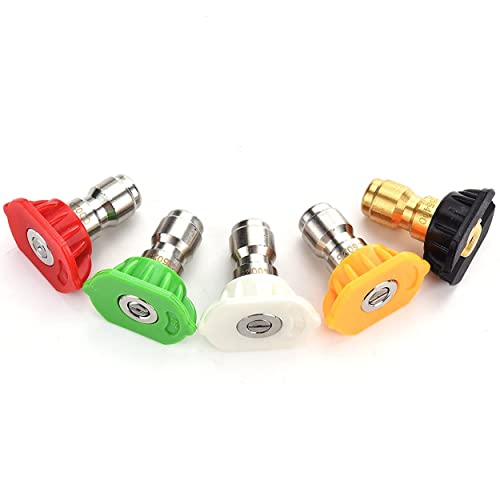
NOTE: Please see Image 6 and find the orifice you need based on working pressure and flow rate (GPM). The orifice of these nozzles are 2.5. Different angle allows you to clean hard-to-reach areas quickly and easily

Package Included: 1 x pressure washer nozzle holder, 1 x rinse mode nozzle tip, 1 x soap mode nozzle tip. 1 x red nozzle (0°), 1 x yellow nozzle (15°), 1 x green nozzle (25°), 1 x white nozzle (40°), 1 x black nozzle (65°).
Reference Table: Nozzle Codes, Orifice Sizes, Flow Rates
A quick glance at the reference table lets you match any nozzle code to its exact orifice size and corresponding flow rate. The first two digits of a code give the spray angle, the last two indicate the orifice—so 2540 means a 25‑degree pattern with a 4.0 mm opening. Use the table to align your washer’s PSI and desired GPM with the listed orifice sizes (3.0, 3.5, 4.0, 4.5, 5.0, 6.5). Smaller orifices boost pressure; larger ones increase flow but drop pressure. When selecting a nozzle configuration, consider the orifice material—black low‑pressure plugs are for cleaning agents only, while standard steel fits most wands. Round up if your calculation falls between sizes to protect the pump and guarantee adequate cooling. Understanding fog nozzle dynamics helps optimize water usage and achieve consistent coverage. Proper nozzle selection also influences droplet size to reduce drift and improve cleaning efficiency. Choosing the right nozzle can significantly impact cleaning performance by balancing pressure and flow.

ATTENTION: Please see Image and find the orifice you need based on working pressure and flow rate (GPM).The orifice of these pressure washer nozzles are 4.0GPM. The working pressure is up to 4000 PSI

Wide Applicability: Pressure washer rotating nozzle can be used in most of the high pressure cleaner. Great for rust removal, metal or plastic tank cleaning, boat cleaning, cleaning dirty garage floors, stripping paint from wood exterior, and removing mud and clay from highway and construction equipment
ATTENTION: Please see Image and find the orifice you need based on working pressure and flow rate (GPM).The orifice of these pressure washer nozzles are 2.0GPM. The working pressure is up to 4000 PSI
Turbo and Rotary Nozzles: When to Use Them in Pressure Washing
Turbo and rotary nozzles—often called turbo nozzles—spin a zero‑degree tip at up to 3,000 rpm, turning a pinpoint jet into a rapidly moving 4‑to‑8‑inch circular spray. Use them on hard, heavily stained surfaces—concrete, brick, textured floors, or large equipment—where you need ten‑times the cleaning power of a standard nozzle and want to cut cleaning time in half. Avoid delicate or porous materials such as wood unless you switch to a gentler deck‑cleaning variant. Before each job, check the orifice for wear and guarantee the quick‑connect fitting is tight; replace a cracked tip immediately. After use, rinse the nozzle, dry it, and store it in a dry place to prevent corrosion. Always evaluate surface compatibility considerations and perform routine nozzle maintenance to preserve performance. Remember that a nozzle shapes fluid flow while a valve controls its passage. turbo nozzles are especially effective for quickly covering large areas with consistent pressure. Surface roughness can significantly increase pressure loss, so maintaining smooth nozzle interiors is essential for optimal efficiency.
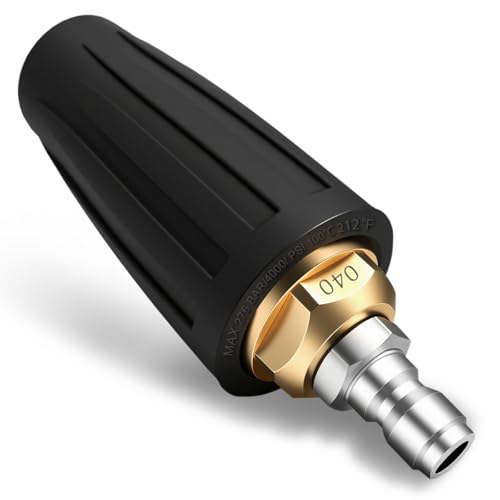
Durable Material: This pressure washer turbo nozzle crafted with a premium ceramic core, Durable rubber housing, And robust stainless steel, Which is built to last. This turbo nozzle stands up to high pressure without wearing down or clogging. It stands out among power washer nozzles for heavy-duty tasks


【CLEANS LIKE MAGIC】Transform your cleaning routine with Yupjlia’s pressure washer turbo nozzle! Its rotating jet pattern increases cleaning power by hitting surfaces from multiple angles, breaking up stubborn stains more effectively than standard nozzles. The rotating motion helps water reach cracks and crevices, making hard-to-reach areas easier to clean. A must-have for any pressure washer setup.(NOTE: THIS NOZZLE CAN NOT CONNECTED WITH HOSE DIRECTLY)
Avoid These Common Nozzle‑Sizing Mistakes
After using turbo or rotary nozzles for heavy‑duty jobs, you’ll notice that the right nozzle size still matters just as much. First, match the orifice to your washer’s PSI and GPM using the formula √(GPM² × PSI/500); a 0.45‑inch nozzle fits 15 L/min at 3000 PSI. Avoid a nozzle that’s too large—pressure drops, cleaning power wanes—or too small—back‑pressure can damage the pump. Check the degree: 15° for high‑pressure spots, 40° for broad coverage. Guarantee each connection is secure; an unsecured nozzle connection can fly off, and a missing O‑ring leaks water. Don’t mix brands or materials without a proper quick‑connect collar. Consistently verify the manual or chart to prevent inadequate nozzle rotation and maintain ideal performance. Check for leaks in the tap, garden hose, and connectors before starting to ensure maximum flow to the pressure washer. Selecting the correct nozzle also aligns with the sprinkler flow rate recommended for your specific cleaning task. Properly sizing the nozzle can also improve water efficiency in your landscaping by reducing excess runoff. Understanding hose diameter effects helps you anticipate how flow changes when you switch between garden hoses and pressure washer attachments.
Swapping & Testing a New Nozzle – Step‑by‑Step Guide
Before you start swapping nozzles, turn off the power, disconnect the water line, and release any remaining pressure by squeezing the trigger until the spray stops. Unscrew the old nozzle counter‑clockwise with a wrench or pliers, then wipe the holder clean. Inspect the wand for cracks or corrosion; if you spot damage, address troubleshooting nozzle issues before proceeding. Align the new nozzle’s threads with the holder, turn it clockwise until it clicks, and avoid overtightening. Pull back any quick‑release collar, insert the nozzle, and release to lock it in place. Reconnect water and power, then test from a safe distance, checking for leaks and confirming the spray pattern matches the nozzle’s spec. Finally, store replacement nozzles in a dry container to protect threads. The typical garden hose nozzle can generate 30–80 psi depending on water source and hose length, which helps you gauge compatible pressure for your washer. Integrated swivel in the handle prevents hose tangling during nozzle changes. Ensure the hose’s flow rate is compatible with the washer’s pressure rating to avoid performance loss.

⭐ DBR Tech Power Washer Nozzle Tips – A Family-Owned Brand | USA Registered Trademark | 7 Years of Proven Reliability | Trusted by 100,000+ Customers

Provides a JET STREAM that reaches farther than standard nozzle tips

[Powerful Jet Wash] Coyardor Rotating Turbo Nozzle is built of durable brass, the body is made of Premium rubber, which is wear-resistant and prolongs the service life. 3400 PSI @ 4.0 GPM can provide powerful spinning water flow, which cut cleaning time in half.
Keeping Your Nozzle and Pump in Sync for Peak Performance
When you match a nozzle’s PSI rating and spray angle to your pump’s type and output, you keep pressure and flow in harmony, preventing loss of cleaning power or premature wear. First, verify pump configuration requirements: axial cam pumps need quick‑connect nozzles that match the brass valve size, while triplex pumps demand adapters that fit the parallel driveshaft layout. Check shaft orientation—horizontal units give easier access to quick‑connect fittings, vertical units may need longer hoses. Next, run nozzle compatibility considerations: color‑coded angles must align with your pump’s PSI range; a 25° green nozzle works with standard output, a 40° white nozzle needs reduced pressure, and a sewer nozzle requires a pump that sustains 8,000 PSI. Finally, tighten all connections, test for leaks, and adjust pressure settings before cleaning.