You should water early in the morning, 20‑30 minutes per session, three times a week, delivering about half to three‑quarters of an inch each time. Use a tin‑can test or a flow‑rate calculator to fine‑tune the runtime for your spray, rotor, or drip heads—typically 22 minutes for a pop‑up spray at 1.65 in/hr. Adjust for soil type, weather, and grass season; clay needs longer cycles, sand needs shorter, more frequent bursts. Follow this schedule and you’ll see rapid, healthy growth, and the next sections will show you how to optimize every detail.
What Is the Ideal Sprinkler Runtime for a Healthy Lawn?
A healthy lawn typically needs 20–30 minutes of watering three times a week, which translates to roughly ½–¾ inch of water per session. You’ll set custom sprinkler timers to match those targets, adjusting each zone to 7–14 minutes for clay soil or 10 minutes for spray heads and 20 minutes for rotor heads. Early‑morning runs between 4 AM and 6 AM minimize evaporation and disease risk. For ideal lawn maintenance, monitor output with a tin can, then fine‑tune runtimes to deliver the prescribed ½–¾ inch per cycle. In hot weather, increase frequency to three‑four times weekly, keeping total weekly water between 1 and 1½ inches. Consistent, precise timing prevents over‑watering while ensuring roots receive adequate moisture. Proper head-to-head coverage ensures even water distribution across the lawn. Adjust spacing based on spray radius to achieve uniform coverage and conserve water. Understanding soil infiltration rate helps prevent runoff and maximizes water absorption. Properly sizing sprinkler flow per zone avoids pressure loss and balances water delivery.
How to Calculate the Right Runtime for Your Lawn Type
You’ve already set your sprinklers to deliver roughly ½–¾ inch per session; now you need to translate that target into minutes for each zone. First, measure the catch‑can rate for the specific head type in the zone. Use the formula: (Seasonal Water Need × 10 min) ÷ (Catch‑Can Average Rate) = Run Time. For a pop‑up spray head (≈1.65 in/hr), a 0.6 in need becomes 0.6 × 60 ÷ 1.65 ≈ 22 min; adjust down to 60 % for shaded areas. Apply seasonal adjustments by consulting recent ET data; increase runtime in hot, dry months, decrease in cooler periods. Record each zone’s soil type and root depth; shallow soils add ~10 % time. This systematic approach supports groundwater conservation and consistent lawn health. Proper shallow frequent watering is critical for encouraging deep root growth in newly established sod. Different crop types require varying sprinkler head spacing, so consider soil moisture retention when planning layout. Understanding the maximum zone capacity helps ensure each zone stays within optimal flow limits.
Spray vs. Rotor vs. Drip: Which System Grows Grass Faster?
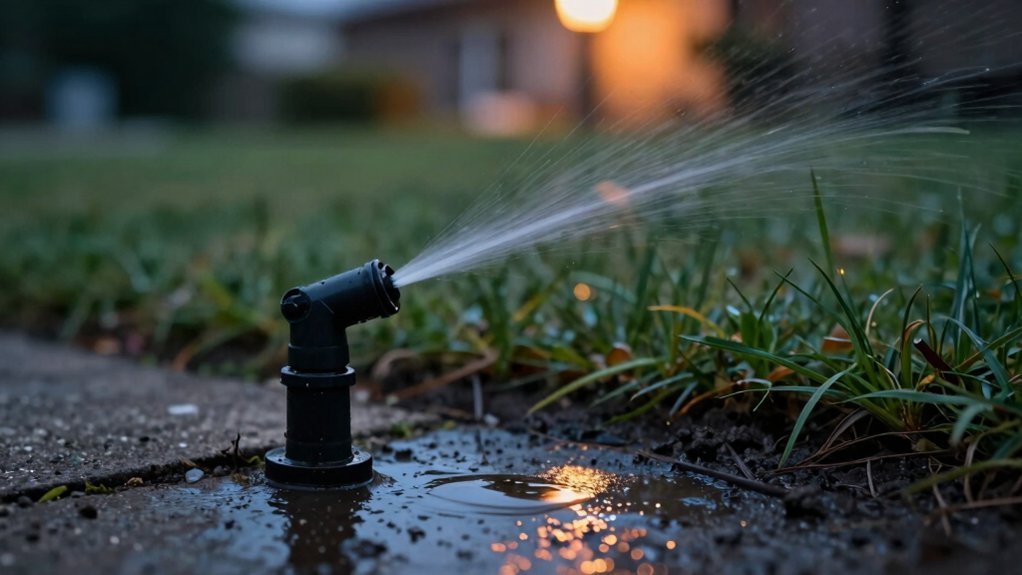
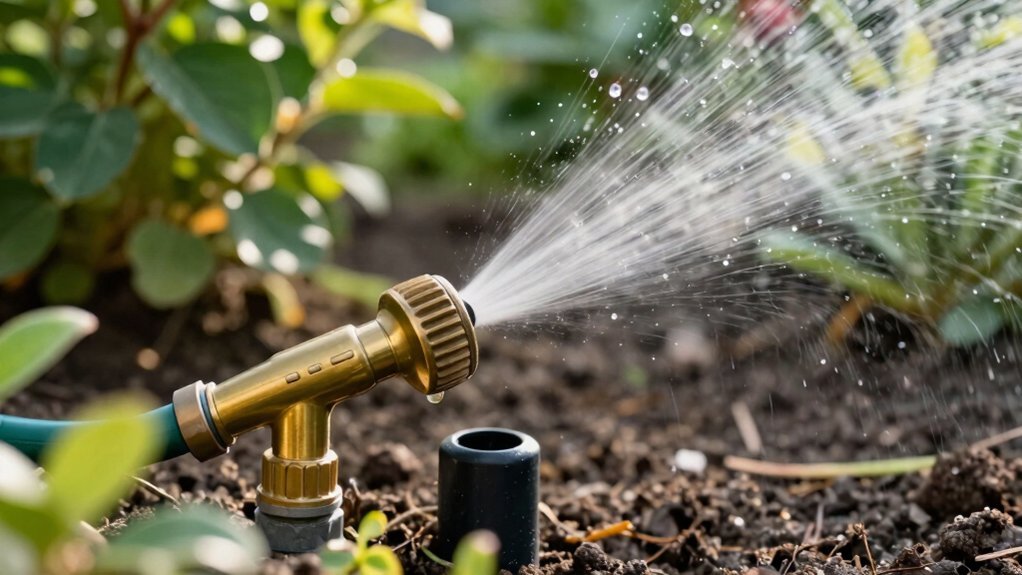
Which system truly speeds grass growth? You’ll find spray heads deliver 1‑2.5 in/hr, applying a quarter‑inch in ten minutes, so a 15‑20‑minute zone run meets most small lawns. That rapid delivery supports runtime optimization and reduces seasonal water usage when you match the zone size. Rotors emit 0.25‑1 in/hr, requiring 30‑40 minutes for equivalent water, but they cover 22‑50 feet uniformly, making them practical for larger turf where slower, even wetting avoids dry spots. Drip systems trickle water for 30‑60 minutes, achieving 90 % efficiency and cutting evaporation, yet they prioritize water savings over speed, so they lag in growth acceleration. For fastest grass establishment on compact areas, spray heads win; rotors suit expansive lawns, while drip excels in water‑conserving applications. Mismatched heads in a zone can cause uneven watering and require separate programming. Proper pressure regulation ensures each sprinkler receives the correct flow for optimal performance. Understanding local water ordinances helps you avoid legal penalties while optimizing irrigation. Designing zones based on soil moisture improves water distribution and promotes healthier root development.
How to Adjust Runtime for Weather, Soil, and Grass Season
Typically, you’ll set your irrigation runtime by matching the zone’s output to the current evaporation rate, soil moisture retention, and the growth stage of your grass. Adjust for seasonal weather patterns by cutting runtime during rainy or cool periods and extending it during hot, dry spells. Use rain sensors or moisture meters to track root zone moisture and trigger automatic changes. Clay zones need longer, deeper cycles; sandy zones require shorter, more frequent bursts. Warm‑season grasses demand higher frequency, cool‑season varieties less. In spring, start with 2‑3 days per week, early morning, then increase as temperatures rise. During summer peaks, schedule 30‑35‑minute runs twice weekly, preferably at dawn or dusk, to minimize evaporation. Monitor soil and adjust per zone for efficiency. Proper scheduling also helps prevent fungal disease by reducing leaf wetness duration. Modern sprinkler systems often incorporate soil moisture sensors to further reduce water waste. Understanding evaporation rates helps fine‑tune watering schedules for optimal water use.
Best Tools and Apps for Real‑Time Sprinkler Monitoring
After fine‑tuning runtimes for weather, soil, and grass season, the next step is to monitor those settings in real time. Smart Rain SmartApp gives you 24/7 zone flow readings and sensor data on iOS, Android, and desktop, while its customizable dashboards turn raw numbers into actionable real time analytics. Rain Bird IQ4 Central Control adds satellite‑station logs, two‑way programming, and automated email alarms, all synced through a cloud based infrastructure that scales across commercial sites. WeatherTRAK Mobile lets you adjust controllers, map sites, and receive alerts from any device, keeping troubleshooting minutes away. SprinklerView Cloud‑Based Monitoring extends fire‑sprinkler oversight with instant alarms and AI‑enhanced analysis. Raindancer’s GPS‑linked, solar‑powered unit monitors pressure and performance on any irrigation machine, feeding data into the same cloud based infrastructure for unified, real time analytics. Modern systems often incorporate low‑voltage DC power supplies to improve energy efficiency and enable battery backup. Regularly checking the battery lifespan can prevent unexpected downtime. Controllers that consistently misbehave after 5‑10 years may need replacement due to wear acceleration from harsh weather and power surges.
Step‑by‑Step Weekly Schedule: From 20‑Minute Sessions to Full‑Week Plan
You’ll start with three 20‑minute watering sessions each week, delivering 0.5 inch per session (1.5 inches total) to keep new grass seed from washing out. Apply the water early morning, use proper watering technique, and monitor soil moisture to 2‑3 inches depth, adjusting for soil type. In week 2, shift to four 25‑minute sessions, totaling 0.75 inches weekly, spaced two days apart; use timers for precise delivery and watch for 50 % sprout coverage. Week 3 expands to five 30‑minute sessions, reaching 1 inch weekly; align this with evapotranspiration monitoring and test infiltration at 0.5 inch per hour. Week 4 moves to six 35‑minute sessions, maintaining 1.25 inches, reducing frequency if rain occurs. The Full‑Week Plan settles on three 40‑minute sessions, supplying 1.5 inches every 2‑3 days, guided by smart timers and ongoing evapotranspiration monitoring. Properly calibrated sprinkler timers ensure consistent water distribution and help conserve water. Understanding wiring diagrams can prevent common installation errors when setting up new timers. Regularly inspect the timer for audible clicks that may indicate a software glitch.
What Common Mistakes Slow Grass Growth and How Can You Fix Them?
When soil is compacted, its pH is off, or nutrients are deficient, grass can’t establish strong roots, leading to sluggish growth; the same slowdown occurs if you water shallowly, over‑water, or miss the ideal 1/3‑inch three‑times‑a‑week schedule. To fix this, start with proper soil preparation: aerate, amend pH, and apply a balanced N‑P‑K blend based on a soil test. Choose a grass species that matches your climate and soil type; warm‑season varieties thrive in hot, sunny zones, while cool‑season types prefer milder conditions. Adjust irrigation to deliver 1‑1.5 inches per week, split into three early‑morning applications, and avoid shallow or excessive watering. Mow at the recommended height, never removing more than one‑third of blade length, and keep blades sharp. Finally, fertilize during active growth periods with slow‑release formulas and monitor for pests or disease. Consistently applying ¼‑½ inch of water multiple times daily during the first two weeks promotes rapid root development. Modern systems that incorporate smart controllers can further reduce waste by adjusting schedules based on weather and soil moisture.
Quick Checklist: Verify Your Sprinkler Timing
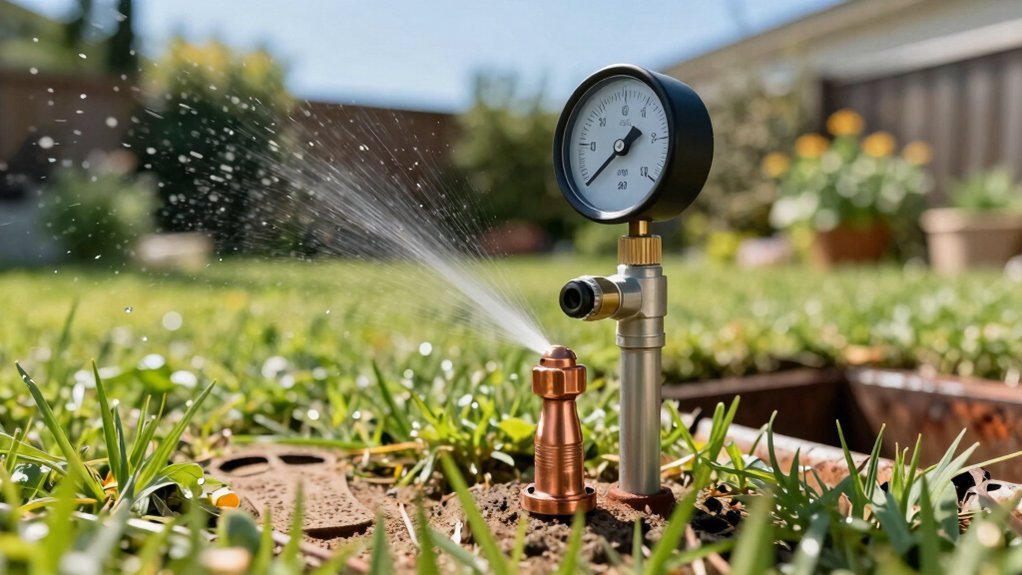
Set your controller to run the sprinkler zones according to the calculated run‑time per station, then verify the output with a simple container test. Place a tuna‑can at the near, mid, and far points of each spray pattern, run the zone for 15 minutes, and record the depth. Compare the measured inches to the expected rate (e.g., 1/2 in/hr for spray heads). Adjust the programmed minutes until the container shows the target 1 in per week.
Next, monitor soil moisture levels with a probe after each cycle; if moisture reads above 2 inches at 6 in depth, reduce run‑time by 10 %. Finally, optimize sprinkler locations by moving heads that consistently under‑ or over‑water, ensuring uniform coverage and minimizing runoff.