Pick a 40° white nozzle with a 3.0‑orifice for gentle, paint‑safe rinsing; it spreads the spray, drops 3000 PSI to about 1090 PSI, and raises GPM to 1.4 for cooling. When grime gets tougher, switch to a 25° green nozzle with a 4.0‑orifice to keep pressure between 1,200‑1,900 PSI and concentrate the flow without harming finish. Avoid 15° yellow and 0° red tips, as they can strip paint. Stay 18‑24 inches from panels and 12‑18 inches from wheels, and you’ll get a flawless wash—more details await.
Best Car‑Wash Nozzle & Orifice Combination for Paint‑Safe Cleaning
If you want paint‑safe cleaning, start with the 40° white nozzle paired with a 3.0‑orifice; its wide fan pattern delivers gentle, low‑pressure water that rinses paint, windows, and upper panels without chipping or scratching. This combo hits ideal maintenance intervals, keeping the surface free of residue while preserving gloss. The 3.0 orifice lowers PSI to about 1,090 and raises GPM to 1.4, preventing high‑pressure spikes that could damage clear coats. Use the 40° nozzle for the bulk of the rinse, then switch to a 25° green for wheels and lower panels where grime is tougher. Follow car safe drying techniques—blot with micro‑fiber towels and air‑dry briefly—to avoid water spots before the next wash cycle. The Ridge Washer nozzle offers a value option but its performance accuracy is still unknown. Selecting the correct nozzle type helps maintain the recommended pressure rating for each cleaning task.

【Effective Protection】 Pressure Washer Nozzle Guard (40° Degree, 3.0 Orifice) — Crafted from stainless steel for extended service life. The protective cover is made of rubber, which provides reliable protection to prevent scratching your car’s paintwork during cleaning and avoids damage to the items being cleaned.

Improved Guard Design: The pressure washer tips often need to be close to the car body when washing, the guard can cushion the impact of accidentally hitting the car body, wall or floor during operation. The nozzle guard can reduce the risk of foreign body clogging when washing your car outdoors
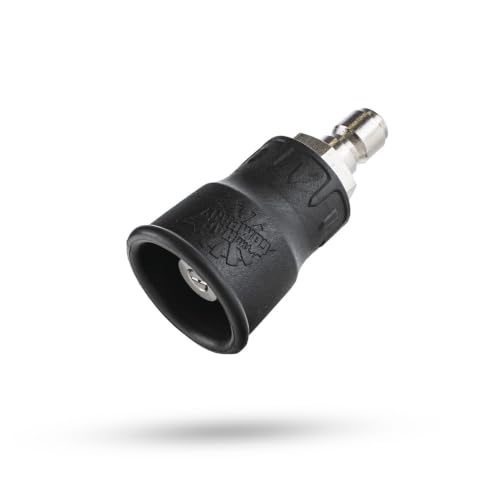
DESIGNED FOR AUTOMOTIVE DETAILING - The Ultra H2O 3.0 Spray Nozzle features a dedicated 40° fan pattern ideal for controlled pressure washing, rinsing, and vehicle cleaning.
Car‑Wash Nozzle Spray Angles: Which Angle Protects Your Paint?
Switching from the 40° white nozzle’s gentle fan, you’ll find the spray angle itself is the key factor in paint protection. A 40° spread disperses force, minimizing paint damaging effects while delivering uniform rinsing. The 25° green tip concentrates enough to lift grime yet stays within safe pressure recommendations for most panels. Avoid the 15° yellow angle; its chiseling spray can strip paint if held too long, especially on delicate surfaces. Never use the 0° red nozzle on a car—its pencil‑jet stream creates gouges and permanent chips. For soap application, the 65° black nozzle offers a low‑pressure, wide pattern that safeguards paint during pre‑soak. Choose the angle that matches the task, not just the nozzle size, to keep your finish flawless. Wider nozzle angles reduce pressure and help protect delicate surfaces. Selecting the proper nozzle also depends on the deck’s material and dirt level, so refer to nozzle tip size guidelines for optimal results. Understanding nozzle diameter is essential for achieving the desired spray pattern and flow rate.
Car‑Wash Nozzle Orifice Sizes: Matching PSI & GPM for Safe Pressure
Choosing the right nozzle orifice is the key to balancing PSI and GPM for safe car washing. You match the orifice size—3.0, 3.5, 4.0, etc.—to the washer’s PSI and GPM using calculators or charts. A 3.0 orifice drops 3000 PSI to about 1090 PSI while raising GPM to 1.4, giving gentle cooling and even nozzle flow rates. For most vehicles, a 4.0 orifice is a solid baseline; step down to 3.0 or 3.5 for detailing or up to 4.5 for 2200‑2700 PSI work. Remember that larger orifices increase GPM but lower PSI, altering nozzle impact patterns. Always round up when in doubt to avoid pump restriction and protect paint. Using a larger orifice than recommended can safely reduce PSI output. A garden hose that is not rated for high pressure can burst, so ensure the hose meets the washer’s pressure rating before connecting it. The psi‑gpm relationship determines how much cleaning power you actually get from the hose‑connected system. Understanding the thread pitch differences helps prevent mismatched connections that could cause leaks.
PURPOSE-BUILT FOR CAR WASHING - The Ultra H2O 4.0 Spray Nozzle uses a dedicated 40° fan pattern designed for safe, effective rinsing and automotive detailing.
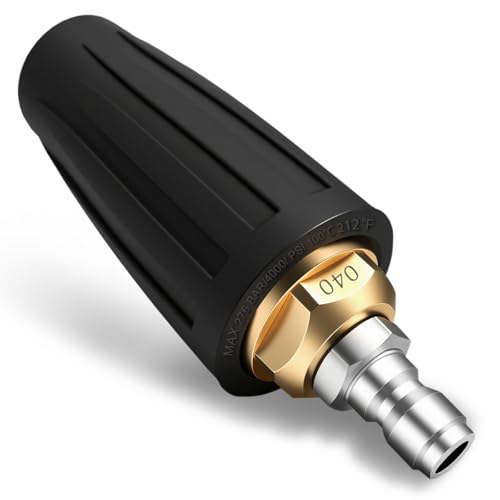
Durable Material: This pressure washer turbo nozzle crafted with a premium ceramic core, Durable rubber housing, And robust stainless steel, Which is built to last. This turbo nozzle stands up to high pressure without wearing down or clogging. It stands out among power washer nozzles for heavy-duty tasks
【Effective Protection】 Pressure Washer Nozzle Guard (40° Degree, 4.5 Orifice) — Crafted from stainless steel for extended service life. The protective cover is made of rubber, which provides reliable protection to prevent scratching your car’s paintwork during cleaning and avoids damage to the items being cleaned.
Why T304 Stainless Steel Is the Ideal Material for Car‑Wash Nozzles
Selecting the right nozzle orifice sets the flow, but the material that holds that orifice together determines whether it will survive repeated high‑pressure cycles. T304 stainless steel delivers superior corrosion resistance thanks to 18 % chromium and 8 % nickel, forming a protective oxide layer that repels rust from rain, snow, and water vapor. Its low carbon content curtails intergranular corrosion, keeping the nozzle intact longer—key when you’re choosing nozzle durability. Heat resistance up to 925 °C prevents brittleness during hot‑water washes, while tensile strength of 540‑750 MPa resists deformation under pressure. Excellent formability and weldability let manufacturers produce smooth, tight passages, which reduces nozzle clogging. Compared with 400 series, T304’s strength and wear resistance make it the ideal choice for reliable, long‑lasting car‑wash nozzles. Proper nozzle selection also depends on spray pattern to match the cleaning task. The nozzle design directly influences droplet size and distribution uniformity, which are critical for achieving desired coverage and minimizing waste. Understanding pressure loss helps optimize pump settings for efficient water use.

360° Turbo Pressure Washer Nozzle: Made of stainless steel housing and ceramic innards. Replaced original nozzle made of a composite material with this, better damage-resistant and strong enough, longer use life.

Powerful Rotating Turbo Cleaning: Our pressure washer turbo nozzle delivers a concentrated rotating jet stream that blasts away stubborn dirt, grime, rust, paint, and moss far faster than standard pressure washer nozzles.

Aluminum material with black finish. The item with small pads, please use them to adjust the angle to get wide sprayed.
How to Use the 40° White Nozzle for Full‑Vehicle Rinsing
When you attach the 40° white nozzle to a pressure washer, its wide‑angle spray blankets the entire vehicle in a gentle, even mist that lifts loose dirt without risking paint. Start by selecting a pressure setting between 500 PSI and 2,000 PSI; lower the water pressure if you notice streaks or foaming. Apply soft rinse techniques: hold the nozzle about 12‑18 in. from the surface, move it in overlapping, steady strokes, and keep the spray parallel to the paint. Begin at the roof, work down the doors, then the wheels, ensuring every panel receives equal coverage. Adjust the flow by turning the washer’s regulator, then finish with a quick burst at 2,500 PSI to clear residual grime before drying. Fine mist sprays are ideal for delicate surfaces and conserve water. Understanding nozzle flow helps you match the spray to the vehicle’s size for optimal coverage. Proper spray pattern selection maximizes cleaning efficiency while minimizing water usage.

SCRATCH-FREE & SPLASH CONTROL: Equip your wand with our premium pressure washer nozzle, featuring a protective silicone guard. This design safely minimizes the risk of scratching your car's paint while concentrating the water flow to reduce splashing by 60%. It delivers a cleaner, neater wash—an absolute must-have for professional detailers and DIY auto enthusiasts

Wide 40 Degree Fan Spray: These pressure washer tips create a broad fan-shaped spray for greater coverage and gentler rinsing than narrow-angle tips. Suitable for cars, boats, windows, siding, fences, exterior walls, patios and outdoor furniture.

Durable Construction: This pressure washer nozzle tip is crafted from high-quality metal for long-lasting performance.
Matching Your Pressure Washer to the Right Car‑Wash Nozzle
Ever wondered how to pair your pressure washer’s PSI and GPM with the proper car‑wash nozzle? Start by checking the washer’s specs—3,300 PSI and 1.6 GPM is a common sweet spot. Use an orifice calculator to select a 3.0‑4.0 mm hole; round up if the result falls between sizes. Then match the spray angle: a white 40° nozzle delivers the gentle, wide coverage that protects paint, while a black 65° soap nozzle spreads detergent at low pressure before rinsing. Avoid red 0° and yellow 15° nozzles; they’re too aggressive for vehicle surfaces. Proper nozzle selection keeps flow balanced, prevents pump strain, and simplifies pressure washer maintenance. The targeted point spray nozzle is especially useful for cleaning small gaps and crevices. Understanding typical garden hose pressure ranges helps you gauge how much PSI your nozzle can actually produce. A typical residential garden hose operates effectively between 40 and 80 psi. The flow rate of a hose is directly affected by its diameter and length.

Adjustable Snow Foam Lance with 1/4" quick connect fitting. 𝐍𝐨𝐭 𝐅𝐢𝐭 𝐆𝐚𝐫𝐝𝐞𝐧 𝐇𝐨𝐬𝐞, 𝐖𝐚𝐭𝐞𝐫 𝐇𝐨𝐬𝐞 𝐨𝐫 𝐘𝐨𝐮𝐫 𝐅𝐚𝐮𝐜𝐞𝐭 𝐃𝐢𝐫𝐞𝐜𝐭𝐥𝐲! This foam cannon must connect to a standard 1/4 inch quick connect pressure washer gun or wand to use. Must use with a pressure washer! Container Capacity: 1 Liter / 0.22 Gallon. Working Pressure: 1000 PSI to 3000 PSI

Wide Applicability: Pressure washer rotating nozzle can be used in most of the high pressure cleaner. Great for rust removal, metal or plastic tank cleaning, boat cleaning, cleaning dirty garage floors, stripping paint from wood exterior, and removing mud and clay from highway and construction equipment
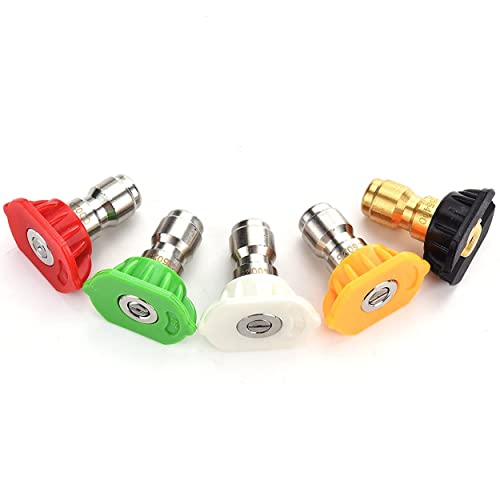
NOTE: Please see Image 6 and find the orifice you need based on working pressure and flow rate (GPM). The orifice of these nozzles are 2.5. Different angle allows you to clean hard-to-reach areas quickly and easily
Safety Tips: Avoiding Paint Damage With High‑Pressure Nozzles
If you keep the spray at the right distance and angle, you’ll prevent paint from chipping or blistering. Maintain 18–24 inches from painted panels and 12–18 inches from wheels, using a 25° or 40° nozzle to keep pressure between 1,200–1,900 PSI. Avoid 0° or turbo tips; they concentrate force and can strip variable paint finishes. Move the wand in smooth, sweeping motions, never holding the jet on one spot. Test on a low‑visibility area first, then work in sections, rinsing thoroughly. Use specialized car wash accessories—foam cannons or adjustable wands—to pre‑soak dirt, reducing the need for higher pressure. Stay clear of emblems, seals, and trim; any spider‑webbing or fading signals you’re too close.
Troubleshooting Common Car‑Wash Nozzle Issues and When to Swap
Maintaining the correct spray distance and angle protects paint, but even a perfectly positioned wand can be hampered by nozzle wear, clogging, or damage. If you notice an irregular spray, larger droplets, or reduced pressure, start by inspecting the orifice for erosion. Abrasion enlarges the opening, raises flow rate, and lowers pressure—classic signs of nozzle failure risks. Next, clear common nozzle contamination: grit, wax, or polish can block the tip. Use a pin or thin wire to dislodge debris; if the blockage persists, replace the injector. Look for cracks or scratches from drops or impacts; physical damage creates leaks and uneven patterns. Swap the nozzle when coverage drops, leaks appear, or cleaning after a thorough flush still fails. Follow manufacturer intervals to keep performance ideal. Matching the pressure to the siding’s condition ensures effective cleaning without damage, and optimal PSI ranges guide you in selecting the right setting. Selecting the proper spray pattern for your vehicle’s geometry helps achieve uniform coverage while minimizing overspray. Connecting a pressure washer to a garden hose requires compatible fittings to avoid leaks and maintain safe operation.