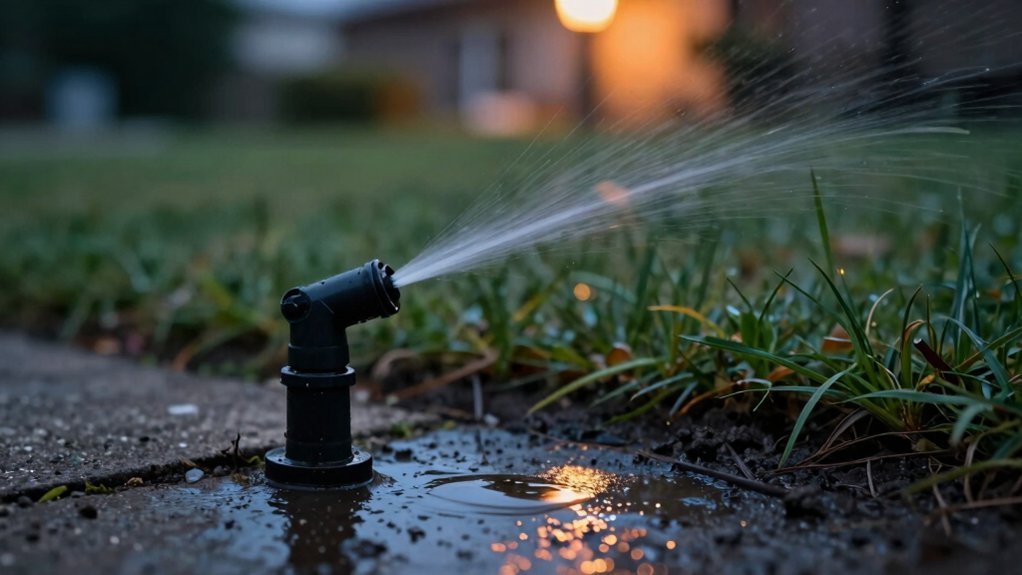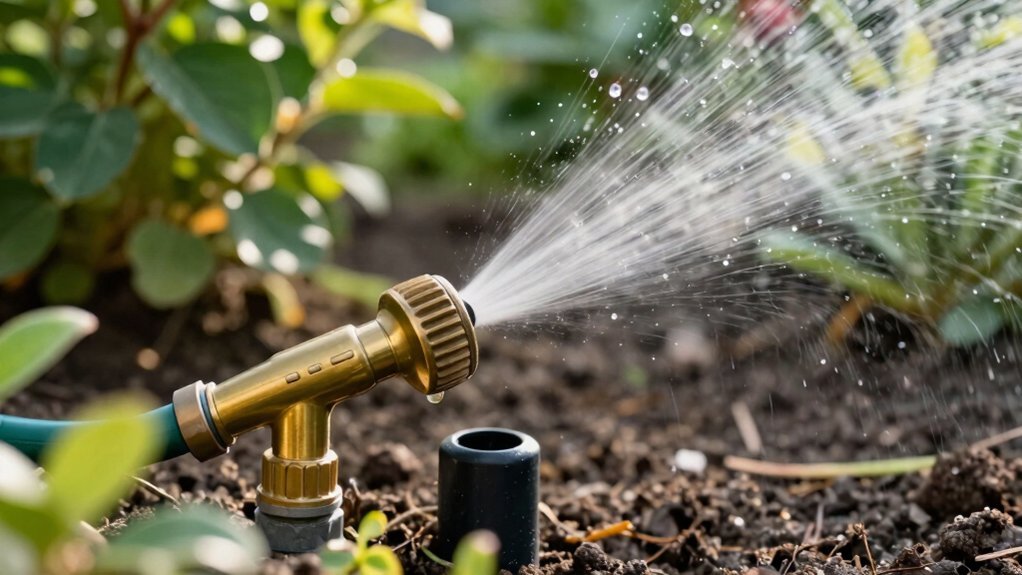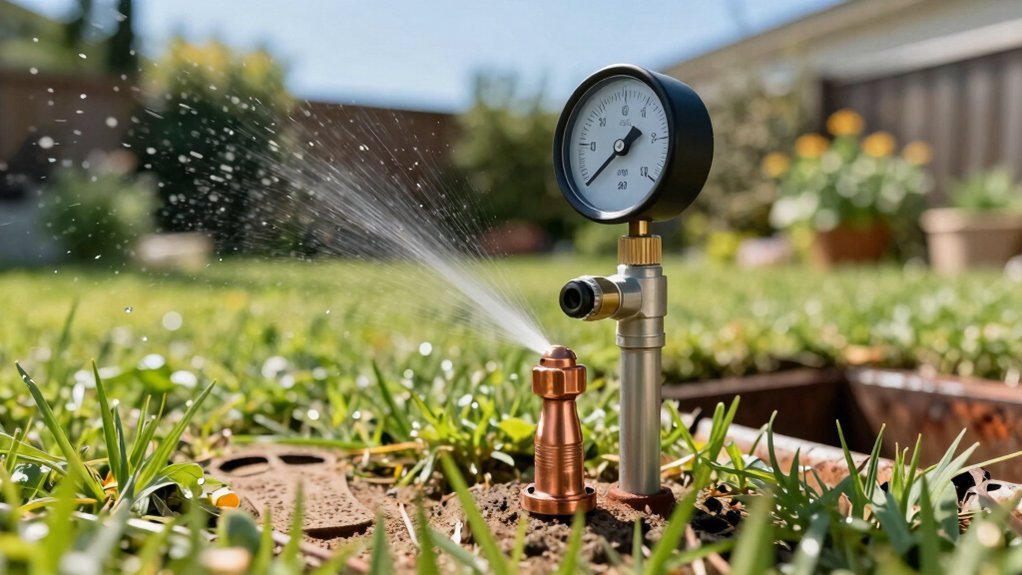
Match your garden’s size, layout, and slope to the right head: pop‑up or rotor sprinklers cover 7‑45 ft lawns with adjustable patterns; fixed spray works for small beds; impact heads need high pressure for large, uniform areas; drip or micro‑spray serve shrubs, vegetables, and low‑runoff zones. Check pressure—spray heads need ~30 psi, rotors 40‑50 psi, drip emitters ~20 psi—and use regulators or boost pumps as needed. For sloped or low‑drainage spots, position rotary heads at the crest, tilt downhill, and keep at least 30 psi. Continue to explore detailed sizing, flow calculations, and ideal spacing.
What Garden Sprinkler Types Exist and When Should You Use Them?
If you’re planning a garden irrigation system, you first need to know which sprinkler types are available and which situations suit each one. Pop‑up sprinklers rise on demand, protect heads from traffic, and offer adjustable spray patterns with radii of 10‑15 feet, making them ideal for optimal suitable lawn sizes between 7 and 45 feet wide, especially on irregular or curvilinear turf. Fixed spray sprinklers emit fan‑shaped streams—full, half, or quarter‑circle—at short to medium range, fitting small lawns or flat flower beds where precise, low‑profile coverage matters. Impact sprinklers rotate a weighted arm to produce a circular pattern, handling large, uniform lawns under higher pressure. Drip irrigation delivers water directly to roots via emitters, excelling in shrub rows, vegetable plots, and any area where evaporation reduction is critical. Micro‑spray and flood heads provide low‑volume mist or localized soaking for tree wells, planters, and sloped zones, using interchangeable nozzles to tailor flow to uneven terrain. Proper selection also depends on soil type to ensure water penetrates efficiently. The zone layout approach helps balance water distribution across varied plant groups and micro‑climates. Understanding water pressure is essential for matching sprinkler performance to system capabilities.
How Do Rotating, Oscillating, and Stationary Sprinklers Differ in Coverage?
Knowing the different sprinkler types helps you match a system to your garden’s layout, and the next step is to compare how rotating, oscillating, and stationary sprinklers cover an area. Rotating units spin two or more arms, creating a circular coverage area footprint up to 4,000 sq ft. Their precipitation pattern variation is a gentle, uniform spray that reaches corners less effectively, but the design negotiates obstacles and slopes with minimal runoff. Oscillating models sweep a rectangular fan back and forth, delivering an even footprint of up to 5,000 sq ft. Their pattern mimics rain, reducing pooling on seeded lawns and allowing width adjustments for narrow strips. Stationary sprinklers emit a fixed, spot‑size spray, ideal for small, unchanging zones where a precise, low‑volume footprint is required. Oscillating sprinklers provide gentle even water that reduces runoff and promotes healthy root development. Proper sprinkler head spacing ensures uniform coverage while conserving water.
Water Pressure & Flow Needs by Sprinkler Type
Understanding the pressure and flow requirements for each sprinkler type is essential for designing an efficient garden irrigation system. Spray heads need about 30 psi; anything lower shrinks radius, forcing tighter spacing, while above 40 psi creates mist. Use adjustment valves or built‑in regulators to keep distribution rates steady. Rotor sprinklers thrive at 40‑50 psi, with stream rotors tolerating lower pressures; boost pumps can compensate for weak mains. Drip emitters perform best near 20 psi, and pressures above 40‑45 psi risk breakage, so install pressure regulators in high‑pressure zones. Pop‑up heads operate ideally at 30‑40 psi; excess pressure generates mist clouds and distorted patterns, requiring in‑line regulators if static pressure exceeds 40 psi. Design pressurized zone dividers and custom sprinkler circuits to balance flow, keep velocity under 5 fps, and minimize friction loss across varying pipe diameters. Ideal pressure range for most sprinklers is between 40 and 60 PSI. Proper pipe sizing and elevation changes also affect system resistance and can limit overall performance.
Which Sprinkler Types Match Your Pressure Range?
Your garden’s irrigation efficiency hinges on matching each sprinkler type to the available pressure range. For low pressure (15‑40 PSI), use stationary heads or bubblers; stationary units cover small zones, while bubblers deliver a 5‑foot radius spot spray at 20‑90 PSI. Keep spray heads at 30 PSI and install pressure regulating stems if you exceed that limit to guarantee that misting is avoided. In the medium band (40‑60 PSI), rotary and oscillating sprinklers provide even distribution; rotors need about 45 PSI for a 17‑foot radius, and spray rotary heads perform best above 30 PSI. High pressure (60‑80 PSI) favors impact and traveling models; impact sprinklers resist wind and minimize evaporation, while turf rotors handle up to 1.5 in/hr. Apply sprinkler pressure regulation and sprinkler performance optimization to ascertain that each zone operates within its ideal range. Rotors are available in common heights of 4″, 6″, 12″ and are ideal for lawns. Modern systems often incorporate flow dynamics sensors to continuously adjust water delivery for optimal efficiency. Understanding the solenoid function helps diagnose why a valve may not open or close correctly. Proper pump sizing ensures sufficient flow when elevation changes or large zones exceed the capacity of the municipal supply.
Select the Right Garden Sprinkler for Sloped or Low‑Drainage Areas
When you install sprinklers on a slope or in a low‑drainage zone, choose rotary heads that emit slow, stream‑like water rather than fine mist; rotary units such as Rain Bird R‑VAN or MP Rotator deliver even coverage while limiting runoff. Position each head at the slope’s crest, tilt it slightly downhill, and use 6‑ or 12‑inch pop‑up risers to protect hardware and preserve aesthetics. For low‑angle trajectories, space heads closer together and set nozzles vertically to the slope to reduce wind drift. Installation considerations include maintaining a minimum of 30 PSI and aligning heads at a 45‑degree angle mid‑slope. These configurations lower maintenance needs, because fewer clogs and less erosion occur, and they maximize water efficiency on slow‑draining soils. Use a long hose to reach remote sections of the irregularly shaped yard. Properly calculating sprinkler head spacing ensures uniform water distribution across varying terrain. Adding a connector kit can simplify joining multiple hose sections while preserving flow rate.
Impact/Impulse Sprinklers: Best‑Fit Scenarios & Drawbacks
Rotary heads work well on slopes, but for open, obstacle‑dense yards or large fields, impact (or impulse) sprinklers outperform them. You’ll appreciate their 360° rotation, adjustable arc, and diffuser‑pin control, which let you target rectangular lawns, sports grounds, or agricultural plots while sparing trees and play sets. Metal heads survive harsh climates, and the simple valve‑lever design minimizes impact sprinkler maintenance needs compared with complex rotary units. However, the limitations of impact sprinklers include higher pressure requirements, potential overspray on delicate beds, and the need to fine‑tune friction collars for precise coverage. Adjust the deflector shield and water‑flow regulator to match plant tolerance, and schedule periodic checks of the pins and seals to prevent clogging and maintain efficiency. Impact heads provide maximum water coverage for large areas. The valve’s water pressure trigger is essential for opening the sprinkler head and creating the spray. The nozzle’s ability to convert pressure energy into kinetic energy follows Bernoulli’s principle. Adding a nozzle‑type comparison clarifies why nozzles shape flow while valves control passage.
Bubblers: Deep‑Root Watering for Garden Beds and Trees
If you need to deliver large volumes of water directly to the root zone of trees, shrubs, or deep‑rooted perennials, bubblers are the most efficient choice. They emit a concentrated stream at the soil surface, typically 2 gallons per minute, far exceeding single drip emitters. This high flow rate penetrates deep into the root ball, minimizing runoff and maximizing uptake. Use adjustable‑flow or pressure‑compensating models for trees and shrubs, and micro‑bubblers when integrating with drip irrigation compatibility. Design a dedicated zone for each bubbler group to avoid simultaneous activation with lawn sprinklers; this isolates water volume and frequency. Position 1‑4 bubblers per mature tree, spacing them evenly for uniform moisture distribution. The system excels in targeted watering applications for woody plants, flower beds, and containerized perennials. Proper design ensures optimal pressure differential for efficient water delivery. Modern controllers can incorporate soil moisture sensors to further reduce waste and only water when the ground is dry. Implementing a smart controller can automatically adjust watering schedules based on real‑time weather data, further enhancing water conservation.
Wing Sprinklers for Low‑Pressure, Water‑Conserving Gardens
Because wing sprinklers operate efficiently at just 15‑30 PSI, they let you water large garden zones while keeping pump size and energy use low. Their low‑pressure design cuts horsepower demand, often halving energy consumption and saving thousands of dollars annually. Larger, wind‑resistant droplets reduce evaporation and drift, delivering over 95 % uniformity and minimizing runoff. Coverage ranges from 50 sq ft to 380 sq ft, with flow rates of 5‑34 gph, allowing you to match head size to garden layout and water‑availability constraints. These characteristics provide clear water conservation benefits by directing more moisture to root zones and limiting waste. The resulting environmental sustainability impacts include lower water extraction, reduced chemical leaching, and diminished carbon emissions from smaller pumps. Understanding sprinkler timer operation helps you synchronize watering cycles with plant needs for maximum efficiency. Efficient scheduling can also lower your water bill by aligning usage with off‑peak water rates periods. Proper timing prevents over‑watering that can lead to fungal diseases.
Final Checklist: Choose the Perfect Garden Sprinkler for Your Space
A solid final checklist starts by confirming that your sprinkler’s coverage pattern, pressure requirements, and soil compatibility align perfectly with your garden’s dimensions and terrain. Verify that the chosen head—rotary for odd shapes, oscillating for rectangles, or spray for borders—matches the assessed area and that the pressure range (15‑30 PSI) meets the model’s specifications. Guarantee soil type and slope are compatible: rotary for slopes, bubblers for level beds, and avoid uneven terrain with low‑flow heads. Review cost savings considerations by selecting eco‑friendly nozzles and smart controllers that reduce water use up to 50 %. Confirm seasonal maintenance requirements, including pressure testing, nozzle cleaning, and zone adjustments before winter. Document zone separations, model compatibility, and any required accessories to safeguard reliable, efficient irrigation.