Yes, you can hook a foam cannon straight onto a standard garden hose; just twist the hose’s threading onto the cannon’s nozzle, hand‑screw the canister, and seal with the brass fittings. Use a 2‑4 oz soap dose in a 32‑oz bottle—concentrated, pH‑neutral car soap works best—and adjust in 0.5 oz steps for desired foam consistency. Turn the volume knob and density dial to fine‑tune output, and point the nozzle for ideal coverage. This setup leverages the hose’s 40‑60 psi flow and venturi effect, delivering dense suds without a pressure washer, and the next sections will show you how to maximize performance.
How to Attach a Garden‑Hose Foam Cannon
Ever wondered how quickly you can get a garden‑hose foam cannon ready for use? You start by screwing the hose’s standard threading into the cannon’s nozzle, a connection that’s universal across brands. This understanding installation process takes seconds and requires no tools; the brass fittings seal securely, resisting corrosion while handling typical residential water pressure. Next, attach the canister head by hand‑screwing the bottom of the canister onto the head, then seat the top attachment firmly to prevent leaks. Guarantee the dial is set to your desired foam thickness, then verify that the water supply pressure is optimized—usually 40–60 psi—to maintain consistent spray and internal pressure throughout operation. Always check the pressure rating of your garden hose before connecting to avoid exceeding its limits. Additionally, ensure the hose’s maximum pressure rating exceeds the pressure washer’s output to prevent rupture. Remember that longer hose lengths can cause pressure loss which may affect foam quality.
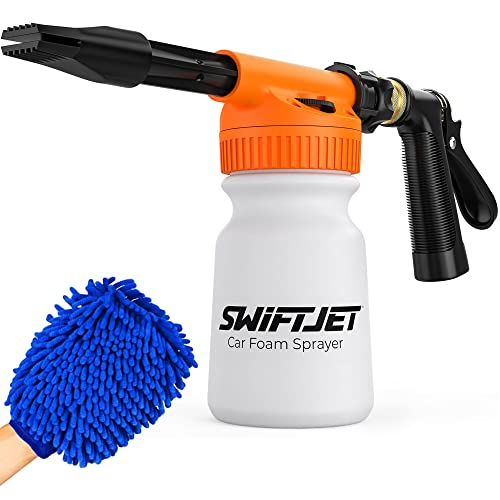
FOAM CANNON PERFORMANCE — NO PRESSURE WASHER REQUIRED Turn your standard garden hose into a powerful foam blaster. This easy-to-use car wash foam gun attaches in seconds—no pressure washer, no extra tools—making it one of the simplest and most effective car cleaning products for home use.

COMPLETE CAR WASH FOAM GUN KIT: Upgrade your home car wash with this all-in-one car wash foam gun kit. It includes a foam cannon for garden hose, microfiber wash mitt and multi-mode sprayer. Everything you need to create thick foam and safely clean your vehicle at home.

ADJUSTABLE FOAMING CAR WASH SETTINGS - Features a foam ratio dial for customizable sud levels, ideal for any car wash kit; choose from light rinse to thick to suit your cleaning needs for cars, wheels, glass, and trim
Choosing the Ideal Soap‑to‑Water Ratio
A typical starting point is 2 – 4 oz of soap mixed into a 32‑oz bottle, then topped off with warm water; this ratio yields a balanced foam that adheres well without diluting the soap’s surfactant power. When you choose a soap brand selection, prioritize concentrated, pH‑neutral, high‑sudsing car soaps that dissolve completely in warm water. Measure precisely; a 3 oz soap dose works for most garden‑hose cannons, then tweak based on water hardness and pressure. For foam consistency adjustment, increase soap in 0.5 oz increments if the foam appears watery, or reduce by the same amount if it becomes overly thick. Always shake the mixture thoroughly and verify that the filter is clear to maintain ideal output. Proper dilution saves both time and money. Turbo nozzles provide finer coverage and can enhance foam distribution over larger areas. Ensure the hose pressure stays within the recommended range for snow foam concentrates to avoid excessive dilution and maintain optimal foam density. The spray pattern of a nozzle determines how evenly the foam is applied across a surface.

Maxi-Suds II Soap (CWS_101_64SW) - High foaming car wash soap for foam cannons produces thick suds that safely lift dirt and grime; perfect for use with foam cannons, foam guns, or traditional bucket washes

Powerful cleaners lift away dirt and road grime

[Car Soap]: One gallon bottle of Armor All All Purpose Car Wash has thick, foaming suds that lift away dirt and road grime
Adjust Foam Density and Volume on Your Garden‑Hose Foam Cannon
Two key controls dictate how much foam you get and how thick it is: the foam‑volume knob on the nozzle top and the density dial near the mixing chamber. Turn the volume knob clockwise to increase output, moving from thin suds toward a thick, shaving‑cream‑like texture. For foam texture customization, set the density dial to its maximum; the pickup tube’s angled cut prevents blockage while you push the foam to its most concentrated state. Use the nozzle pointing technique to orient the spray pattern: twist the nozzle near the mixing chamber for vertical or horizontal coverage, then adjust the fan angle clockwise for a narrow stream or counter‑clockwise for a wide fan. This combination lets you fine‑tune both volume and density for ideal cleaning performance. Regular rinsing before applying foam helps lift heavy dirt and makes the foam more effective. The psi and gpm of your garden hose determine how much pressure the foam cannon can generate. Maintaining a pressure within the optimal range of 40–80 psi ensures consistent foam quality and coverage. Hose diameter also influences the flow rate, with larger diameters allowing more water to pass through for richer foam production.

FOAMY CAR WASH: The F3 Foam Gun transforms liquid soap into a foamy wash. Spray and rinse for a fun and easy car wash. This gun attaches to any garden hose for a professional grade car wash from home.

Fast and Easy: Armor All 2-in-1 car soap foam sprayer kit features a car wash foam cannon for pressure washer that achieves high-foaming results to maximize suds with intense cling to make car washing faster and easier for vehicle owners

6-Level Dial Adjustable Foam Gun: Our foam cannon garden hose features adjustable foam settings with 5 foam levels and 1 rinse level, giving you complete control over the foam output. For optimal performance, we recommend following the manufacturer's dilution instructions. Equipped with a 32oz bottle made of premium thick plastic, this durable and versatile car soap foam gun can be used for various applications and allows you to customize the foam output to suit your specific needs.
Why This Foam Cannon Works Without a Pressure Washer
Because the cannon relies on the garden hose’s 40‑60 PSI flow and the venturi effect, it can generate usable foam without a pressure washer. The venturi constriction accelerates water, creating a low‑pressure zone that draws soap into the stream and aerates it as it passes the mixing chamber. This mechanical agitation produces a stable lather using only household water pressure, eliminating the need for electricity or a pump. You benefit from cost effective cleaning because the system uses a standard hose and inexpensive high‑foam soap, while the adjustable nozzle delivers a convenient application that covers a vehicle in a single, steady pass. The design maintains sufficient foam density to loosen dirt despite the lower pressure compared with professional washers. Understanding Bernoulli’s principle helps explain how the pressure drop in the venturi draws in soap. Continuity equation ensures that the increased velocity through the nozzle corresponds to a proportional decrease in pressure. The nozzle geometry determines how much the flow is restricted, directly affecting the pressure reduction and resulting foam quality.

【Professional Grade Foam Sprayer】: The foam cannon for hose is made of high-quality ABS material. It has a large capacity, is long-lasting, and is sturdy. Professional foam spraying technology makes car washing fast and easy. It's a good partner for car cleaning.

CAR PRO’S SECRET: Every car professional knows that using a car wash foam helps to carry dirt particles and grime gently away from paint or chrome surfaces, avoiding harmful scratching. The SwiftJet Foam Washing Gun turns any car wash into a foaming bubble party keeping your paintwork and chrome bling intact.

【High-Quality Materials】: The car wash foam gun is crafted from wear-resistant ABS material, featuring a sturdy texture and strong impact resistance. It can withstand collisions and water pressure during daily use, resisting damage or cracking, thus effectively extending its service life.
Key Limitations of Garden‑Hose Foam Cannons
Many users quickly discover that garden‑hose foam cannons fall short in several practical areas. The low‑pressure supply yields a runny foam that lacks the density needed for vertical adhesion, so you’ll see a thin liquid film rather than a shaving‑cream‑like coating. Inconsistent mixing performance arises because hose pressure fluctuates, forcing you to adjust soap‑to‑water ratios constantly and waste time refilling. The foam’s limited coverage area stems from its weak output, reducing dwell time and making it ineffective on large surfaces such as RVs or vans. Additionally, the device consumes excessive water and soap, depleting reservoirs after a single pass and increasing runoff. These constraints make the cannon unsuitable for heavy‑duty cleaning where thick, clinging foam and reliable coverage are essential. The pressure washer foam cannon also offers a adjustable fan width for broader surface reach. Selecting the correct nozzle can further improve foam density and spray pattern control. Understanding flow rate differences helps you choose a nozzle that maximizes foam output and efficiency.
Best Use Cases & Pro Tips for Maximum Foam Performance
You’ll get the most out of a garden‑hose foam cannon when you treat it as a pre‑soak and dirt‑encapsulation tool rather than a primary wash. Focus on thick, creamy foam to lift grime before you touch the paint; this maximizes foam cannon cleaning capabilities while reducing friction and swirl risk. Use high‑quality car‑wash soap at the manufacturer‑recommended 4‑5 oz per gallon ratio, and adjust the mix if the foam appears too light. Hose water pressure considerations are critical: moderate pressure (≈30‑40 psi) provides enough flow to generate dense suds without blasting the foam off too quickly. Apply foam section‑by‑section, especially on dark vehicles, and allow a 30‑second dwell time before rinsing. This technique guarantees consistent coverage, ideal lubrication, and superior paint protection. Selecting a hose with an appropriate pressure rating ensures the foam cannon operates within its optimal performance range. Understanding standard garden hose thread sizes helps you match the foam cannon securely to your hose and avoid leaks. Choosing the correct GHT size prevents cross‑threading and ensures a tight seal.
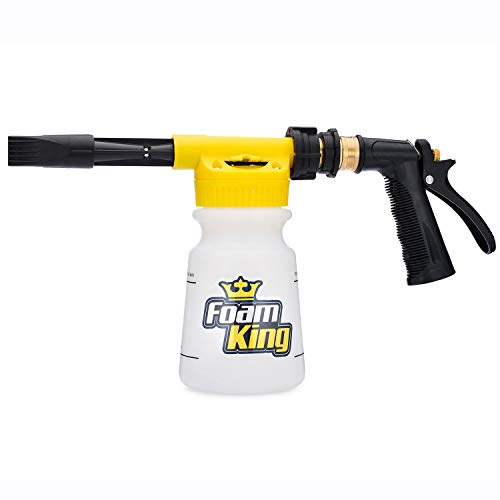
THE DETAILER’S CHOICE: The Foam King car wash foam gun for garden hose creates thick suds for a scratch free wash at home. Lift dirt safely while saving time and avoiding costly commercial washes.

Best Care for Car: Make your car cleaning uncomplicated with the Siapupy foam sprayer! Just turn the nozzle screw to easily remove dirt and grime from your vehicle, leaving it spotless and shiny in no time

Adjustable Snow Foam Lance with 1/4" quick connect fitting. 𝐍𝐨𝐭 𝐅𝐢𝐭 𝐆𝐚𝐫𝐝𝐞𝐧 𝐇𝐨𝐬𝐞, 𝐖𝐚𝐭𝐞𝐫 𝐇𝐨𝐬𝐞 𝐨𝐫 𝐘𝐨𝐮𝐫 𝐅𝐚𝐮𝐜𝐞𝐭 𝐃𝐢𝐫𝐞𝐜𝐭𝐥𝐲! This foam cannon must connect to a standard 1/4 inch quick connect pressure washer gun or wand to use. Must use with a pressure washer! Container Capacity: 1 Liter / 0.22 Gallon. Working Pressure: 1000 PSI to 3000 PSI