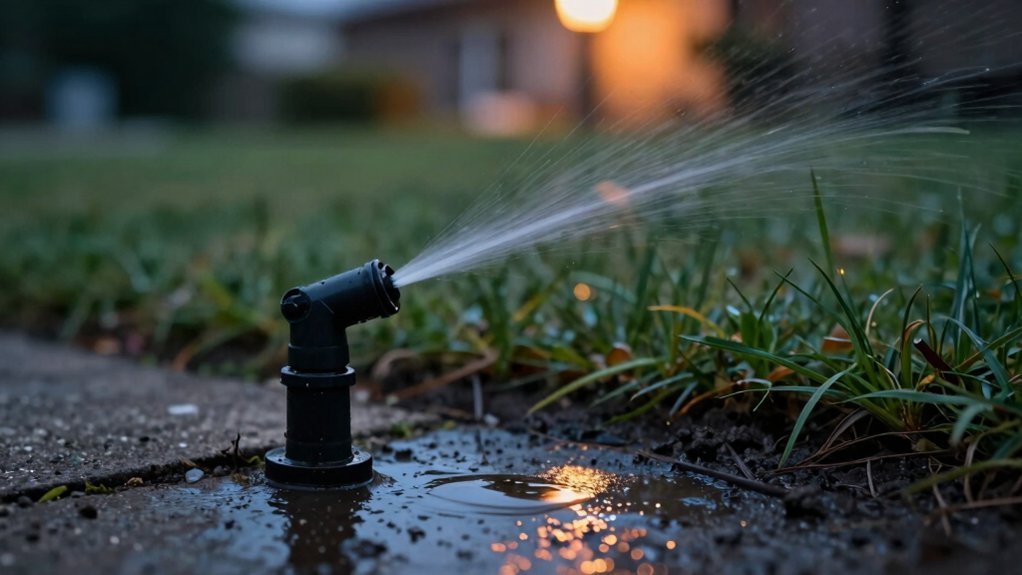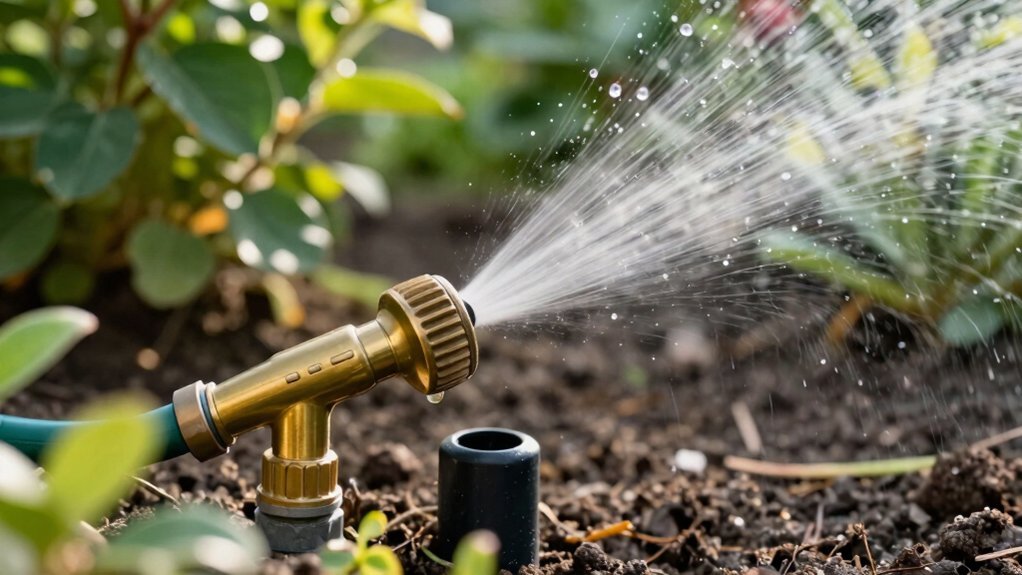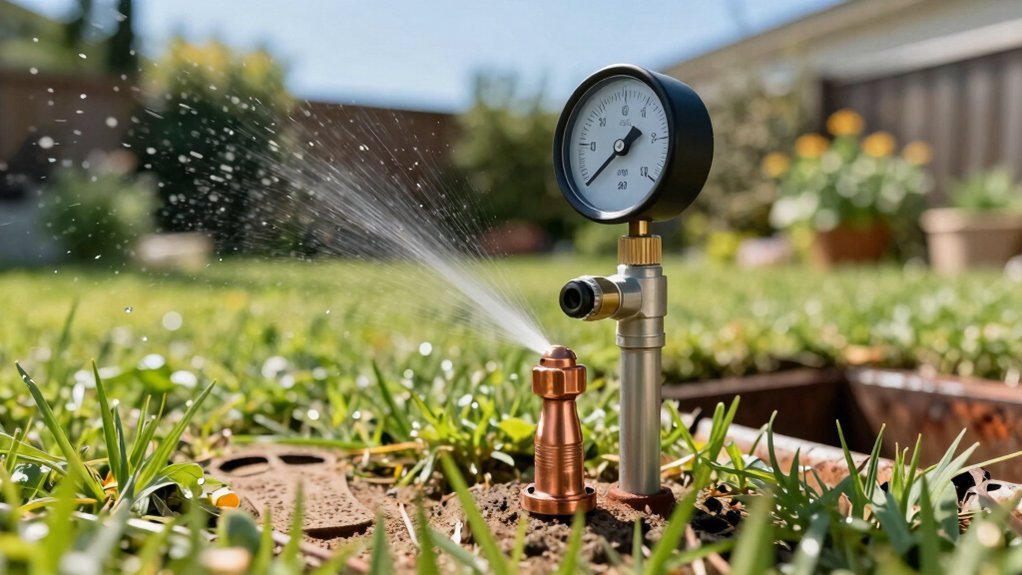
Your hose’s capacity hinges on its peak flow and pressure, the demand of each sprinkler, and friction losses from hose length and diameter. First, note the limiting pipe—½‑inch copper caps flow ~3.6 GPM, while ½‑inch CPVC bibs reach ~7 GPM. Divide that safe flow by each head’s GPM (standard pop‑ups ≤2 GPM, large rotors ≥6 GPM, Hunter PGP 1.5 GPM) and subtract sequentially until the remainder is non‑positive. Keep velocity under 5 ft/s to avoid turbulence, and remember longer, narrower runs increase pressure drop. If you follow the detailed steps, you’ll see how to calculate the exact number of sprinklers your hose can support.
Calculate Hose Maximum Sprinkler Capacity
The maximum number of sprinklers a hose can power is determined by the hose’s safe flow rate, which is set by the smallest‑diameter pipe or the bucket‑test measurement. You first identify the limiting pipe: a ½‑inch Type L copper pipe caps flow at 3.6 GPM, while a ½‑inch CPVC bib can reach 7 GPM under ideal conditions. Next, list each sprinkler’s GPM demand—standard pop‑up heads use ≤2 GPM, large rotors require ≥6 GPM, and a Hunter PGP rotor at 45 PSI draws 1.5 GPM. Divide the safe flow by each head’s demand, subtracting sequentially until the remainder is non‑positive. Guarantee sprinkler head placement avoids excessive run‑lengths that could amplify water hammer effects, which would otherwise reduce effective flow and damage the system. This calculation yields the maximum simultaneous heads you can safely run. Using friction loss charts can further refine the estimate by accounting for pressure drop along the hose. Understanding hose diameter impact on flow helps you select the appropriate size for your garden. Choosing the correct hose size ensures adequate flow rates for both residential lawns and commercial landscaping. Maintaining water pressure within the optimal 40‑80 psi range helps prevent performance loss and protects the hose from over‑pressurization.
Compare Flow Rate and Pressure Requirements
Understanding how flow rate and pressure interact is essential when sizing sprinklers, because a given pressure determines the velocity at which water can travel through a pipe, while the flow rate dictates how much water each head receives. You’ll notice that stationary heads need 2‑4 GPM at 30‑50 PSI, while rotating heads demand higher PSI to widen spray and boost rotation speed. Sprinkler nozzle optimization hinges on matching nozzle diameter to pressure: a 5 mm nozzle yields 10 GPM at 60 PSI and a 100‑ft radius, whereas a 12 mm nozzle pushes 60 GPM at the same pressure, reaching 175 ft. Sprinkler pressure dynamics also involve friction loss; velocity must stay below 5 ft/s to avoid turbulence that erodes usable pressure. Balance these variables to guarantee uniform coverage. Modern sprinkler systems often use PVC tubing to ensure reliable water delivery. Schedule 40 PVC is generally not approved for sprinkler use because it lacks the necessary pressure rating and certification. Properly sized backflow preventer helps protect water quality by stopping reverse flow. Selecting the correct pump requires calculating the total system head, which includes elevation, friction, and pressure requirements. Hydraulic head is the key metric for matching pump capacity to the irrigation layout.

【High Quality Plastic】Our garden lawn sprinkler uses high quality engineering materials, not easy to break, more durable - aging resistance.They also do not clog as easily as others.

With large diameter nozzle design, our water sprayer heads have larger water output and strongers which has powerful effect.
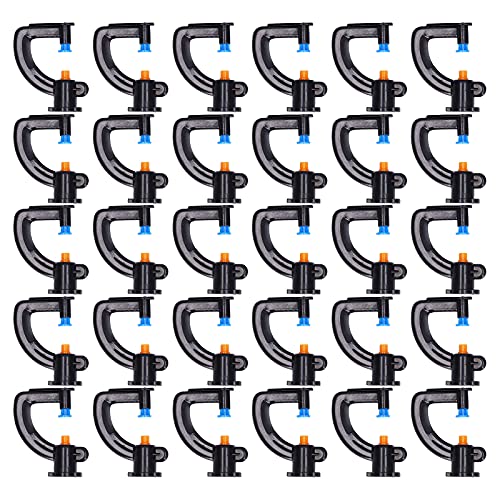
Widely Used: Spray with a diameter of 1.8 meters/5.9 feet. The sprinkler head is suitable for efficient cooling and irrigation in agriculture, gardens, terraces, greenhouses, backyards, atomization cooling, and anywhere needed.
Determine Typical Sprinkler GPM Needs
Typical sprinkler GPM needs hinge on head type, nozzle size, and desired coverage radius, so you’ll first catalog each head’s specification—stationary heads usually require 2‑4 gpm at 30‑50 psi, while rotating heads can demand 10 gpm (5 mm nozzle) up to 60 gpm (12 mm nozzle) at 60 psi. Next, calculate sprinkler head density by dividing total heads in a zone by the irrigated area; higher density raises cumulative GPM. Use the bucket test or a flow meter to verify individual head flow, then sum the values for the zone. Apply runtime adjustments: if pressure drops, increase runtime to maintain volume, but keep total daily gallons within the 1,920‑gal benchmark for six 15‑minute zones. This precise accounting guarantees each hose supports the intended head count without over‑pressurizing the system. The bucket test provides a quick way to measure available water flow at the source. Properly accounting for system pressure ensures the hose can sustain the calculated demand. Remember to secure connections with plumber’s tape to prevent leaks. The Bernoulli principle explains how pressure and velocity interact within the hose, influencing flow rate.
How Pipe Size and Length Affect Hose Capacity
After cataloging each sprinkler’s GPM requirement, you’ll see that the hose’s ability to deliver that flow hinges on its size and length. You must calculate ideal pipe size by balancing cross‑sectional area against friction loss. A 2‑inch pipe at 150 ft carries roughly 13 GPM, while a 1‑inch pipe drops to 8 GPM over the same distance because velocity rises and Darcy‑Weisbach losses increase. Below 50 ft the pressure drop effects are negligible; beyond 100 ft they accelerate, especially in narrow hoses. Use the Hazen‑Williams or Darcy‑Weisbach equations to quantify loss per foot, then select a diameter that keeps head loss within pump capacity. Larger diameters reduce velocity, lower friction, and preserve flow for long runs. A 4‑inch pipe can fit 16 1‑inch pipes and thus provides a dramatically higher flow capacity. Choosing a hose with a higher pressure rating ensures it can safely handle the pump’s output without bursting. Properly timed valves and sensors can further optimize flow distribution by regulating pressure throughout the system. The nozzle’s conversion of pressure energy into kinetic energy illustrates the Bernoulli principle that underlies these flow dynamics.

ANKA SERIES FITTING: Designed for use with all ID (inside diameter) rated pipe, ANKA Series fittings are high pressure inserts that can be used on poly pipe, clear or braided hose, and garden or wash down hoses. They are constructed from high performance materials approved for use with drinkable water.

Package: 1pc. Size: Threaded inner diameter: 25mm. Threaded outer diameter: 26.5mm inner diameter. Thread type: G3/4 (BSP). Suitable for 3/4 inch pipe. NOTE: Not suitable for standard NPT garden hose. Please verify the product SIZE and TYPE before buying.

Precision Dual-Scale with Peak Memory: This pressure meter measures 0-200 PSI/0-14 Bar with ±2-1-2% accuracy (ASME B40.1 Grade A). Red max pointer tracks and retains peak pressure spikes, easily reset for monitoring faucets, spigots, or hydraulic systems.
Measure Spigot Output With a Pressure Gauge
A reliable pressure gauge attached to your spigot lets you quantify the exact water pressure feeding your irrigation system. Choose a gauge with female hose threads, a rubber gasket, and a 300 PSI capacity. Turn off all interior and exterior fixtures, then connect the gauge by hand to the nearest hose bib; tighten with pliers if leaks appear. Open the faucet fully, let the needle settle, and record the stabilized reading. Use the black hand for current pressure and the red hand for peak pressure tracking; leave the gauge installed for 48 hours to capture surges up to 70 PSI. Take multiple readings at different times to assess seasonal pressure variability, noting the lowest value for sprinkler calculations. Ideal home pressure lies between 40–60 PSI; values above 80 PSI demand a regulator. Pressure spikes can cause pinhole leaks in pipes. Check for kinks before attaching the gauge to ensure accurate readings. Selecting the proper gauge size helps match the flow rate requirements of your sprinkler system. Regularly inspect the gauge for corroded connections to maintain accurate measurements.
Determine Maximum Sprinklers Supported by Your Hose
How many sprinklers you can run from a single hose hinges on the hose’s flow capacity and the individual nozzle demand. First, identify the hose’s maximum safe flow: a 1/2″ Type L copper pipe caps at 3.6 GPM, a 1/2″ CPVC bibb reaches 7 GPM, and a 1‑inch line can deliver 15 GPM. Next, list each sprinkler’s GPM—standard pop‑up heads ≤2 GPM, Hunter PGP rotors 1.5 GPM, larger rotors ≥6 GPM. Divide the hose’s safe flow by the individual GPM to get the simultaneous count, ensuring the remainder stays positive. Use at least 5/8″ hose, preferably 3/4″ poly, for adequate pressure equalization and ideal sprinkler placement. Verify that static pressure (≈40 PSI) and dynamic pressure losses keep each head within its performance chart limits. Multiple hose connections further reduce pressure, so keep the total length reasonable. Proper water‑rate awareness helps you balance usage with cost. Zone‑based design ensures each area receives water according to its specific needs.

Tubing Details - Black vinyl tubing, 1/2 inch (12.7mm) inner diameter, 5/8 inch outer diameter, wall thickness 1/16 in, 100 feet length. Working temperature: 23°F to 149°F (-5°C to 65°C), Hardness: 73A (firm), Max working Pressure: 60PSI. Can be used for low pressure applications.

Tubing Details - Black vinyl tubing, 1/2 inch (12.7mm) inner diameter, 5/8 inch outer diameter, wall thickness 1/16 in, 100 feet length. Working temperature: 23°F to 149°F (-5°C to 65°C), Hardness: 73A (firm), Max working Pressure: 60PSI. Can be used for low pressure applications.

Complete 240FT Drip Irrigation Kit - The garden irrigation system includes 40FT of 1/2" main tubing, 200FT of 1/4" distribution tubing, and 143 essential components. You can customize the setup to fit your garden layout, covering up to 250 sq. ft. or split into two areas of 120 sq. ft. each
Split the Flow: When Two Hoses Outperform One?
When you split a single hose into two branches, each branch inherits roughly half the original flow, so the pressure at each sprinkler drops and its coverage radius shrinks. To avoid that loss, you can adopt hose arrangement alternatives that employ two parallel hoses instead of a single split. A pressure equalization strategy across the two lines preserves the original GPM per hose, delivering full‑rated flow to each sprinkler. In practice, a single 8 GPM hose split yields two 4 GPM streams, while two 4 GPM hoses maintain the intended pressure, doubling effective capacity without increasing mechanical strain. Dual hoses also reduce energy consumption and mitigate negative pressure effects, though they add weight, complexity, and modest cost. This configuration excels for large areas where consistent coverage and efficiency outweigh the added logistical considerations. Using two‑wire hoses further improves durability and longevity. Additionally, selecting a larger‑diameter hose for longer runs helps maintain adequate flow despite increased friction loss. The friction loss increase with hose length can be mitigated by minimizing bends and using smoother‑material hoses.
Match Pump Specs to Your Hose’s Capacity (1 HP vs. 1.5 HP)
Three key factors—pump horsepower, total dynamic head (TDH), and cumulative sprinkler flow—determine whether a 1 HP or 1.5 HP pump will meet your hose’s capacity. First, calculate hose sizing factors: add depth, lift, and required pressure (40‑60 PSI adds 92‑139 ft) to get TDH. Next, sum the flow rates of every sprinkler in each sprinkler system zone; a 1 HP pump sustains 8‑12 GPM at 200 ft TDH, while a 1.5 HP unit delivers 25‑55 GPM at comparable heads. Compare this total GPM to the pump curve. If your zones require 12‑15 GPM each and TDH exceeds 200 ft, the 1.5 HP pump is necessary; otherwise, a 1 HP pump suffices, avoiding oversize and excess energy use.

Optimal Suction and Discharge: MAX.Q 4250 GPH, Max Head 108 ft, With a 2" NPT suction and a 1-1/2" NPT discharge, the jet pump offers optimal water flow for various irrigation requirements, ensuring your lawn remains lush and green

BUILT TO LAST: Rugged cast iron pump housing and glass-filled thermoplastic impeller for well water and lake water

High-Flow Performance: This shallow well jet pump delivers up to 4250 GPH with a powerful 1.5 HP motor, ideal for large-area irrigation and fast water refilling. With 25 ft max suction lift and NPT 2 in inlet, it draws water quickly and boosts efficiency
Reference Table: Sprinklers per Hose for Common Setups
Matching pump horsepower to hose capacity gives you the baseline for how many sprinklers you can attach, and the reference table translates those limits into concrete configurations. In a 1 HP setup with a 5/8″ hose, you can safely run up to three 1 GPM spray heads, six 0.5 GPM pop‑ups, or two 3 GPM impact units, respecting a 40 PSI pressure drop. A 1.5 HP system with a 3/4″ poly pipe expands capacity to four 1 GPM spray heads, twelve 0.5 GPM pop‑ups, or three 3 GPM impact units. For rotor sprinklers, limit to two Hunter PGP units at 1.5 GPM each. Apply sprinkler system zoning and maintain proper sprinkler head spacing—head‑to‑head overlap of 10‑15 %—to guarantee uniform coverage and avoid exceeding flow limits. During the transition to fall, humidity levels drop which helps maintain consistent water pressure across the system.