You’ll find Harbor Freight’s gas‑powered washers paired with 0° high‑pressure tips for stubborn concrete, 15° and 25° fan‑tips for moderate jobs, and 40° wide‑spray heads for delicate surfaces, plus a 5‑in‑1 adjustable nozzle that switches angles and adds soap mode. Match your unit’s PSI/GPM—3200 PSI/2.8 GPM works best with 15°‑25° tips, while 4400 PSI/4.2 GPM handles 0° or 10° turbo nozzles for heavy‑duty cleaning. Quick‑connect collars let you swap safely, and proper maintenance keeps pressure consistent. Keep going to uncover which nozzle excels on concrete, brick, welds, and soap‑up.
Harbor Freight Gas‑Powered Pressure Washer Nozzle Types
When you pick up a Harbor Freight gas‑powered pressure washer, the nozzle you attach determines both pressure and coverage. You’ll find zero‑degree tips for peak pressure, fifteen‑degree for moderate pressure with wider reach, twenty‑five‑degree for low‑pressure, broad spray, and forty‑degree for the widest pattern. Each tip is color‑coded for quick‑connect swapping. The five‑in‑one adjustable nozzle lets you shift among these unique spray angles and even switch to soap mode, which pairs with the on‑board detergent tank accessories for efficient cleaning. Turbo nozzles, sold separately, deliver turbo‑pressure while covering an area comparable to a twenty‑five‑degree tip, ideal for concrete, brick, and pavers. All quick‑connect kits fit standard wands and support washers up to 2300 PSI. Zero degree nozzles are red and deliver the maximum pressure. Selecting the proper nozzle ensures you stay within the recommended pressure range for each cleaning task. Use a hose with a pressure rating that matches your washer’s PSI to avoid failure. Choosing the right nozzle also helps protect delicate paint surfaces from excessive force.
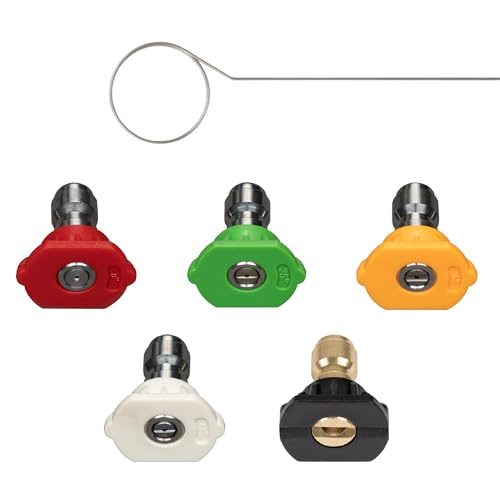
FIVE HIGH-PERFORMANCE NOZZLES: Includes 0° (red) for pinpoint blasting, 15° (yellow) for heavy-duty stripping, 25° (green) for general cleaning, 40° (white) for gentle rinsing, and a black soap applicator for detergent application

【Pressure Washer Nozzle Tips】Pressure up to 4500 PSI, 1/4-inch quick connect, 2.5 orifice size, 2.5GPM, adjusts 5 different cleaning angles.

QUICKLY SWITCH BETWEEN JOBS: 6-in-1 design allows you to seamlessly switch between standard rinse, soap, 0°, 15°, 25°, and 40° nozzles, speeding up cleaning when multiple uses are needed
Choosing the Right Nozzle for Your Gas‑Powered Washer (PSI & GPM)
Choosing the right nozzle for your gas‑powered pressure washer hinges on matching its PSI and GPM to the spray angle you need. If you run a 3200 PSI, 2.8 GPM unit, stick to nozzles rated at or below 3300 PSI and pick a 15°‑25° tip for residential surfaces. For the 4400 PSI, 4.2 GPM commercial model, a 0° or 10° nozzle maximizes force on stubborn grime, while a 40° tip safeguards delicate paint. Check each nozzle’s detergent types rating—some support foam‑based cleaners, others only water. Use the quick‑connect rotation to switch angles on the fly; the 5‑in‑1 kit lets you spin from 0° to 40° without swapping tools, preserving pump life and ensuring ideal coverage. The washer comes with a high‑altitude carburetor jet that optimizes fuel delivery for better performance at sea level. This conversion follows Bernoulli’s principle where pressure drops as velocity increases. Proper nozzle maintenance reduces pressure loss caused by surface roughness and wear. Understanding momentum change helps predict the thrust generated by different nozzle sizes.
Turbo Nozzles: Faster Cleaning Explained
A turbo nozzle turns a razor‑thin 0° water jet into a high‑speed spinning cone, delivering up to ten times the cleaning power of a standard flat‑fan tip. The internal ceramic ball or steel pin spins the jet at 3000‑5000 RPM, turning a pinpoint stream into a conical spray that covers 25° while preserving cutting force. This rapid rotation creates a pulsating action that chisels grime, boosting cleaning performance dramatically. Internal stabilizer vanes keep the spray pattern stability tight, so you hit the surface uniformly without constant repositioning. Use it on patios, driveways, or heavy‑duty equipment, start at a safe distance, and match the pressure to your washer’s PSI range for ideal results. The turbo nozzle is rated at 3,600 PSI and provides a pulsating action to the spray pattern. Maintaining consistent pressure throughout the nozzle ensures steady, uniform flow and minimizes turbulence. Understanding spray pattern dynamics helps you select the optimal nozzle for each cleaning task. Proper nozzle selection is essential for uniform coverage and minimizing waste.
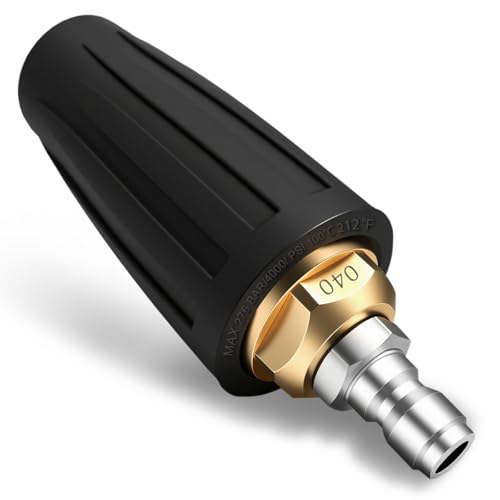
Durable Material: This pressure washer turbo nozzle crafted with a premium ceramic core, Durable rubber housing, And robust stainless steel, Which is built to last. This turbo nozzle stands up to high pressure without wearing down or clogging. It stands out among power washer nozzles for heavy-duty tasks

Wide Applicability: Pressure washer rotating nozzle can be used in most of the high pressure cleaner. Great for rust removal, metal or plastic tank cleaning, boat cleaning, cleaning dirty garage floors, stripping paint from wood exterior, and removing mud and clay from highway and construction equipment

【CLEANS LIKE MAGIC】Transform your cleaning routine with Yupjlia’s pressure washer turbo nozzle! Its rotating jet pattern increases cleaning power by hitting surfaces from multiple angles, breaking up stubborn stains more effectively than standard nozzles. The rotating motion helps water reach cracks and crevices, making hard-to-reach areas easier to clean. A must-have for any pressure washer setup.(NOTE: THIS NOZZLE CAN NOT CONNECTED WITH HOSE DIRECTLY)
Best Nozzle for Concrete, Brick, Welds, and Soap‑Up
If you need a single nozzle that handles concrete, brick, welds, and soap‑up, pick a versatile, low‑pressure fan‑tip with interchangeable tips. This fan‑tip works for surface cleaning techniques on concrete, delivering a 5‑ or 15‑degree pattern for spot work while a 9‑pattern spread lifts dirt without etching. Swap to the low‑pressure brick nozzle—255‑degree spread, gentle on masonry, and ideal for stucco or efflorescence. For weld prep, attach the solid copper alloy tip; its conductivity and size markings give reliable contact on welded seams. Finish with the 9‑pattern car‑wash nozzle that doubles as a soap dispenser, applying even foam on patios or vehicles. These interchangeable heads provide versatile nozzle applications, letting you tackle every material without changing equipment. Porter, Texas location ensures quick access to these supplies. Nozzle size directly influences flow speed, with larger diameters allowing higher volume delivery. Understanding nozzle inches per hour helps match flow rate to pressure for optimal performance. Nozzle geometry determines how the fluid is shaped and directed, affecting both coverage area and cleaning efficiency.

Package included 2pcs 1/4' fan nozzles.

Flat Fan High Pressure Washer Spray Tip - 1/4BSPT Male Thread 304 Stainless Steel Nozzle - 65 Degree 2mm Orifice Diameter - Easy to Install

Technical Specifications: Flat fan spray tip features a 6 mm inner diameter, 15 mm maximum diameter, 11 mm height, 110° spray angle, 0.18-0.37 GPM flow rate, and 30-60 PSI operating pressure for consistent performance
Installing, Maintaining, and Swapping Quick‑Connect Nozzles Safely
The versatile fan‑tip you just learned about works best when its quick‑connect collar is locked securely, so start every job by turning the power off, pulling back the collar, and pushing the nozzle onto the wand until it clicks. Before each use, inspect all connections, hand‑tighten the wand in the spray gun outlet, and guarantee the high‑pressure hose is fully seated. When swapping nozzles, power the unit off, release the trigger, pull back the collar, remove the old tip, and push the new one on, confirming the click. Periodically clean the filter and tip with a non‑metallic tool. For O‑ring replacement techniques, use a straight pick to extract the old ring, seat a new one with a flat tool, and test for leaks. Winterizing pressure washer involves flushing with antifreeze and storing in a frost‑free area. The rear connector can be screwed into the back of the pressure washer to ensure a secure connection. Selecting the proper nozzle size depends on the spray pattern required for the specific application. Proper pressure regulation ensures even coverage and prevents water waste.