You need a hose that can handle the static pressure from your tap—typically 35‑80 psi—while staying below the hose’s maximum rating (200 psi for light‑duty, 400 psi for medium‑duty, 600 psi for heavy‑duty). Measure the source pressure with a gauge, then compare it to the hose’s rating and guarantee it never exceeds 60‑80 psi unless you install a regulator. Choose a diameter that matches your required flow rate, and factor in length‑related friction loss to keep enough pressure at the nozzle. The next sections will show you how to calculate those losses and select the right hose.
Determine the PSI Your Garden Hose Actually Needs
How much PSI does your garden hose really need? You start by measuring the source pressure at the spigot with a reliable gauge; the median home system sits near 50 PSI, but it can swing from 35 to 80 PSI or higher. Compare that reading to the hose’s maximum allowable pressure—typically 200 PSI for light‑duty, 400 PSI for medium‑duty, and 600 PSI for heavy‑duty models. Make certain the source never exceeds 60–80 PSI unless you install a regulator, because burst strength is roughly three times the normal operating pressure. Next, calculate the ideal flow rate: larger‑diameter, shorter hoses preserve PSI and deliver higher gallons per minute, while longer or narrower hoses cause pressure drop. Match the flow to your task—40 PSI for light watering, 50 PSI for typical lawns, and above 60 PSI for heavy cleaning—while staying within the hose’s safety margin. Also, verify that the hose material and construction meet the required pressure rating for your specific application. Understanding hose diameter helps you predict how much water you can deliver per minute. Choosing the correct thread size ensures a leak‑free connection between the hose and sprinkler system.
Compare Static vs. Dynamic Garden‑Hose Pressure
When water sits idle in your hose, the pressure you read at the bib is static pressure—an equal, direction‑independent force per unit area that doesn’t depend on hose length or diameter. You measure it with a gauge before opening any valve, and it reflects the stagnation pressure of water at rest. Once you open the tap, water accelerates, creating dynamic pressure that equals ½ ρ v². This kinetic component reduces the static reading along the hose, so the pressure difference impacts downstream performance. Dynamic pressure varies with flow rate, hose diameter, and friction, whereas static pressure remains constant despite those factors. For accurate pressure measurement considerations, record static pressure with no flow, then assess dynamic pressure under operating conditions using a force‑gauge or flow‑meter. This distinction guides valve sizing and nozzle selection. Dynamic pressure is calculated using the formula ½ ρ v². The nozzle’s design exploits Bernoulli’s principle to convert pressure energy into kinetic energy, increasing fluid velocity while lowering static pressure. The flexible tubing of the hose also contributes to pressure loss as it bends and stretches. Understanding flow continuity helps predict how changes in hose diameter affect velocity and pressure.
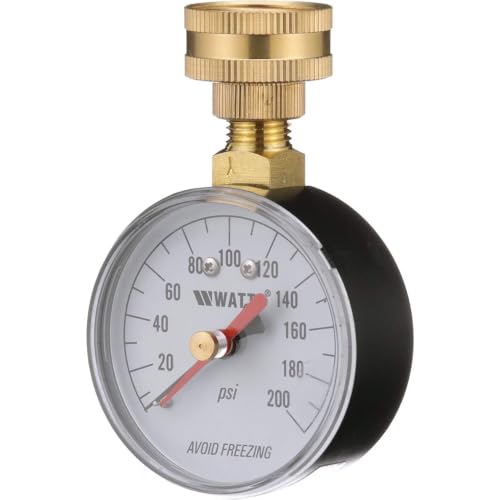
WATER PRESSURE GAUGE: Designed to test water supply pressures within a distribution system, the Watts Water Pressure Test Gauge ensures accurate measurement and detection of pressure variations. It is equipped with a copper alloy Bourdon tube sensing element for reliable and precise pressure readings.

IP67 Waterproof: The circular dial is enclosed in a 304 stainless steel case for corrosion resistance. The PRV-Tex Vent design can reduce fogging of windows inside or moisture damage from the infiltrating water such as being installed in environments exposed to moisture or rain. Offer clear reading and rain-resistant.
Calculate Pressure Loss for Different Hose Lengths
Static pressure tells you the baseline at the tap, but once water starts moving the friction‑induced pressure drop along the hose becomes the dominant factor. To evaluate pressure drop formula, you input flow rate, hose length, and diameter into the standard Darcy‑Weisbach expression, then convert the resulting loss to PSI per 10 ft. For a ½‑inch hose, a 25‑ft run at 50 PSI yields roughly 9.5 GPM, while extending to 100 ft cuts flow to 7 GPM, indicating a 1.5 PSI loss per 10 ft. A 5/8‑inch hose shows a smaller loss: 9.8 GPM at 25 ft versus 8.5 GPM at 100 ft. Use these data points to optimize hose layout design, keeping runs short where high flow is critical and selecting length that balances pressure availability with required GPM. Friction loss increases with hose length and decreases with larger diameter. Understanding hose diameter impact helps you choose the right size for efficient cleaning. Selecting a 1/4 inch hose is ideal for light, short‑run watering tasks such as potted plants or small flower beds.
Select Hose Diameter & Length to Meet Desired PSI
Choosing the right hose diameter and length hinges on preserving enough PSI at the nozzle while delivering the required flow. First, evaluate pressure requirements for location: measure tap PSI, note garden size, and identify task volume. Then, suitable size hose for flow rates by matching internal diameter to expected GPM. For short runs (≤50 ft) a ¾‑inch hose yields 38 GPM at 45 PSI, ideal for high‑volume tasks, while a 5/8‑inch offers 24 GPM, balancing pressure and flow for typical households. For longer runs (≈100 ft) friction losses cut output; a ¾‑inch still delivers 20 GPM, whereas ½‑inch drops to 7 GPM, making it suitable only for light jobs. Select the smallest diameter that meets the required flow without dropping PSI below the nozzle’s operating range. The 1800 PSI reading remains consistent even with 100‑ft of 1/4‑inch hose. The hose’s length directly influences the total water volume that can be delivered to a given area.

Outdoor hose is made of double-reinforced, commercial grade rubber and vinyl with a rugged, abrasion-resistant red cover that won’t mar surfaces

Light Weight - Expertly developed hybrid material from rubber and polymer, the thickness of lawn hose is 3mm. This hose is lighter than traditional rubber hose while being abrasion-resistant and durable.

Strong pressure resistance: WiseFlow garden hose features a five layer braided design and is reinforced with double layer braided wire, providing 300 PSI working pressure and 1200 PSI high intensity burst pressure. Our rubber garden hose has excellent resistance to abrasion, cuts, punctures, tears, and even excessive chewing by pets.
Decide When a Garden‑Hose Pressure Regulator Is Required
If your tap delivers more than the emitter’s rated pressure—typically above 25 psi for drip irrigation or 10‑12 psi for soaker hoses—you’ll need a pressure regulator to protect the system. Measure the source with a gauge; readings above 30 psi trigger regulation, while 30‑40 psi can feed a drip line directly. Choose a regulator that matches the recommended psi for hose connections and the thread type—hose‑thread for bibs, pipe‑thread for valves. Non‑adjustable units suffice for standard drip setups; adjustable models are better for larger arrays or mixed emitters. Install downstream of a shut‑off valve, ensuring inlet pressure exceeds the regulator’s preset by at least 5 psi. This prevents common pressure issues for hose users such as emitter blow‑out, fitting disengagement, and premature wear. Standard garden hose thread sizes are typically ¾‑inch, but ½‑inch and 1‑inch options also exist for specialized applications. Understanding the tapered NPT design helps when selecting adapters for high‑pressure connections. Regularly inspect the hose for kinks and blockages to maintain optimal flow.
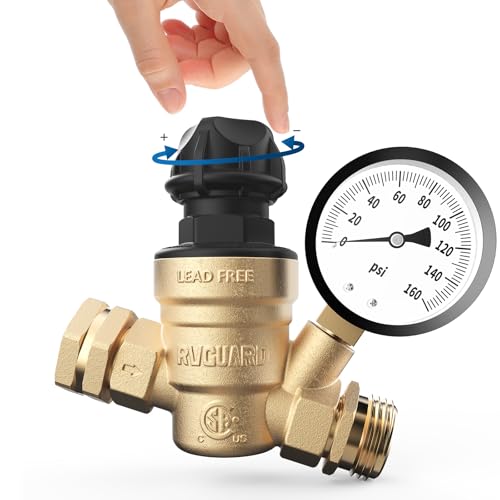
Adjustable Knob: RVGUARD new design water pressure regulator with an adjustable knob. Just use your hand to adjust the pressure, no tool required, easy to operate. Turn clockwise to increase pressure, and turn counterclockwise to decrease pressure. Factory Setting: 45 PSI.
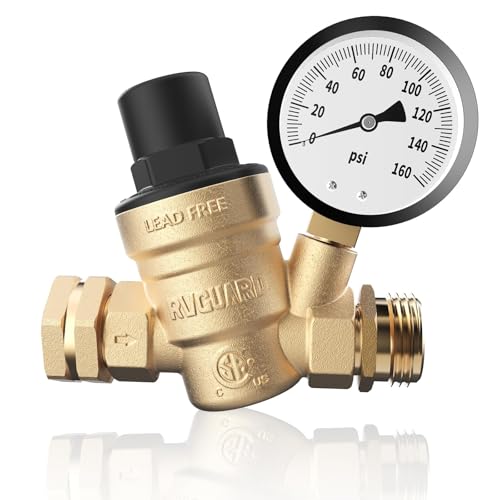
Function: Prevent water pipes from being damaged due to high pressure, suitable for campers, trailers, and RV plumbing systems.

Maintains optimum 25 psi pressure and water flow to Drip lines and emitter devices
Step‑by‑Step Checklist for Maintaining Correct Garden‑Hose Pressure
A reliable garden‑hose system starts with confirming the baseline pressure at the faucet, then systematically inspecting the hose, selecting the proper diameter, monitoring flow, and adjusting as needed. First, turn off all downstream devices, attach a pressure gauge to the outdoor spigot, open fully, and record the PSI—typically 40‑60. Verify next, inspect water flow consistency by checking for kinks, clogs, abrasions, or mildew, and guarantee hose length stays within 25‑100 ft. Choose a diameter that matches length and desired GPM: 1/2‑in for 100 ft at 7‑7.5 GPM, 5/8‑in for 50‑100 ft at 8.5‑24 GPM, or 3/4‑in for higher flow. Monitor hose attachment effects by running the hose without emitters, then re‑check with nozzle or sprinkler, adjusting emitters or upgrading diameter if flow falls below 10 GPM. Consider the pressure rating of the hose to ensure it can safely handle the washer’s output without bursting. Selecting the appropriate nozzle type, such as a 0‑degree jet for high‑pressure cleaning, further optimizes performance and safety. Understanding the typical psi range of garden hose nozzles helps you match the nozzle to the task at hand.

Precision Dual-Scale with Peak Memory: This pressure meter measures 0-200 PSI/0-14 Bar with ±2-1-2% accuracy (ASME B40.1 Grade A). Red max pointer tracks and retains peak pressure spikes, easily reset for monitoring faucets, spigots, or hydraulic systems.

Wetted materials: lead free brass, stainless steel, and food-grade silicone sealing ring. Suit for measuring potable drinking water pressure.

Product Name: Dry Iron Shell Water pressure test gauge