You should have a pressure tank for any well‑powered sprinkler system because it stores water under a steady 20‑psi range, acting as a buffer that smooths demand spikes and prevents pump cycling. The diaphragm separates pressurized air from water, delivering instant flow when a zone opens and absorbing kinetic energy when a valve closes, which eliminates water‑hammer. Proper sizing—typically at least 32 gallons for an 8 GPM pump—ensures consistent pressure and prolongs pump life. Continue for and you’ll uncover how to choose the right tank and maintain it.
Understand What a Pressure Tank Does
Because a pressure tank stores water under pressure, it acts as a buffer between your pump and the irrigation lines. The tank’s diaphragm separates pressurized air from water, so when water is drawn the air compresses, maintaining a steady 20‑psi range. You’ll notice the pump only starts when pressure falls to the cut‑in point (20, 30, or 40 psi) and stops at cut‑out (40, 50, or 60 psi), preventing constant cycling and reducing wear. Proper pressure tank placement near the pump maximizes air intake optimization, ensuring the bladder receives clean air and the system avoids waterlogged conditions. This arrangement stabilizes flow, curtails water hammer, and extends the life of all well‑system components. Proper sizing of the pressure tank is essential to match the water demand of the house and maintain consistent pressure. Selecting a pump with adequate flow rate ensures the system can meet the sprinkler heads’ GPM requirements without excessive head loss. Understanding sprinkler head flow helps size the tank correctly for peak irrigation demand. Additionally, evaluating elevation changes in your landscape can determine if a pump is needed to overcome gravity‑induced pressure loss.
Learn How It Stabilizes Sprinkler Pressure
When a sprinkler zone opens, the tank instantly supplies the needed flow, keeping the system’s pressure within the pre‑set 20‑40 psi range instead of letting it plunge. The tank’s pre‑charged air sits 2‑3 psi below the pump’s cut‑in point, so as water is drawn the pressure drops only to the cut‑in threshold, then the pump re‑engages. This buffer stabilizes sprinkler demands by delivering a steady psi despite rapid valve actuation, preventing the sharp dips that cause uneven coverage. Because the pump runs only when the reserve is exhausted, you reduce cycling, lower energy use, and extend component life. The result is a tightly regulated pressure profile that optimizes sprinkler performance across all heads. Reserve capacity provides extra water during peak demand or power outages. Understanding the solenoid valve operation helps explain how electrical signals translate into mechanical movement. Manual valve options are also available for zones that do not require electronic control. Proper sizing of the pressure tank is essential for maintaining consistent flow and preventing pump short‑cycling.
Identify Water‑Hammer and Prevent It With a Pressure Tank
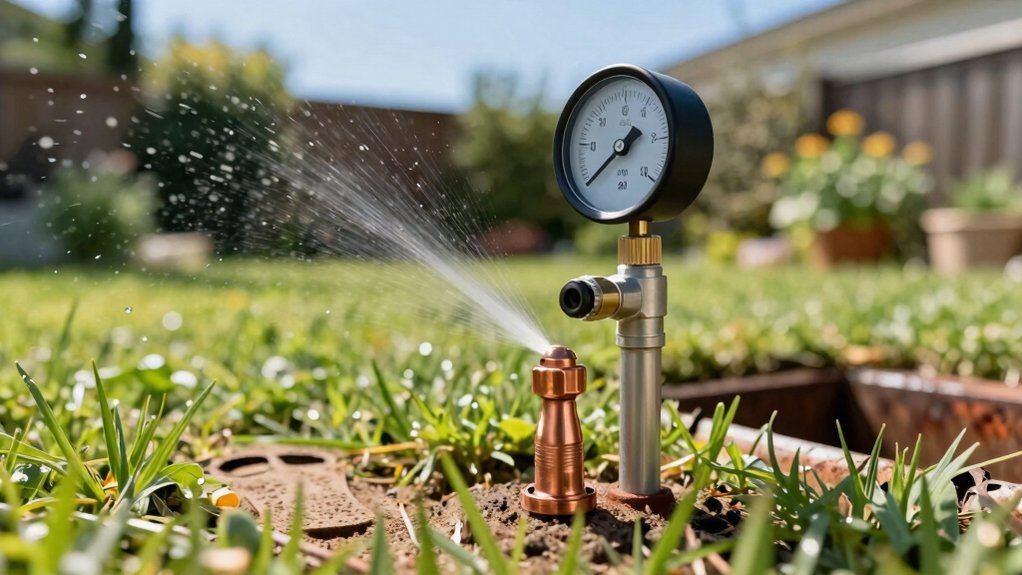
You’ll notice a sharp bang and a sudden pressure spike whenever a sprinkler zone shuts off – that’s water‑hammer, the hydraulic shock created by the water’s momentum being halted instantly. Identify it by listening for loud bangs and feeling pressure surges; they indicate rapid valve closure or excess flow velocity. Evaluate system demand: compare sprinkler GPM to source capacity, check for oversized zones, and verify that backflow preventer diaphragms aren’t fluttering. Monitor pressure fluctuations with a gauge; spikes approaching 60 psi confirm hammer. Install a pressure tank close to the valve cluster; its sealed air piston absorbs kinetic energy, smoothing shutdowns. The tank’s buffer prevents pipe fatigue, cracked valves, and head damage, preserving system longevity without additional shock arrestors. Faulty valve can also cause water hammer by closing too quickly or leaking, adding to the surge. Use of rebar can further stabilize the pipe network and reduce vibration. The valve’s transparent cover lets you inspect the diaphragm for wear. A proper system grounding can also reduce the intensity of water‑hammer by providing a path for excess energy.
Pick the Right Pressure Tank for Your Well‑Powered Sprinklers
If your well‑powered sprinkler system runs a pump that delivers 8 GPM, you’ll need at least a 32‑gallon tank, but a 52‑gallon tank is the preferred choice for consistent drawdown and reduced pump cycling. Apply pressure tank sizing rules: 1 gallon drawdown per GPM for pumps ≤10 GPM, 1.5 gallons per GPM for larger units. A 30/50 PSI switch yields more usable volume than 40/60 PSI, so factor setting into calculations. Choose a tank one size larger than the minimum to buffer pressure spikes and extend pump life. For maintenance, inspect the bladder, verify air pressure, and flush sediments quarterly. Proper pressure tank maintenance preserves drawdown capacity, prevents premature wear, and guarantees reliable irrigation performance. The Amtrol WX 202 offers a corrosion‑resistant polypropylene liner that helps maintain tank integrity over time. Garden hoses typically operate best between 40‑80 psi for optimal water flow. Using a hose that can handle up to 150 psi ensures safety when connecting to high‑pressure equipment. Understanding hose length helps you plan reach and water volume for larger garden areas.
Track Flow and Save Water in Well‑Based Systems
Flow sensors and master valves work together to keep well‑based irrigation systems tight, detecting leaks instantly and cutting off supply before gallons slip away. You install a flow sensor after the backflow device; it monitors real‑time usage, flags irregularities, and triggers the master valve. The master valve benefits include immediate shutoff, pressure stabilization, and prolonged component life. Flow sensor advantages are continuous detection, automatic overflow protection, and precise usage data for billing and landscape health. Pairing the sensor with a smart controller lets you adjust schedules based on weather, further reducing waste. This closed‑loop system complies with conservation rebates, prevents hundreds of gallons from slipping through cracks, and maintains ideal pressure across all zones. Selecting the proper pump capacity ensures consistent flow and pressure throughout the system. Submersible pumps provide steady pressure that supports reliable sprinkler operation even with variable water levels. Understanding the municipal water source can help you design a system that works with local supply constraints and pressure standards.