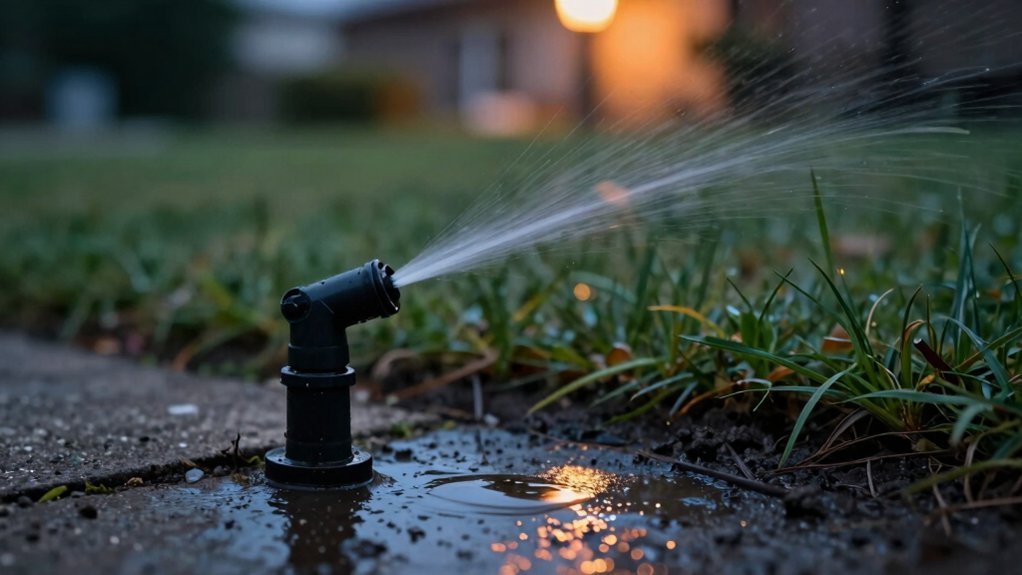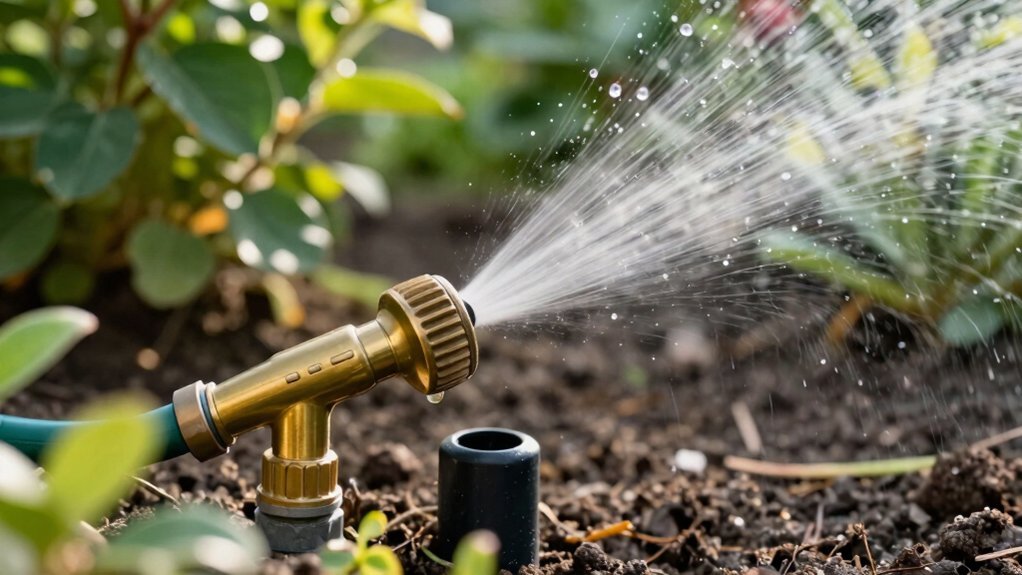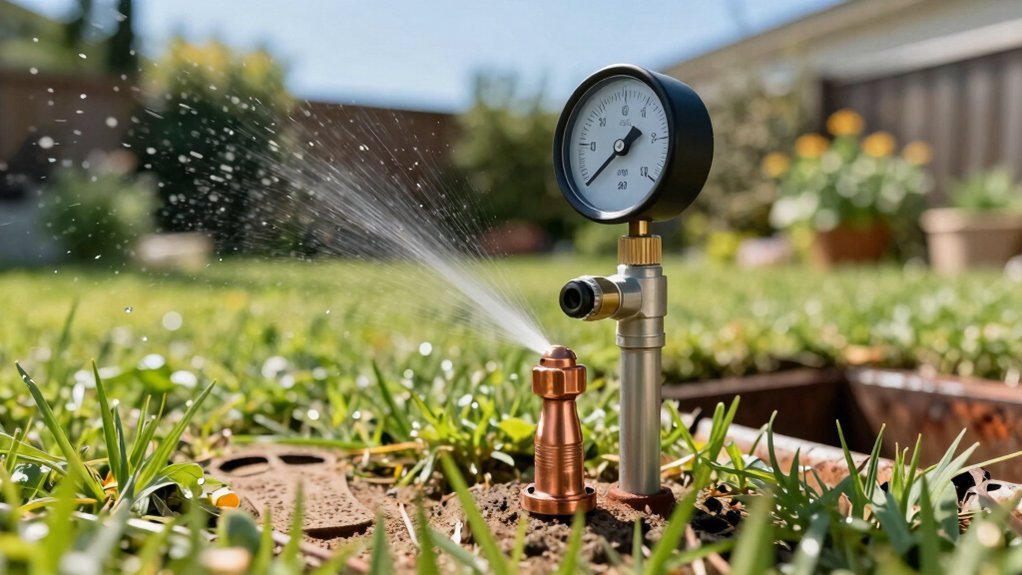
Calibrate your detector, power it fully, and set the right sensitivity and ground‑balance before you start. Sweep the coil slowly in a tight, overlapping grid along visible sprinkler lines, keeping it level and parallel to the ground. When the unit emits a strong, consistent tone, mark the spot with a flag and verify by running the zone and digging a small test hole. Adjust sensitivity around utilities and mineralized soil, and keep a steady pace of about 10 cm/s. Follow these steps and you’ll master quick detection, and the next sections will expand your technique.
How to Locate Buried Sprinkler Heads With a Metal Detector
Where do you begin when you need to locate buried sprinkler heads with a metal detector? You start by sweeping the detector slowly over the lawn, following visible sprinkler lines and any green‑grass patches that suggest coverage. Adjust sensitivity after you confirm a functioning head, then move in straight, grid‑pattern lines to guarantee systematic coverage. When the detector emits a strong, consistent tone, pause and mark the spot with a landscape flag—this is part of identifying unique signals. Next, dig a small test hole to verify the metal component and differentiate it from pipe fragments by depth and pattern. Throughout, you’re analyzing ground disturbance patterns, cross‑referencing marks with zone maps, and documenting each location to satisfy compliance and future maintenance. Use a rounded screwdriver to probe the ground and expose any buried heads you encounter. Remember to call 811 before you dig to ensure you avoid damaging underground utilities. Check local building codes to confirm whether a permit is required for sprinkler installation. Understanding metal conductivity helps you distinguish sprinkler heads from other metallic debris.

[360° Comprehensive Detection] - With its 360° side-scan capability and impressive 3.5-inch detection depth, this metal detector pinpointer guarantees thorough detection of all metals. Quickly pinpoint targets with precision, maximizing your efficiency and ensuring every dig is worthwhile.
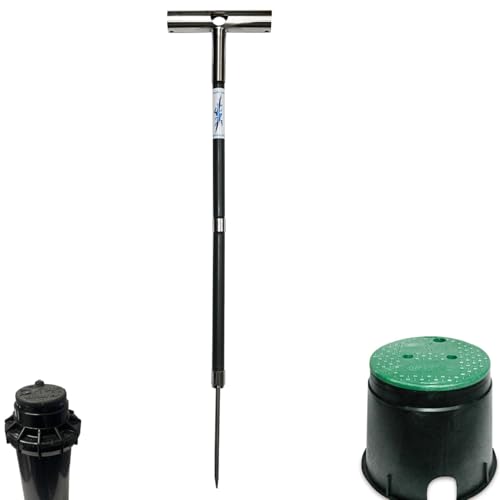
Keyfit Tools Lightning Rod HeadHound Sprinkler head Valve Zone Box Locator Finder Locate & Find Buried Valve Boxes & Sprinkler heads Works Great For Sprinkler System Startups With Stuck Sprinkler Heads
Prepare Your Metal Detector for Accurate Sprinkler Detection
Before you head out, make certain the detector is fully powered, calibrated, and set to the appropriate sensitivity for sprinkler‑head metal; verify battery voltage, engage ground‑balance, and confirm coil integrity. Test the unit on a visible sprinkler head, noting signal strength and tone, then adjust sensitivity in 5‑dB increments to capture gears without triggering mineral noise. In mixed soil composition, fine‑tune ground‑balance to suppress false positives from iron‑rich clays. Position the coil parallel to the ground, maintaining proper detector orientation to maximize depth perception and reduce side‑lobe interference. Secure the battery pack, lock the mode selector, and record baseline readings before proceeding to unseen locations. This protocol guarantees repeatable, compliant detection across varied lawn conditions. Pulse Induction offers deeper penetration than BFO or VLF detectors, making it especially useful for locating buried sprinkler heads. Understanding the continuity equation helps explain why the fluid speed increases as the nozzle narrows. The Bernoulli principle describes how pressure drops when fluid velocity rises in a constricted flow. A nozzle’s design demonstrates that energy conversion occurs as pressure is transformed into kinetic energy.

Precise & Stable Target Detection: Powered by an upgraded large search coil and advanced DSP chip, this metal detector delivers 40% higher detection accuracy with outstanding stability. The expanded coil covers more ground for faster scanning, and it will not lose targets even during fast sweeping. It accurately locates quarter‑sized metal items buried as deep as 12 inches underground, offering trustworthy performance for serious treasure‑hunting hobbyists.

MULTI-FLEX TECHNOLOGY: Choose from 5 kHz, 10 kHz, 15 kHz, 20 kHz, Multi-Frequency, or Multi-Salt for optimal target detection.

[Adjustable & Ergonomic Design for All Ages] 🗺️ BOXTREN 10-inch metal detector featuring a unique dual-adjustable system with a 23" to 35" telescopic stem and a 5.9" to 11.8" adjustable armrest. This "humanity design" ensures a perfect fit for both adults and teenager s (ages 12-19), reducing arm fatigue during long hunts. Whether it's a family outing or a solo professional trek, its 1-minute quick assembly lets you start your treasure hunt instantly.
Metal Detector Scanning Techniques to Pinpoint Buried Heads Quickly
When you sweep the lawn, move the detector head slowly and keep it level, following a tight, overlapping grid that mirrors the irrigation layout; this guarantees consistent ground‑level positioning and uniform detection depth. Begin by calibrating the sensor over a known sprinkler head, adjusting sensitivity to balance depth reach and soil metal content. Use a systematic, grid‑pattern scan, walking parallel lines spaced no more than half the head’s detection radius to eliminate gaps. Optimize scan patterns by aligning rows with the irrigation map, then shift slightly on each pass to cover the entire area. Maintain a steady pace—about 10 cm per second—to allow the detector’s response time to register subtle metallic components. This disciplined approach improves sensor calibration and maximizes detection accuracy while minimizing false positives. Understanding the role of the main pipe helps you locate the primary water supply line, which can be a useful reference point when mapping underground components. Valve location can be verified by listening for the chatter box’s clicking sound when the valve is energized. Control valve box can be quickly identified by tracing the wiring diagram from the main controller. Adding a quick visual check for wet spots can help confirm the presence of underground lines before scanning.

Works on wallpaper & fabric: depth range of ¾-in through drywall and works on surfaces covered in wallpaper and fabric
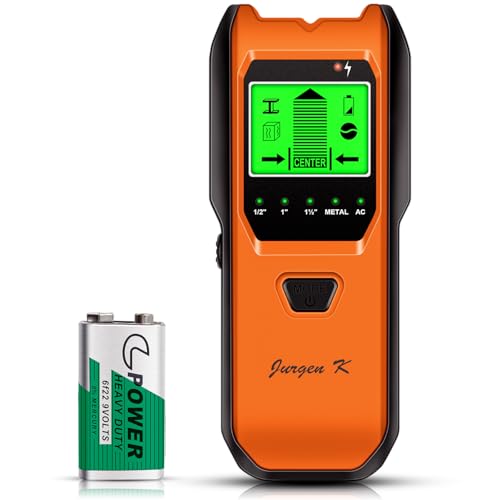
Reliability and Consistency: The Jurgen K stud finder uses multi-sensing technology to accurately and quickly find the edges and centers of live AC wires behind metal, studs, joists, pipes, walls, floors and ceilings. Whether you're hanging a picture, installing a TV or renovating part of your home, the Jurgen K stud detector is a must-have tool!

DETECT METAL STUDS AND FASTENERS: Magnetic stud finder efficiently detects metal studs and fasteners within wooden studs
Mark and Verify Detected Sprinkler Heads Before Digging
After you’ve pinpointed each head with the detector grid, you must mark and verify those locations before any digging begins. Switch the irrigation controller to manual mode, run each zone for two to three minutes, and watch the spray to confirm the exact spot. Place a durable flag or paint mark directly on the verified head, and extend the marking to valve boxes and visible components. Coordinate with key project coordination roles: notify contractors, call 811, and engage a private locator to trace mains and wires. Document the marks in your site plan and schedule seasonal marking maintenance to keep them visible throughout the project. Double‑check every flag against the running zones, respect tolerance zones, and keep all markers until completion to avoid costly damage. Ensures proper functioning of the irrigation system by preventing accidental damage. Check the main water valve before starting any verification process. Verify that the power supply to the controller is stable to avoid faulty wiring issues. Understanding the solenoid operation helps ensure the valve responds correctly to the controller signal.

YARD FLAGS FOR OUTSIDE - Use our yard flag markers for yard projects such as landscaping flags, yard flags marking sprinkler heads, marker flags for lawn care, or property markers.

⛳【MARKING FLAGS】Made of PVC, Not faded, the flags do not tear easily, and they are attached to a high carbon steel wire pole with a high-strength adhesive. These poles are also able to easily penetrate the soil without deforming. Support writing on it for better markup, Marking flags are best marking solution. Reuse many times.

⛳【MARKING FLAGS】Made of PVC, the flags do not tear easily, and they are attached to a high carbon steel wire pole with a high-strength adhesive. These poles are also able to easily penetrate the soil without deforming. Support writing on it for better markup, Marking flags are best marking solution.
Metal Detector Pro Tips for Complex Sprinkler Networks
If you’re tackling a dense, branching sprinkler system, fine‑tuning your metal detector’s sensitivity is essential: start at medium, raise it gradually until you see stable signals on pipe junctions, then lower it near power lines or mineralized soil for interference management. Apply automatic ground‑balancing, or manually neutralize and adjust until noise disappears, especially in gold‑bearing or saltwater soils. For coil configuration optimization, select small DD coils in trashy zones and concentric coils where branches converge; reserve larger coils for deeper heads despite higher interference risk. Sweep slowly, overlapping 1‑2 inches above ground, side‑stepping to map networks while keeping the coil parallel to suspected lines. Maintain low discrimination to capture all metal components and avoid false alerts from nearby radio towers. Switching to PVC in the 80s and 90s reduced interference from metal pipes. Properly segment zones based on plant types and sun exposure can further improve detection efficiency. Understanding flow rate is crucial for balancing water distribution across zones.

Dual audible and visual alarms for clearer identification: When a target is detected, the device simultaneously emits a buzzer and illuminates an LED indicator. Even in noisy construction sites or dimly lit environments, the dual audible and visual cues accurately pinpoint the location of hidden objects.

DIF TECHNOLOGY. An essential part of your detection tool kit, the PRO-FIND 35 finds coins, rings and gold with speed and accuracy. Equipped with Detector Interference Free (DIF) technology to reduce interference with an operating metal detector.

【Ergonomic Portable Design】The handheld metal detector features a bar-shaped probe design and anti-slip silicone rubber on the sides, making it easy to hold and use for detection while providing a secure grip. It weighs only one-third of a traditional metal detector. Whether you're at home or on the go, it's easy to carry and use. For frequent adventurers, it's a reliable companion you can trust.