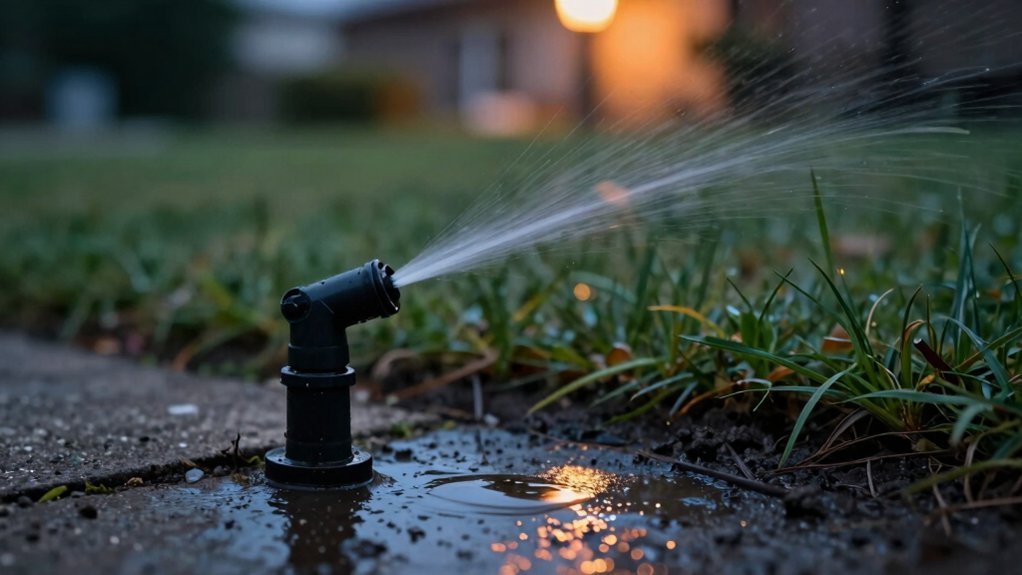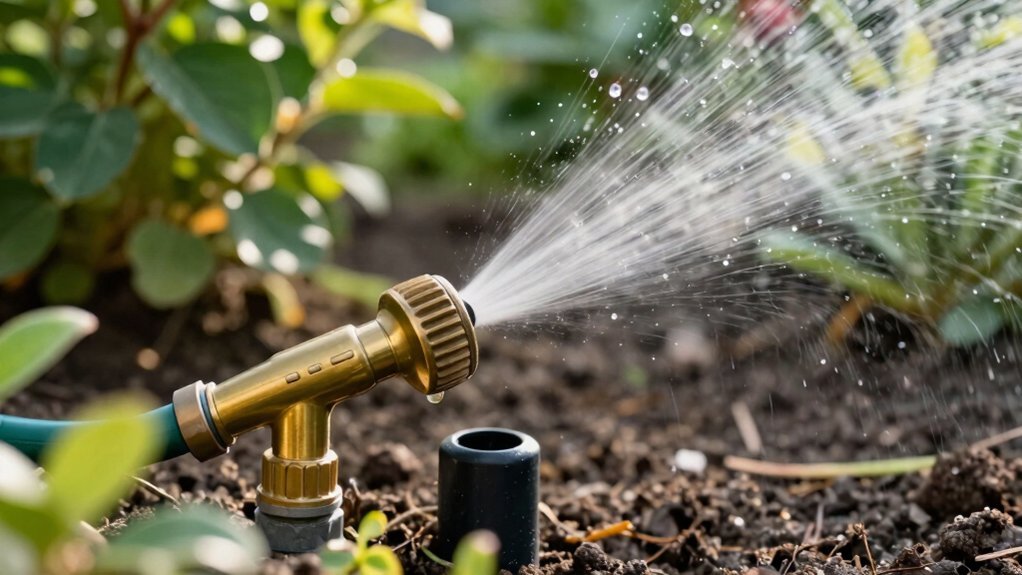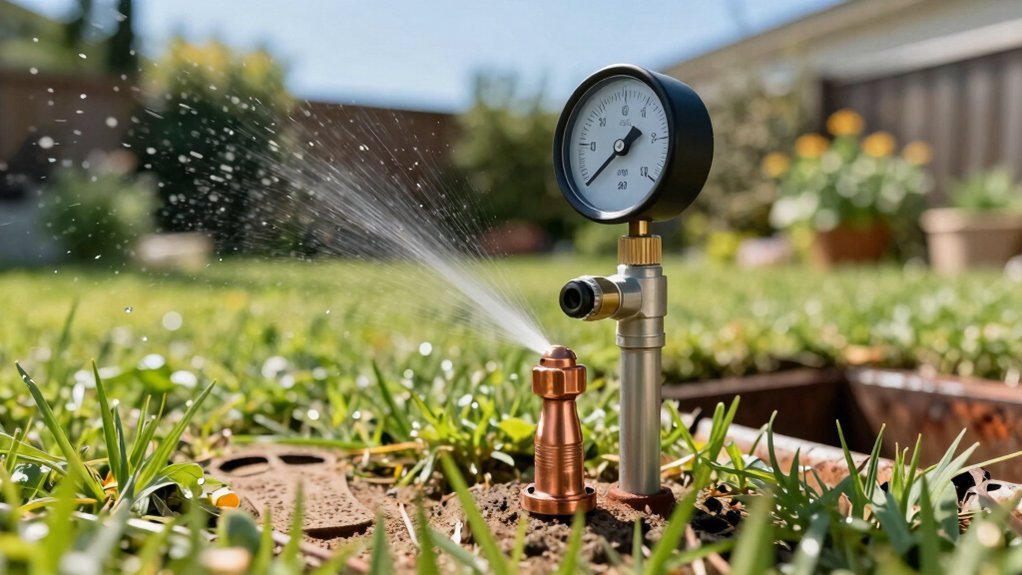
A 360° rotating impact sprinkler with a 43‑ft radius, like Orbit Impact, gives you the largest single‑head coverage, reaching up to 6,200 sq ft. It combines gear‑driven rotary motion and Uniform Rain Curtain™ technology for uniform spray and minimal overlap. Choose 4‑inch nozzles for the 30‑ft effective radius, maintain 30 psi pressure, and verify flow with a bucket test. If you keep going, you’ll ascertain how to fine‑tune pressure, materials, and layout for even broader reach.
Choose a Sprinkler for 5,000 sq ft+ Lawns
Choosing the right sprinkler for a lawn exceeding 5,000 sq ft hinges on coverage radius, spray uniformity, and adjustability. You’ll assess sprinkler efficiency by comparing throw distance and spray pattern. Orbit Impact delivers a 43 ft radius and 360° rotation, covering up to 6,200 sq ft, which maximizes single‑unit effectiveness for expansive lawns. Rain Bird’s 5000 Series rotors provide a 50 ft radius and Uniform Rain Curtain™ technology, ensuring consistent water distribution and reduced runoff. Toro RapidSet offers precision nozzles with a 50 ft adjustable radius, maintaining uniform output while minimizing waste. Melnor XT oscillators, with 20 precision nozzles, span 4,200 sq ft and can be widened for larger zones, but they fall short of the 5,000 sq ft threshold. Align each model’s adjustability with your watering schedules to achieve ideal coverage and water‑use efficiency. The Lawn Tractor Sprinkler can cover up to 14,000 sq ft, making it ideal for very large lawns. Modern systems often incorporate sensor‑driven control to further reduce water waste. Properly calculating the required sprinkler flow rate ensures balanced water distribution across the zone.
Pick Nozzle Count & Spray Diameter for 5,000 sq ft Lawns
Any 5,000 sq ft lawn typically requires three to four 90‑degree rotary heads or two to three 180‑degree oscillators to achieve full coverage without excessive overlap. For nozzle selection, calculate the total spray coverage pattern needed: 5,000 sq ft ÷ the effective radius of each head. A 30‑foot radius yields roughly 2,800 sq ft per head, so three heads suffice; a 20‑foot radius covers about 1,250 sq ft, requiring four to five heads. Choose nozzles that match those radii—standard 4‑inch nozzles for 30‑foot reach, 2‑inch for 20‑foot. Verify that the combined spray coverage pattern overlaps 10‑15 % to avoid dry spots while minimizing water waste. Adjust spacing to maintain uniform pressure across the zone. Dynamic pressure must be accounted for when sizing the system to ensure each nozzle receives adequate flow. Properly balance sprinkler head flow with the total demand to prevent pressure loss. Consider the soil type to fine‑tune head placement for optimal infiltration. Understanding water distribution principles helps maximize efficiency and conserve water.
Match Pressure & Flow to 5,000 sq ft Coverage
How do you align pressure and flow to reliably cover a 5,000 sq ft lawn? Begin with the Q = D × A formula: 0.10 gpm/sq ft × 5,000 sq ft yields 500 gpm total. Use the K‑factor equation Q = k√P to select sprinklers that deliver 0.05 gpm/sq ft at 30 psi, the ideal pressure for stationary heads. Verify supply with a bucket test; 5 gal in 23 s confirms ~13 gpm, so you must aggregate enough heads to reach 500 gpm without exceeding the source. Apply pressure management by setting regulators at the lowest stable gauge reading, typically 30 psi, to avoid misting above 40 psi. Conduct flow optimization by spacing heads (12 × 12 ft or 16 × 20 ft) to balance individual flow (≈10 gpm) and overall demand, ensuring total flow stays within the water‑supply capacity. Pipe diameter also influences the maximum flow a zone can handle without excessive pressure loss. Properly accounting for system resistance helps maintain consistent coverage across the entire area. Assess the need for a pump by evaluating elevation changes that can affect pressure distribution.
Select Weather‑Resistant Materials for Longevity
Balancing pressure and flow for a 5,000 sq ft lawn sets the stage for selecting materials that will endure the elements. You should prioritize UV resistant polymer materials for the outer shell because they maintain tensile strength after prolonged sun exposure and resist cracking. Pair them with high temperature silicone compounds at seals and gaskets; these compounds retain elasticity from -20 °C to 150 °C, preventing leaks when daytime heat spikes. Verify that the polymer’s melt index stays below 5 g/10 min to avoid deformation under load. Choose a silicone formulation with a Shore A hardness of 30–40 for flexible yet durable joints. By matching these specifications, you guarantee the cover’s structural integrity and functional longevity across seasonal extremes. Metal garden hoses offer enhanced durability that can reduce long‑term replacement costs. Proper kink resistance ensures consistent water flow even under high pressure. Stainless steel hoses typically last 10–15 years with proper care.
In‑Ground or Pop‑Up? Which Gives the Broadest Reach?
When deciding between in‑ground and pop‑up sprinkler systems, the key metric is the maximum uninterrupted coverage radius each can sustain. In‑ground pop‑up heads, when installed with proper head height adjustment, can deliver a consistent circular pattern up to 55 ft radius using gear‑driven rotary units, while water pressure regulation maintains steady flow across zones. Pop‑up rotors, optimized at 30‑40 PSI, reach 45 ft radius on average, with gear‑drive models extending to 55 ft, but they rely on surface mounting and may suffer from nozzle‑adjustment limits. In‑ground installations avoid relocation and provide permanent broad lawn irrigation, leveraging pressure regulators to sustain 30‑80 PSI for medium lawns up to 3,000 sq ft. Consequently, for the widest uninterrupted reach, in‑ground gear‑driven pop‑ups outperform surface units. Rotor heads are ideal for very large areas such as parks and athletic fields, where each head must cover a lot of ground. Proper soil type assessment helps ensure optimal water distribution and prevents runoff. Smoke detectors are a separate fire safety system that does not contain sprinklers. Selecting the appropriate sprinkler spacing ensures uniform coverage while conserving water.
Fixed‑Arc vs. Rotating Impact Sprinklers for 5,000 sq ft
If you need to irrigate a 5,000 sq ft lawn efficiently, choosing between a fixed‑arc sprinkler and a rotating impact model hinges on coverage radius, precipitation rate, and water‑use efficiency. Fixed‑arc units deliver a narrow 8–15 ft radius at high rates, risking runoff on slopes and wasting water. Rotating impact sprinklers reach 20–150 ft, producing efficient rotational patterns that create ideal spray trajectories across the entire area. Their 0.1–1.5 in/hr precipitation rate penetrates the root zone slowly, cutting evaporation and wind drift. Impact heads double the volume of gear‑driven rotors, yet they require minimum 50 psi to maintain radius. For a 5,000 sq ft lawn, impact impact sprinklers provide superior coverage, uniformity, and long‑term water‑use efficiency. Selecting a sprinkler with a high uniformity ratio ensures consistent moisture distribution across varied terrain. Properly grouping plants by soil type can further enhance water efficiency. Modern systems often incorporate moisture sensors that shut off irrigation when soil moisture reaches optimal levels.
Daisy‑Chain Sprinklers for Extra Reach
Although a single Flex‑Design sprinkler can cover up to 840 sq ft at 50 psi, chaining several heads in series lets you extend that reach across larger zones; however, each additional unit downstream suffers pressure loss, shrinking its spray radius and coverage. You should start by installing the first sprinkler at the highest pressure point, then connect a second 1‑Way hose connector to feed the next head. As water travels through the 1/2‑inch tubing, monitor pressure loss with a gauge and adjust spray angle on each downstream unit to compensate for reduced flow. Overlap patterns by 10‑15 % to avoid gaps, and limit the chain to three sets per circuit to keep pressure within acceptable limits. Field‑test each configuration, record actual radius, and fine‑tune direction and flow until the target zone receives uniform water. Consistent and even water coverage is essential for successful overseeding. Properly overlapping spray zones ensures uniform lawn coverage and prevents dry spots. Consider soil type when determining the optimal overlap distance to maintain adequate moisture retention. Selecting the appropriate spray pattern for each sprinkler head helps balance coverage and water efficiency.
Save Water While Keeping 5,000 sq ft Sprinkler Reach
A well‑designed system can keep water use low while still reaching a 5,000 sq ft zone by combining high‑efficiency rotor heads with strategic spacing and pressure regulation. Choose a Water‑Saving Rotor Head, such as the Rain Bird 5000 Series, and set its arc and radius to match the target area. Use pressure‑regulating technology to maintain a constant flow, preventing overspray and ensuring water efficient performance. Apply irrigation pattern optimization by overlapping spray footprints only where necessary, and adjust spacing to 20‑30 ft intervals for uniform coverage. Integrate X‑Flow shut‑off to block 99 % of loss from compromised heads. Verify that each head’s spray distance aligns with the 5,000 sq ft boundary, eliminating redundant watering and preserving resources.
Real‑World 5,000 sq ft+ Sprinkler Installations
Most homeowners installing a sprinkler system for a 5,000 sq ft (or larger) lawn find that a multi‑zone layout—typically four to six zones—balances water pressure, coverage, and cost. You’ll allocate 10‑15 GPM per zone, install 550‑1,000 $ valve manifolds, and run 1‑inch PVC main lines 6‑12 inches deep. Smart zone controllers let you set automated run times that respect pressure limits while minimizing overlap. For a quarter‑acre (≈10,890 sq ft) job, budget 10‑20 heads, rotors for open areas, spray heads for edges, and a backflow preventer at the supply. Labor runs $50‑100 /hr, trenching $4‑12 per ft, and permits add $35‑200. Expect a total of $1,800‑$2,630 for a 5,000‑plus‑sq ft installation, scaling to $10,520 for an acre.