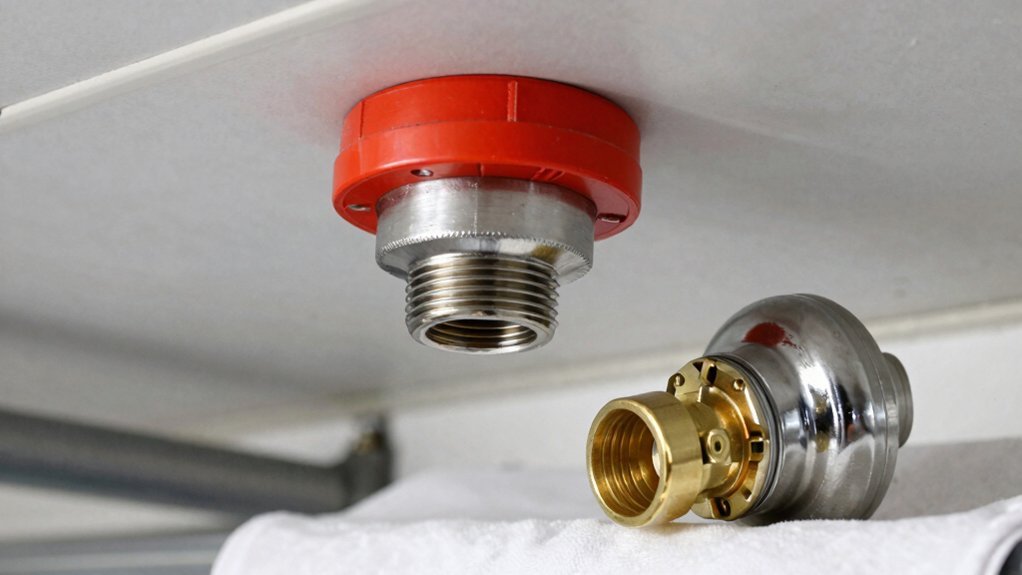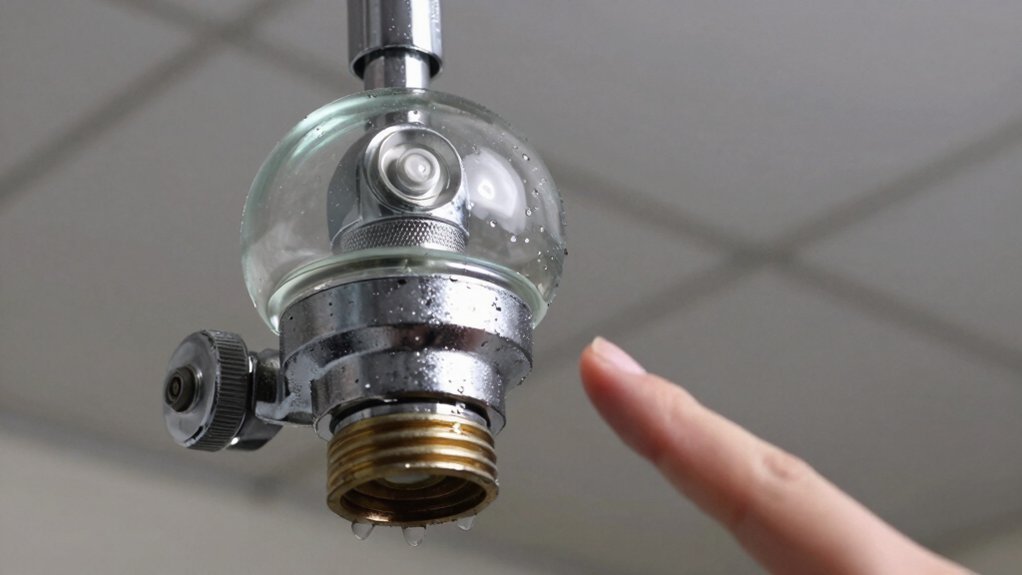
You trigger a fire sprinkler when the ceiling‑ambient temperature hits the rated activation point of the head—ordinary heads fire at 135 °F–170 °F (57 °C–77 °C), while higher‑temperature models are calibrated from 175 °F up to 650 °F (79 °C–341 °C) for specific hazards. The fusible link’s eutectic alloy melts at that temperature, freeing the valve and releasing water within milliseconds. NFPA requires six‑month link replacements and regular inspections to prevent corrosion‑induced failure. If you keep reading, you’ll uncover how color‑coded glass bulbs, rating selection, and maintenance practices keep the system reliable.
What Temperature Actually Triggers a Fire Sprinkler?
What temperature actually triggers a fire sprinkler? You’ll find that most standard heads activate near 68 °C (155 °F), fitting the 135–170 °F (57–77 °C) classification. For residential and commercial spaces, the typical range narrows to 135–155 °F, with a mandated 20 °F buffer above the highest ambient ceiling temperature. High‑temperature models span 79 °C–141 °C (174 °F–286 °F), with intermediate (175–225 °F) for kitchens, high (250–300 °F) for industrial gear, extra‑high (325–375 °F) for ovens, and very extra‑high (400–475 °F) for extreme conditions. Sprinkler response time hinges on this precise activation point, ensuring early fire suppression. Sprinkler reliability testing validates that each glass‑bulb or fusible‑link assembly consistently meets its rated temperature under controlled heat plume conditions. The activation mechanism relies on thermal expansion of a metal element that breaks the seal when the preset temperature is reached. Proper system design also considers coverage area to maximize protection while minimizing water damage.

FM Approved 3053441and UL / CUL listed EX6430. 1/2 " NPT (National National Pipe Thread) American thread fire sprinkler heads

UL & CUL Certified-UL & CUL listed EX6430, 1/2 inch NPT (National Pipe Thread) American thread fire sprinkler heads. Built for dependable fire protection and rigorous quality standards, the glass compression bulb activates automatically at the rated threshold, delivering a consistent hemispherical spray pattern. Ideal for fire sprinkler heads bulk orders by contractors and property managers who require code-compliant, inspector-approved fire safety for residential and commercial installations
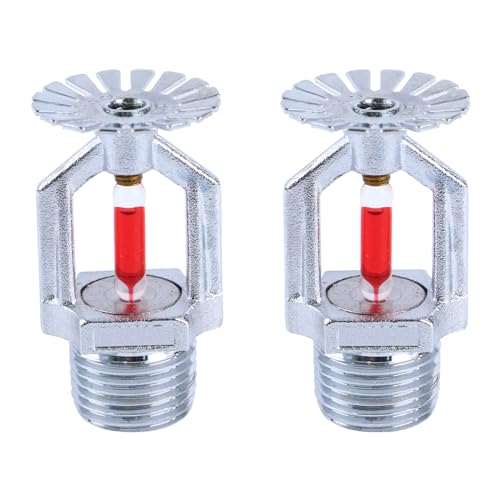
Standard 1/2" NPT (National National Pipe Thread)Threaded End Fire Sprinkler Fitting.
How Do Standard Sprinkler Temperature Ratings Map to Glass‑Bulb Colors?
Five standard temperature ratings correspond directly to specific glass‑bulb colors, allowing you to identify a sprinkler’s activation range at a glance. The ordinary rating activates at 57–77 °C (135–170 °F) and uses orange or red bulbs; its maximum ambient temperature is 38 °C (100 °F), suitable for residential spaces where nuanced thermal activation must avoid false trips. The intermediate rating, 79–107 °C (175–225 °F), employs yellow or green bulbs and tolerates ambient temperatures up to 65 °C (150 °F), addressing elevated ambient temperature in kitchens or garages. High‑rating sprinklers trigger at 121–149 °C (250–300 °F) with blue bulbs, handling ambient heat up to 107 °C (225 °F) in boiler rooms. Extra‑high units fire at 163–191 °C (325–375 °F) with purple or mauve bulbs, supporting ambient levels up to 149 °C (300 °F) in industrial heating zones. Ultra‑high devices activate at 204–343 °C (400–650 °F) with black bulbs, designed for extreme ambient conditions up to 260 °C (465 °F). Proper maintenance ensures reliable activation and compliance with fire codes during emergencies. Replacing fire sprinkler heads requires shutting off the water supply and draining the system before removal. Regular inspections also verify that the control valve remains functional and that the system’s water supply is adequate for immediate response.
When Should You Select Intermediate or High‑Temperature Sprinkler Ratings for Kitchens and Industrial Spaces?
When you’re designing fire protection for a commercial kitchen or an industrial area, the key is to match the sprinkler’s activation temperature to the highest normal ceiling temperature plus a safety margin of at least 20 °F, as NFPA recommends. For kitchens, ambient ceilings often reach 150 °F; select an intermediate rating (175‑225 °F) to accommodate boiler‑room and cooking‑equipment heat while avoiding false‑activations. Use green‑bulb indicators for the 200 °F midpoint and maintain a minimum 3‑inch clearance from the ceiling. In industrial spaces with process heat up to 225 °F, choose a high‑temperature rating (250‑300 °F) and blue‑bulb indicators for the 286 °F point to prevent discharge near machinery. Apply key sprinkler maintenance practices—regular inspection, cleaning, and testing—to guarantee reliable operation and compliance. Consider sprinkler sprinkler orientation when planning installations in rooms with sloped ceilings or varying geometry. Building size thresholds determine when sprinkler systems are required under the International Building Code and NFPA 13. The wet‑pipe system remains the most common and cost‑effective solution for both residential and commercial installations.

★ 93℃/199℉ fire sprinkler head pendent type with brass material,the thermal red glass bulb response quickly to spray water .

Automatic Temperature Activation – The fire sprinkler head activates automatically when the ambient temperature reaches 68°C (155°F), ensuring timely water release for fire suppression.

UL & CUL listed EX6430. 1/2 " NPT (National National Pipe Thread) American thread fire sprinkler heads
What Do “Extra‑High” and “Ultra‑High” Sprinkler Temperature Ratings Mean for Extreme Environments?
Extra‑high and ultra‑high sprinkler ratings step in when normal ceiling temperatures push beyond 300 °F, ensuring the fusible link only melts at the specified high‑heat thresholds. You select Extra‑High (325‑375 °F) for ovens, furnaces, or warehouses where atmospheric temperature variations may approach 300 °F, and you rely on its red‑coded fusible link to resist thermal shock effects. Very Extra‑High (400‑475 °F) and Ultra‑High (500‑650 °F) serve environments with sustained ambient heat or peak spikes, such as chemical‑processing plants, where black‑colored bulbs signal extreme activation points. NFPA 13 2022 Table 7.2.4.1 mandates these classifications; matching the rating to the maximum ceiling temperature prevents premature discharge while maintaining compliance with fire‑protection standards. Proper sprinkler spacing ensures adequate coverage despite higher ceiling heights. Smoke detectors operate independently of sprinklers, providing early warning while sprinklers focus on fire suppression. Pulling a fire alarm activates the fire alarm system, which then sends a signal to the sprinkler control valve, causing the sprinklers to discharge water in the affected area. This signal flow is essential for coordinated fire response.

Compact Design: With dimensions of 1x1x8 inches, this rooftop sprinkler is compact and can fit in most spaces.

Fire Sprinkler Technician Job Occupation Profession. This Sprinkler Systems Save Lives is for a fire sprinkler technician who installs, inspects, maintains, and repairs fire sprinkler systems.

Premium Aluminum Material for Durability: Crafted from high-quality aluminum alloy sheets with uniform thickness and sturdiness, it boasts excellent corrosion resistance, rust proofing, and scratch resistance. Suitable for long-term use in humid, high-temperature indoor and outdoor environments without deformation or fading.
How Does the Fusible Link Work in Sprinkler Temperature Rating Systems?
The extra‑high and ultra‑high ratings you just reviewed rely on a fusible link that only yields at the designated temperature, and that same principle governs every sprinkler rating. You’ll find the link composed of two metal plates bonded by a eutectic alloy calibrated to melt at a specific point—typically between 135 °F and 500 °F. When ambient heat reaches that threshold, the alloy liquefies, allowing the plates to separate and release the spring‑loaded valve or gravity‑driven plug. This mechanical release initiates water discharge within milliseconds, supporting sprinkler response time optimization. Structural design considerations dictate plate thickness, alloy composition, and clearance to guarantee consistent activation across temperature ranges while preventing premature operation in high‑heat zones. NFPA mandates replacement of fusible links every six months to ensure reliable operation. Regular inspections can detect corrosion buildup that may impair the link’s performance. Sprinklers significantly reduce fire‑related injuries and fatalities by limiting smoke spread.
What Installation and Maintenance Tips Ensure the Right Sprinkler Temperature Rating Works Reliably?
How can you guarantee that a sprinkler’s temperature rating performs as intended? Start by selecting proper cover plates that correspond exactly to the sprinkler’s rating, using the SIN to locate the data sheet and ensuring the plate’s melting point is about 20 °F below the activation temperature. Verify temperature ratings match the ambient ceiling temperature; choose a rating at least 20 °F higher than the maximum expected. Install away from HVAC diffusers and any heat sources that could exceed Table B limits, and protect the heads during transport and storage. During routine inspections, check the NFPA color code on bulbs and frames, confirm cover plates are correct, and replace any mismatched components with parts from the same manufacturer. Document occupancy changes and future modifications to maintain compliance with NFPA 13‑2022 Table 7.2.4.1. Perform a hydrostatic pressure test to confirm the system can sustain the required pressure without leaks. Understanding the red sprinkler pipe code helps ensure proper identification and compliance with fire‑code requirements.