Pick a quick‑fill nozzle that matches your sprinkler’s fuel type, thread size, and required flow rate—typically 5–8 gal/min for rapid refills. Verify it has an automatic shut‑off valve, built‑in venting, and corrosion‑resistant construction to prevent spills and maintain pressure balance. Verify the nozzle’s dimensions and connection type fit your can, and add a compatible stainless‑steel extension with a 0.2 µm filter if you need extra reach. This setup guarantees fast, safe refills, and the next sections explain compatibility checks, vent importance, and troubleshooting.
How a Quick‑Fill Nozzle Works for Fuel Can Refills
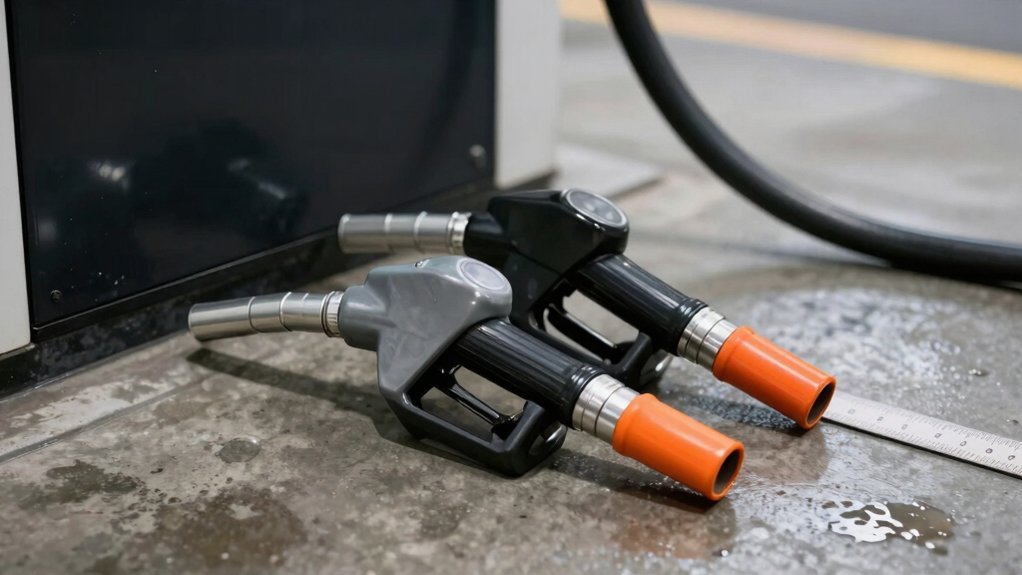
A quick‑fill nozzle operates by engaging an automatic shut‑off valve that snaps shut the moment the tip lifts off the tank lip, instantly halting fuel flow and containing vapors. The valve closes as soon as the nozzle separates, preventing fumes and sealing the tank at full capacity. Pressurization drives 5‑8 gal/min rates, while the self‑venting spout equalizes pressure, ensuring steady flow. The angled nozzle advantages include a safer pouring angle, clear line of sight into the container, reduced splashing, and precise delivery into small openings. Fuel storage capacity is managed by marked indicators at 2.5 L and 5 L, with 5, 10, and 20 L canisters built for two‑handed operation. This schematic design minimizes spills, accelerates refilling, and maintains vapor containment throughout the process. The new nozzle must be pushed and held to pour, which can be cumbersome for small containers. Using a diesel‑compatible nozzle prevents accidental cross‑fueling and the tank damage. Always wear protective gloves to reduce the risk of skin contact with fuel.
Check Compatibility Before Buying a Quick‑Fill Nozzle
The automatic shut‑off that makes a quick‑fill nozzle safe also means you must verify that the nozzle’s dimensions and connection type match your can before buying. Measure the can’s opening, compare it to the nozzle’s length (e.g., 3½ in for No‑Spill®, 7½ in assembly) and check cap size (2.25 in dry break for Fuel Safe kits). Confirm brand‑specific compatibility: No‑Spill® fits only its own 1.25‑, 2.5‑, and 5‑gal cans, while EZ‑POUR® kits cover 98 % of plastic jugs, including Jerry and Scepter cans. Guarantee the nozzle supports required fuel containment measures (flame arrestor, vent, filter). Account for seasonal storage considerations: select a model that resists corrosion, tolerates temperature swings, and maintains a secure seal during long‑term idle periods. Flexible spout nozzles can bend to fit irregular can shapes, reducing the risk of breakage. Choosing the correct nozzle also helps maintain optimal water pressure for efficient irrigation. Durable materials such as brass or stainless steel can extend the lifespan of the nozzle under harsh outdoor conditions. Proper hose selection prevents excessive pressure spikes that could damage the nozzle or cause leaks.

The front of the universal watering can head is made of metal material, and the base is made of elastic rubber material, which has strong durability

UNIVERSAL DESIGN: Fits most standard watering can spouts as a replacement rose head, making it a versatile addition to your garden tools
Quick‑Fill Nozzle vs. EZ‑POUR: Speed, Control, and Spill Prevention
Speed and control differ markedly: Quick‑Fill nozzles pump fuel at a higher flow rate, emptying a five‑gallon can in seconds, while EZ‑POUR’s 8‑inch extension maintains a steady, slower pour that caps at about 35 seconds for the same volume. Quick‑Fill offers throttle adjustment, maintaining consistent pressure across large tank openings and enabling rapid transfers for boats, ATVs, and farm equipment. EZ‑POUR limits flow to protect capless systems, suiting smaller containers and diesel trucks. Both include automatic shut‑off (Quick‑Fill) or flame arrestor with push‑in vent (EZ‑POUR) to prevent overfill spills. Their kits feature base caps for convenient storage options and color‑coded organization. Quick‑Fill’s multi‑tool compatibility expands its versatile application range beyond basic yardwork. Stationary nozzles are easier to relieve of debris, while adjustable nozzles are nearly impossible. Proper nozzle selection also depends on the spray pattern required for the specific cleaning task. The nozzle’s narrowing converts static pressure into kinetic energy, illustrating the principle that a nozzle does not create pressure but pressure into speed.

TRIGGER HOSE ATTACHMENT: Designed for precise control, this vp trigger hose fits securely on compatible fuel jugs for easy and efficient fuel transfer with minimal mess or waste.

Car replacement fuel hose: 13.6 inch transparent fuel tank hose with a thread size of 3/4 inch (standard), suitable for 5-gallon fuel jug , including fuel jug hose,tractor and Scribner fuel tanks

Makes Life Easier: This filler hose fits in any filling receptacle to make the small jobs of filling tillers, pressure washers, boats, lawn mowers, trucks and off road vehicles much easier
Why a Built‑In Vent Is Critical for Consistent Fuel Flow
Venting is the linchpin that keeps fuel flowing smoothly; it regulates fill level, balances pressure, and prevents air from entering the tank during high‑rate transfers. You’ll notice that the built‑in vent’s 5‑inch stem positions the check valve precisely, allowing air to escape while fuel rushes in. This geometry satisfies pressure regulation considerations by equalizing pressure on both sides of the shut‑off piston, letting the tension spring close the piston once the fuel reaches the set level. The high flow venting importance becomes evident at rates above 300 GPM, where uncontrolled air ingress would cause cavitation or over‑filling. By maintaining a constant air space, the vent guarantees steady bulk flow, reduces spill risk, and keeps the tank non‑pressurized after shut‑off. Hydroflow valves monitor actual fuel level rather than internal tank pressure, ensuring safer and more reliable refueling. The nozzle’s design leverages Bernoulli’s principle to convert pressure energy into kinetic energy, boosting fluid velocity while lowering static pressure.
Select the Right Extension and Filter for Quick‑Fill Nozzles
Choosing the proper extension and filter for a quick‑fill nozzle is essential to maintain steady flow and prevent debris from entering the sprinkler system. You’ll start by measuring the nozzle’s inlet diameter; match it with a stainless‑steel extension that offers the same metric size and a wall thickness of at least 0.5 mm to withstand collapse under pressure. When selecting replacement filters, opt for a 0.2 µm mesh cartridge that fits the nozzle’s thread‑type (NPT or BSP) and can be swapped without tools. Verify that the extension length does not exceed 30 cm for residential setups, as longer runs increase pressure drop and risk of clogs. Align the filter’s flow rating with the nozzle’s maximum output, typically 2–4 L/min, to guarantee uninterrupted delivery. Using a flexible extension can help reach tight spaces without kinking. Garden hoses are not designed for air pressure and can burst under compressor loads. Proper storage in a cool, shaded area can also prevent UV degradation and extend the hose’s service life. Material quality plays a crucial role in determining how long the hose will last under regular use.

Focused Spray for Tight Spaces: Concentrated stream helps loosen stubborn dirt and buildup in narrow gaps and confined areas on appliances, equipment and other surfaces.

Package: three quick connect shower heads (three kinds of spray nozzles with screen holes of 0.3mm, 0.4mm and 0.5mm)

Made of SUS304 stainless steel
Installation Tips and Troubleshooting for Quick‑Fill Nozzle Set‑ups
After picking the right extension and filter, focus on installing the quick‑fill nozzle correctly. Begin with proper rim preparation: remove wheels, verify rim tape integrity, and clean the surface. Drill a 25 mm hole using a Forstner bit, measure from the action back end to the nipple centerline, and chamfer edges. Insert the valve stem through the hole, ensuring appropriate valve insertion; hand‑tighten until the rubber seal compresses without gaps. Attach the hose barb, run the hose near the tank bottom, and mount the quick coupler with a plug to prevent leaks. Seat the tire beads, inflate to 15–20 psi, and test for slippage. If foam appears, switch to a bottom‑push‑up suction tee; tighten any loose coupler with a plug insert. Check convex seal orientation to avoid seal failure. The farm’s sprayer nozzle selection must match the required pressure range for optimal performance. Properly managing nozzle friction reduces pressure loss and improves spray efficiency. Selecting the proper spray pattern helps achieve uniform coverage and minimizes waste. Understanding flow rate is essential for sizing the nozzle to meet desired water coverage.

【THREADED SCREW-IN NOZZLE】 Designed to Solve the Problem of Air Leakage, Will be Screwed Into The Tire Inflator, Locking Type Press The Locking Clip on The Tire Inflator, Tire Inflator Nozzle Pushed or Screwed Into The Valve Stem Until Clamped Can Be

【Hands Free & Leakage Solver 】This premium air chuck with tire valve fine thread, was specially designed to resolve the annoying air leakage problem by converting tire inflator's screw-on (twist-on) air chuck to lock-on air chuck, just put on and lock the clamp, then start your hands free tire inflation.

THREADED SCREW-IN NOZZLE:Designed to Solve the Problem of Air Leakage, Will be Screwed Into The Tire Inflator, Locking Type Press The Locking Clip on The Tire Inflator, Tire Inflator Nozzle Pushed or Screwed Into The Valve Stem Until Clamped Can Be