Yes, you can attach a garden hose to a bathroom faucet by installing a 15/16‑inch‑27 thread adapter that matches your aerator’s male or female threads. First, unscrew the aerator, then screw the adapter on hand‑tight and finish with pliers—stop before resistance to avoid stripping. Seal the joint with a fresh O‑ring or Teflon tape, and attach the hose to the adapter’s middle outlet. This setup lets you fill a bucket, siphon water, or connect a pressure washer, and the next sections will show you how to verify thread size and avoid common pitfalls.
Can Your Bathroom Faucet Take a Garden‑Hose Adapter?
Can your bathroom faucet actually accept a garden‑hose adapter? Most standard bathroom spouts use a 15/16‑inch‑27 thread, the same size that portable dish‑washer and clothes‑washer adapters target. Before you buy, verify the thread size; a quick visual check saves you a mismatched purchase. For a temporary hose hookup, screw the adapter in by hand—no tools needed—and tighten just enough to feel resistance. Replace any worn O‑ring with a fresh one to seal the joint and prevent leaks. A 360‑degree swivel adapter gives you flexibility while you clean a black‑water tank or run a portable washer outdoors. This quick connection technique keeps the faucet functional and lets you tap hot water without permanent modifications. Garden hose thread standards are widely adopted, ensuring compatibility across many hose accessories. Understanding the tapered NPT design helps avoid cross‑threading when mixing hose and pipe fittings. Proper sealing ensures a leak‑free connection.
Select the Correct Adapter for Male or Female Faucet Threads
Wondering which adapter fits your faucet? First, identify whether your spout has external (male) or internal (female) threads. For male faucet threads, measure the aerator—most are 15/16 in. with 27 threads. Your male adapter selection should match that size; a MJT multi‑pack adapter works after you remove the aerator. If the threads are recessed, choose a longer male adapter to reach the opening. For female faucet threads, remove the aerator and note the 55/64 in. standard size. Your female adapter selection can be a 55/64 in. female to 55/64 in. male converter, or a non‑standard size like 13/16 in. or 3/4 in. with the appropriate male thread. Use a washer to prevent leaks and verify fit before tightening. Two‑Pack adapters are designed for female faucets but may be too small or large for some models. Selecting the proper garden hose thread size helps ensure a leak‑free connection. Securely tighten the connector to avoid drips.

Chrome-plated brass for greater durability

Multi-Size Faucet Adapter with Aerator - Unlike single-size faucet adapters, this sink faucet to garden hose adapter supports G1/2" female, 55/64"-27 female and 15/16"-27 male faucet connections, then converts to a standard 3/4" GHT garden hose thread. One kit covers more common faucet connection needs
Install the Adapter: From Removing the Aerator to Securing the Hose
Once you’ve identified the correct adapter size, start by unscrewing the aerator with a pair of pliers; the grip is firm enough to remove it without damaging the faucet. Hold the faucet body steady, then twist the aerator clockwise until it comes free. Inspect the threads for debris, then thread the adapter clockwise by hand, making sure it aligns with the faucet’s male or female threads. Tighten the adapter with the pliers, but stop before you feel resistance that could strip the threads—this safeguards the faucet finish. Next, attach the garden hose to the adapter’s middle outlet, using the snap‑fit or threaded coupling provided. Guarantee the hose is fully seated; a secure fit prevents water leakage. Finally, give the hose a gentle pull to confirm it’s locked in place. The snow‑covered deck can be cleared quickly by spraying hot water from the newly connected hose. Garden hose flow must match the faucet’s pressure rating to avoid excessive strain. Pressure loss can become noticeable if the hose is too long for the given pressure rating. The flow rate is also affected by the hose’s internal diameter, so a wider hose can deliver more gallons per minute under the same pressure.

faucet adapter for garden hose: This quick coupler has a 55/64-27 female thread and a 15/16-27 male thread, and will fit faucets with M22 male and M24 female threads. Please note that this adapter will only fit faucets with removable aerators.

Sink faucet hose adapter:faucet To Hose Adapter To Connect Standard 3/4"Garden Hose. The Built-in Aerator Can Prevent Water From Splashing When The Garden Hose Is Not Connected. Make Your Faucet Have Two Functions, Which Can Connect The Garden Hose Or Discharge Water Normally, And Do Not Need To Remove And Connect The Adapter Every Time.
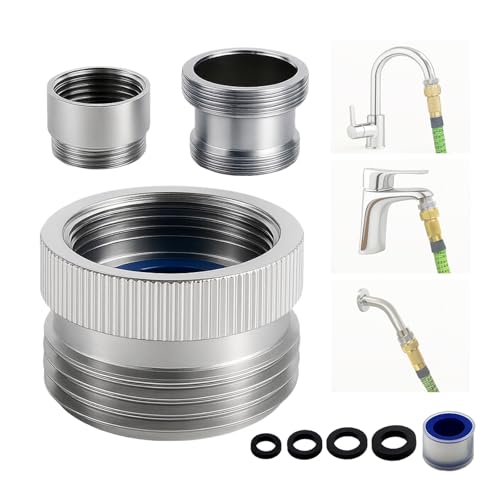
Enhanced Compatibility (3-Piece Set): Includes a 55/64" female-to-3/4" GHT male adapter for kitchen faucets, a 55/64" male-to-15/16" male converter for bathroom faucets, and a G1/2" female adapter that also works as a shower hose adapter, supporting shower arms, diverters, tees, and angle valves. All components connect to standard 3/4" GHT garden hose fittings
Seal the Connection: Gaskets, Thread Seal Tape, and Tightening Tips
A few simple steps will keep the hose‑to‑faucet connection leak‑free. First, pick a reliable gasket material—white rubber works best for standard faucets up to 1.5 inches wide. Seat the gasket fully into the faucet recess, pressing it until it compresses evenly. If the threads on the adapter look worn, wrap a thin strip of Teflon tape around them; use just enough to fill gaps without thickening the joint. Next, hand‑tighten the connector so the gasket pulls down and contacts the faucet bottom. Apply reusable tightening techniques: start loose, then give a firm, moderate twist—avoid overtightening. Finally, turn the water on and inspect for drips; adjust only if a leak appears. This method guarantees a stable, leak‑free seal. The connector’s design allows it to fit up to 90% of standard faucets, ensuring broad compatibility. For optimal durability, consider using a high‑grade brass fitting, which resists corrosion and provides a tighter seal over time. Properly wrapping the tape can also prevent water‑penetration at the thread junction, especially when using a tight‑wrap technique for extra security. Maintaining water pressure within the 40‑80 psi range helps ensure consistent flow and prevents strain on the hose.

Assortment kit:faucet washer and hose washer Assortment kit contains 134 PCS of 5 different beveled and flat faucet washer kits and 24 PCS of 1" garden hose washer kits, mostly used for sealing and repairing various outdoor faucet and garden hose connection
![M METERXITY 20-Pack Faucet Leak Proof Sealing Gasket, Tube Seal Sleeve Silicone Plugs Leak-Proof Sealing Gaskets for Plumbing Fixtures, Rubber Pipe Sealing Rings [White]](https://m.media-amazon.com/images/I/31gzesaVosL._SL500_.jpg)
[Multipurpose Use] - Widely used in home courtyards, kitchens, bathrooms or industrial hot and cold water systems, faucet sealing gaskets provide sealing solutions for different applications

【Faucet Leak-Proof Sealing Gasket】A must-have accessory for any piping system. Made of high-quality silicone material, it has excellent leak-proof performance and prevents the faucet triangle valve from dripping or leaking.
Fill With Hot Water, Use a Siphon, or Attach a Pressure Washer
How do you decide whether to fill, siphon, or power‑wash with your garden‑hose‑to‑faucet adapter? For a hot‑water fill, twist the bottom adjustment clockwise to the closed position, attach the hose to the middle outlet, then turn on the faucet. Hot water runs straight through the adapter, letting you control water temperature while maintaining a clean faucet flow path. To siphon, twist the adjustment counter‑clockwise and down, secure the hose, and open the faucet; the tap’s exit creates suction that draws water from the source. When attaching a pressure washer, use the brass 90‑degree elbow, connect the ¾‑inch hose, and guarantee the faucet’s flow path remains clear. Choose the mode that matches your task, then follow the simple install steps. The water nymph faucet adapter includes a gasket and brass fitting for a leak‑free connection. Ensure the hose’s pressure rating exceeds the maximum output of the pressure washer to prevent failure. Remember that using a garden hose for compressed air can cause pressure build‑up and lead to dangerous ruptures.
Drain via Siphon: How the Adapter Works for Water Evacuation
The adapter turns a regular faucet into an efficient siphon for draining pools, tanks, or any low‑lying water source. You twist the bottom valve counter‑clockwise until it’s fully open, then turn on the tap. Water exits the adapter’s bottom, creates a vacuum that pulls water through the garden hose attached to the middle outlet. Gravity and faucet flow maintain the siphon until the source level falls below the hose intake, giving you versatility for draining without extra pumps. The T‑joint design fits 90 % of standard faucets, and the snap adapters lock onto male 15/16‑27 or female 55/64‑27 threads, ensuring a secure seal. This makes the device ideal for emergency water evacuation, pool maintenance, or emptying raised beds quickly and reliably. Balcony cleaning is often easier when a hose can be attached directly to the faucet. Properly securing the hose with a hose clamp prevents accidental disconnection during use. Using a decorative hose reel can also keep the hose tidy and complement garden aesthetics. Rain barrel systems benefit from this setup by allowing easy transfer of collected water to garden beds.
Common Garden‑Hose Adapter Compatibility Issues and How to Verify Thread Sizes
Most garden‑hose adapters stumble over thread mismatches, so you’ll need to confirm whether the faucet uses GHT, NPT, or a regional variant before buying anything. Start by measuring the faucet’s external thread with calipers; a ¾‑inch straight thread signals GHT, while a tapered ¾‑inch indicates NPT. Compare the hose’s interior diameter—⅜”, ½”, ⅝”, or ¾”—to the coupling size; mismatched IDs cause leaks. If you spot partial threading, the threads are incompatible and you’ll need a cross‑thread adapter. For non‑standard taps (e.g., 7/8‑inch), seek customized adapter solutions that convert NPT or PVC to GHT. Verify fit by hand‑tightening the female hose coupling clockwise, then add a quarter‑turn; a snug, leak‑free seal confirms correct thread size and supports proper garden hose maintenance. Understanding flow rate helps you choose an adapter that maintains adequate water volume for your gardening tasks. Selecting the appropriate hose diameter, such as a 1/2‑inch or 5/8‑inch, ensures optimal flow capacity for residential lawns.

Chrome-plated brass for greater durability

[Garden Hose Adapter] Sink Adapter for Garden Hose to connect standard 3/4” Garden Hose. Tips: Remove the aerator when connecting the garden hose to obtain a larger water flow for flushing.

Type: Standard 3/4 inch garden hose thread female to 1/2 inch national pipe thread male.
Adapter‑Specific Safety: Prevent Over‑Pressure and Preserve Faucet Finish
A few simple steps can keep your faucet finish pristine while protecting your plumbing from dangerous pressure spikes. Install a pressure regulator right after the main shut‑off valve and set it to 60 PSI or lower. Use a gauge to verify the setting and adjust until you read 40‑60 PSI, the sweet spot for most quick‑connect adapters. Turn the water off, bleed the hose, then attach the brass connector—its corrosion‑resistant body handles the pressure without stressing the faucet aerator. Check that the adapter’s over pressure safeguards are engaged; they prevent spikes that could crack chrome plating. Regularly inspect the regulator and replace faulty seals to maintain adapter longevity and keep your faucet looking new. Larger hose diameter can increase GPM when pressure is adequate. Cleaning blockages before attaching the hose helps sustain optimal flow. Longer hoses experience greater friction loss due to increased surface contact, which can further reduce water pressure.
Low‑Cost Alternatives and Where to Buy Reliable Garden‑Hose Adapters
Keeping your faucet finish safe is only half the battle; now you need a budget‑friendly adapter that still performs. Plastic adapters cost $5.38‑$7.72 for a 3/4″ male thread, but you’ll face plastic adapter’s durability concerns after a few months of pressure. Nylon‑polymer hybrids stretch the life span while staying under $10. For quick‑connect reliability, brass kits run $13.74‑$15.25 and survive 115 PSI, making them worth the extra spend if you expect frequent use. Pick up these parts at Home Depot, Lowe’s, or Ace Hardware, and consider Harbor Freight for the cheapest basics. Specialty stores like Plumbing Supply or Grainger carry higher‑grade options. Store unused adapters in a dry drawer, preferably wrapped to prevent corrosion and keep threads clean.

Fits Removable Aerators: The package included adapters are designed to be compatible with faucets that have removable sink aerators. Make one purchase to get the right one for multiple sinks in your home. Note: Please check the dimensions of the faucet and hose, and choose one or two adapters to diy combine to connect your faucet and hose

Update & Improve Design: Hourleey hose splitter 2 way come with update design and high level quality. The update valve handles is more ergonomically designed, easier to use within less strength, friendly using for the stiff hands or hands with arthritis. And the brass hose splitter is more stronger than normal, built to last and never break. Easy to install without any tools.

Heavy Duty Metal Construction: Built with durable brass and metal materials; this garden hose splitter 2 way heavy duty design resists corrosion and leaks; perfect outdoor faucet splitter for year-round use