Most garden hoses still use PVC or brass fittings that can contain lead—about 33 % of hoses exceed 100 ppm lead in the material and brass fittings can hold 500‑16,000 ppm. Even “lead‑free” hoses can leach 13‑20 ppb into drinking water, crossing the EPA’s 15 ppb action level, especially when heated, sun‑exposed, or stagnant. Safer options are polyurethane, rubber, or hybrid polymers with stainless‑steel, nickel, or aluminum fittings, and you should verify NSF‑51 or similar certification. Check the hose label for full‑system “drinking‑water‑safe” claims, inspect for wear, and flush regularly; the next sections will guide you through choosing, decoding labels, and testing for safety.
Do Garden Hoses Usually Contain Lead?
Do garden hoses usually contain lead? You need to treat the data as a risk matrix. In a 2016 sample of 32 hoses, 29 % of PVC hoses showed ≥100 ppm lead, with peaks up to 68 000 ppm. One‑third of all hoses exceeded 100 ppm, especially in flexible PVC sections and metal fittings. Metal brass fittings contributed 500‑16 000 ppm lead, and 13 % of hoses had lead‑laden fittings. Water tests from half the hoses revealed 13‑20 ppb lead, crossing the EPA 15 ppb action level. Non‑PVC alternatives (polyurethane, drinking‑water‑safe) showed no detectable lead. The lead contamination risk is high for older, PVC‑based garden hoses, and lead exposure concerns should drive you toward certified lead‑free options. Regularly flushing hoses can reduce biofilm buildup and lower bacterial contamination. Proper maintenance also helps prevent Legionella growth in stagnant water. Many municipalities now accept garden hoses for recycling if they are made of recyclable PVC and free of lead‑containing fittings.

Premium-Grade RV Drinking Water Hose 25ft: Camco's premium-grade RV fresh water hose is constructed with NSF/ANSI 61 certified hose for drinking water. Lead, BPA, & phthalate-free, this drinking water hose prioritizes your health with every use.
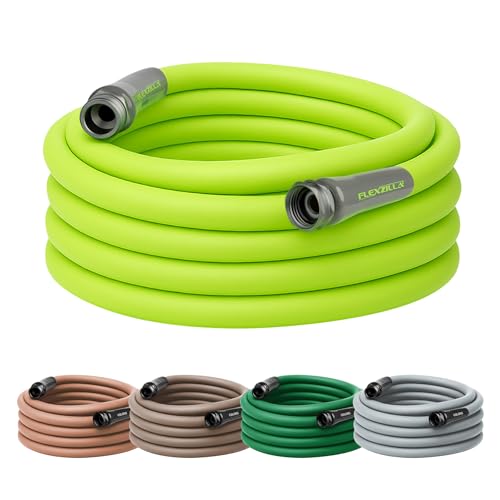
AWARD-WINNING: HGTV, USA Today and Best Reviews voted Best Overall Garden Hose

Professional Elite Drinking Water Hose for RV: The Camco EvoFlex2 RV water hose delivers premium quality and safety, crafted to be lead-free, BPA-free, & phthalate-free—prioritizing your health and peace of mind with every use.
How Much Lead Can Leach From a Lead‑Free Garden Hose?
A lead‑free garden hose can still release measurable lead into drinking water, with test results showing 13 ppb, 19 ppb, and 20 ppb—values that hover around or exceed the EPA’s 15 ppb action level. You should note that leaching isn’t a one‑off event; lead leaching duration matters because heat, sunlight, and stagnation accelerate transfer from brass fittings and plastic sections. In the sample set, 33 % of hoses exceeded 100 ppm lead in material, and fittings showed up to 16 000 ppm, yet water concentrations stayed near the 13‑20 ppb range. Those numbers sit at or above lead concentration thresholds that trigger regulatory action. Even “lead‑free” labels permit trace amounts, so continuous exposure risk persists, especially for older hoses or those stored in hot, sunny conditions. The taste of water from a hose can also be affected by biofilm buildup on the interior surface, which may introduce additional flavors and contaminants. Regular flushing can help remove mineral deposits that contribute to discoloration and potential lead release. The flow rate of a hose is directly influenced by its diameter and pressure, making larger‑diameter hoses capable of delivering more water per minute.

Premium Grade Drinking Water Hose: Camco's premium-grade RV fresh water hose is constructed with NSF/ANSI 61 certified hose for drinking water. Lead, BPA, & phthalate-free, this quality PVC hose prioritizes your health with every use.
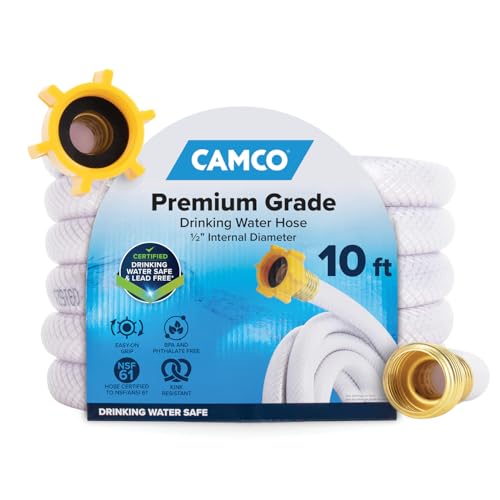
Premium Grade Drinking Water Hose: Camco's premium-grade RV fresh water hose is constructed with NSF/ANSI 61 certified hose for drinking water. Lead, BPA, & phthalate-free, this quality PVC hose prioritizes your health with every use.

AWARD-WINNING: HGTV, USA Today and Best Reviews voted Best Overall Garden Hose
Which Materials Make a Lead‑Free Garden Hose Safer Than PVC?
Most non‑PVC hoses—especially polyurethane, rubber, and hybrid polymer models—outperform PVC in every measurable safety metric. Polyurethane toxicity levels sit near zero, while 29 % of PVC hoses contain 100‑68 000 ppm lead and 75 % harbor phthalates. Polyurethane also avoids bromine, antimony, and tin, and its chemical‑resistance testing shows negligible leaching into drinking water. Rubber hose advantages include consistently low heavy‑metal content, absence of lead in brass connectors, and durability without added additives. Both materials meet NSF/ANSI 61 and 372 standards, and California Prop 65 limits keep contaminants below health‑risk thresholds. Choose hoses with stainless‑steel, nickel, or aluminum fittings to eliminate residual lead from brass. This data‑driven selection cuts exposure risk far beyond what PVC can offer. A diesel nozzle cannot fit into a gasoline tank due to different nozzle size standards. Selecting a hose with a ½‑inch diameter provides a balanced flow rate for most residential lawns while maintaining manageable water pressure.

VERSATILE. BALANCED. THE SWEET SPOT: Not too light, not too heavy - the 500 Series finds the perfect balance between performance and comfort. With a 1/2" inner diameter, it delivers plenty of water flow while staying flexible, manageable, and easy to maneuver.

AWARD-WINNING: HGTV, USA Today and Best Reviews voted Best Overall Garden Hose

AWARD-WINNING: HGTV, USA Today and Best Reviews voted Best Overall Garden Hose
How to Decode Drinking‑Water‑Safe Labels on a Lead‑Free Garden Hose?
Polyurethane and rubber hoses already beat PVC on safety metrics, so the next step is to interpret the “drinking‑water‑safe” label that many of these lead‑free models carry. First, verify hose material certifications: look for NSF‑51 or equivalent third‑party testing that confirms leachate below EPA’s 15 ppb lead threshold. Identify safe lead‑free labels by cross‑checking two claims: “drinking‑water‑safe” (no detectable lead, bromine, antimony, tin) and “lead‑free” (entire hose, not just couplings). Note that 30 % of “drinking‑water‑safe” hoses still contained phthalates, so prioritize polyurethane versions that showed zero chemicals of concern. Avoid PVC entirely; its leachate routinely exceeds EPA limits by orders of magnitude. This systematic check minimizes toxic exposure risk. Sprinkler systems can also introduce contaminants, so consider source water quality when evaluating hose safety. For additional context, review the sprinkler water safety guidelines. Also, be aware that chemical residues from treated water can accumulate in hose material over time.

VERSATILE. BALANCED. THE SWEET SPOT: Not too light, not too heavy - the 500 Series finds the perfect balance between performance and comfort. With a 1/2" inner diameter, it delivers plenty of water flow while staying flexible, manageable, and easy to maneuver.

SLIM DESIGN: The 400 Series features a 7/16" inner diameter that offers the perfect balance of water flow and flexibility - perfect for smaller gardens, raised beds, patios, or anyone who prefers a lighter, easier-to-handle hose.
LIGHTWEIGHT. CLEAN WATER. EASY HANDLING. Perfect for gardeners who want a lightweight, easy-to-handle hose that's safe for drinking water, edible gardens, pets, and everyday watering. Ideal for raised beds, container gardens, patios, flowers, vegetables, and anyone looking for an easier alternative to a heavy traditional hose.
How to Choose a Lead‑Free Garden Hose for Your Home?
Why settle for a hose that could leach toxins into your garden? First, scan the label for “drinking water safe” and “phthalate‑free.” Those two together confirm compliance with FDA, NSF, and the Safe Drinking Water Act, cutting lead exposure to near‑zero. Next, eliminate PVC; choose polyurethane (PU) or rubber, which Ecology Center tests showed contain no detectable lead, bromine, or antimony. Verify that garden hose fittings are also lead‑free, because a safe body means nothing if couplings leach. Prioritize hose performance features like UV‑stabilization, abrasion resistance, and lightweight construction (≈3 lb per 50 ft) to guarantee durability without chemical degradation. Finally, look for third‑party certifications—California Prop 65, NSF, or brand‑specific testing—to validate the hose meets all risk‑based standards. Local store policies may differ, so confirm acceptance before donating. Consider the pressure rating to ensure consistent flow under high‑water demand. Understanding garden hose thread sizes helps match fittings correctly.
SLIM DESIGN: The 400 Series features a 7/16" inner diameter that offers the perfect balance of water flow and flexibility - perfect for smaller gardens, raised beds, patios, or anyone who prefers a lighter, easier-to-handle hose.
VERSATILE. BALANCED. THE SWEET SPOT: Not too light, not too heavy - the 500 Series finds the perfect balance between performance and comfort. With a 1/2" inner diameter, it delivers plenty of water flow while staying flexible, manageable, and easy to maneuver.

SLIM AND EASY TO HANDLE: The 300 series features a 3/8-Inch inner diameter for a perfect mix of flow and flexibility. It's light, compact, and effortless to use - ideal for everyday gardening, patio plants, RV's and boats. Stretches up to 80% of it's length, then springs back for easy storage. Our 25 foot coil reaches ~20 feet.
How to Maintain and Test Your Lead‑Free Garden Hose for Safety?
A few simple steps keep your lead‑free garden hose safe and reliable. First, checking hose durability means inspecting the outer coating for cracks, abrasions, or stiffness; any soft spots could indicate material degradation that raises contamination risk. Next, monitoring hose condition requires a visual sweep before each use—look for discoloration, brittleness, or kinks that could trap water and leach residues. If you suspect wear, run cold water through the hose for three to five minutes to flush stagnant water, then collect a sample from the nozzle for lab analysis. Follow a certified laboratory’s protocol and repeat annually or after any repair. Finally, store the hose coiled in shade, avoid direct sunlight, and replace it when visual or test data show compromised integrity. Plastic pipes are safe and not made of lead, so identifying them rules out lead contamination. Ensure the hose meets Schedule 40 PVC pressure specifications for irrigation use. Properly sized pressure regulator helps maintain consistent flow and protects the system from over‑pressurization. Understanding the difference between garden hose threads and NPT connections can prevent mismatched fittings that might compromise the hose’s integrity.