You’ll find that fire sprinklers stay on for at least 30 minutes, which is the minimum set by the International Building Code for most wet‑pipe systems. Dry‑pipe, pre‑action, and deluge systems follow the same baseline but can run longer if the occupancy is high‑hazard or if local AHJ approvals require extra time. Residential sprinklers under NFPA 13D or 13R only need a 10‑minute minimum, while ESFR heads may operate up to 120 minutes in extreme cases. The exact duration depends on system type, hazard classification, and code‑mandated flow requirements—continue for deeper details.
How Long Do Fire Sprinklers Stay On?
When a fire activates a sprinkler, the system is designed to deliver water for a prescribed minimum duration, typically 30 minutes, but often 1 hour or 2 hours depending on occupancy and building design. You must verify water supply requirements against the International Building Code, which mandates at least a 30‑minute secondary water supply for high‑rise and seismic‑category structures. For low‑hazard occupancies, the code permits the 30‑minute baseline, while fire‑separation barriers such as window sprinklers demand extended durations matching their fire‑rating, often 2 hours. Designers calculate secondary water supply durations by summing total hose‑stream demand and sprinkler demand, then confirm the system can sustain flow for the required period. Compliance documentation, AHJ approval, and insurance clauses may further extend these durations beyond the code minimum. Proper head‑to‑head coverage is essential for even water distribution. Properly designed sprinkler systems can reduce fire damage by up to 70 % and increase occupant survival rates, underscoring the importance of adequate water supply planning. Understanding the role of heat‑sensitive glass bulbs helps explain why automatic activation occurs without human intervention. Regular functional testing verifies that each sprinkler responds correctly to heat, ensuring reliability when needed.
Which Sprinkler System Type Sets the Fire Sprinkler Runtime?
The fire‑sprinkler runtime is dictated primarily by the system type, because each design—wet pipe, dry pipe, pre‑action, deluge, or ESFR—has its own code‑specified duration based on occupancy hazard and water‑supply requirements. You’ll find that wet‑pipe systems, the most common, hold constant pressure and follow NFPA 13 occupancy hazard classification, delivering at least 30 minutes for light‑hazard spaces. Dry‑pipe systems rely on pressurized air; their reliability drops after ten years, so you must test quarterly and replace sprinklers to maintain the required 30‑minute minimum. Pre‑action units add detection before water release, extending runtime only when a fire is confirmed, while deluge systems discharge all heads simultaneously, with duration set by the same classification but often longer for high‑hazard areas. ESFR sprinklers, built for rapid suppression, can run up to 120 minutes in storage, balancing response‑time indices with system reliability. The practical upper limit for ESFR systems is influenced by hazard classification and ceiling height, which affect required flow and pressure. Wet‑pipe systems are praised for their quick activation and cost‑effectiveness in most climates. A sprinkler will not fire from mere contact because its thermal activation mechanism requires a specific temperature rise rather than physical pressure.

Compact Design: With dimensions of 1x1x8 inches, this rooftop sprinkler is compact and can fit in most spaces.

🛠️ EASY TO INSTALL – Features a standard 1-inch inlet connection for fast, tool-free setup with most residential water or irrigation systems.

What Are Typical Fire Sprinkler Runtime Standards for Residential and Care‑Facility Buildings?
Typical fire‑sprinkler runtime standards for residential and care‑facility buildings differ mainly in duration and head count. In residential design features, NFPA 13D mandates one or two heads to deliver up to 40 gpm for a minimum of 10 minutes, while NFPA 13R permits smaller heads with 15‑26 gpm each, still holding the 10‑minute minimum. You’ll find that 90 % of home fires activate only one or two heads, so the short discharge suffices for escape. Care‑facility systems follow NFPA 13, which treats them as commercial, requiring higher commercial flow requirements—often 26 gpm per head—and sustained operation across multiple heads to control or extinguish a fire. Their hydraulic design thus supports longer runtimes than residential setups. Dry‑pipe systems must be filled with water before they can discharge, which adds a brief delay compared to wet‑pipe systems. Sprinklers significantly reduce casualty rates by suppressing flames and limiting smoke spread. The automatic detection of fire relies on heat‑sensitive elements that trigger the sprinkler head when a predefined temperature is reached.
What Temperature Actually Makes a Sprinkler Head Pop?
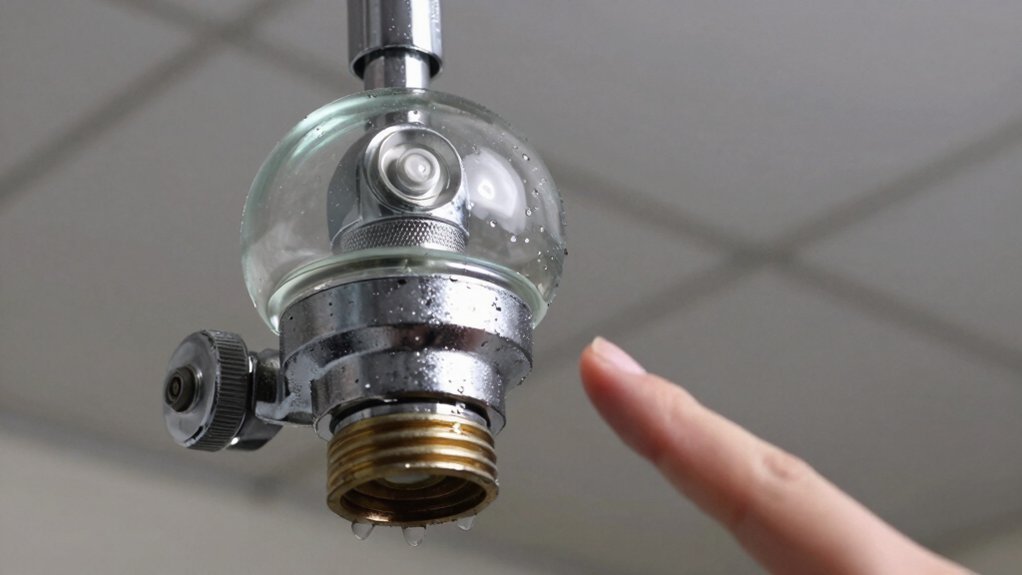
Different runtime standards dictate how long a sprinkler must discharge, but the moment it starts depends on a single factor: temperature. You’ll see that a glass bulb filled with heat‑sensitive liquid expands as ambient heat rises; pressure builds until the bulb shatters at its calibrated threshold, releasing the valve. Fusible links work similarly, softening and melting at a preset temperature, then freeing the plug so water pressure forces water out. Sprinkler orientation impacts activation because heat rises and pools near the ceiling, so a head pointing upward reaches its rating faster. Sprinkler placement and temperature classification—ordinary (135‑170 °F), intermediate (175‑225 °F), high (250‑300 °F), extra high (≥325 °F)—determine the exact pop point, ensuring discharge only when the fire’s air temperature exceeds the designed limit. Most standard sprinklers are calibrated to activate at around 155 °F (68 °C), though specialized systems may use higher thresholds. Understanding the activation temperature is essential for proper system design and safety.
How Do I Test My Sprinklers to Verify Runtime and Activation?
When you verify a sprinkler system’s runtime and activation, start with a thorough visual inspection to spot damage, corrosion, leaks, or obstructions on heads, pipes, valves, and control panels. Conduct a sprinkler head inspection on each accessible unit, noting any cracked or missing components. Close the alarm control valve and open the main drain valve to perform a main‑drain test, recording residual pressure to confirm supply adequacy. Next, execute periodic flow testing: simulate activation, measure flow and pressure at the riser for at least 30 seconds, and validate gauge readings meet NFPA limits. Trigger the detection alarm and observe bell or strobe operation. Finally, remove a representative sample of heads for plunge testing, calculate response‑time indices, and replace any failing units. This structured approach guarantees accurate runtime verification and reliable activation performance. Check gauge on the riser to ensure correct pressure before testing. Elevator shafts often require sprinkler protection to meet fire safety codes and prevent vertical fire spread. Fire extinguishers remain essential for localized fire suppression even when a sprinkler system is installed.

PORTABLE IRRIGATION SYSTEM TESTER: The Model 24BK Station Master Pro is a highly portable, battery-operated sprinkler valve locator, ideal for quick troubleshooting and diagnosing faults in irrigation systems.

Effortless Yard Irrigation Setup: The Orbit All-in-One Automatic Watering System simplifies yard irrigation with a complete 2-zone automatic sprinkler system designed to deliver consistent watering

17 IMPORTANT PARAMETERS: The Varify Premium Drinking Water Test Kit offers an unrivaled, complete analysis of your drinking water by testing for 17 essential parameters. This includes crucial tests for chlorine, fluoride, lead, iron, bacteria, and more, ensuring that you're fully informed about the quality of your water. With this extensive range of testing capabilities, you can detect contaminants and imbalances that could affect your health, providing a holistic view of your water's safety.
How Can I Balance Water Conservation and Fire Sprinkler Runtime?
Balancing water conservation with fire‑sprinkler runtime starts with selecting efficient heads and calibrating system pressure to deliver the minimum flow needed for extinguishment. You should adopt water conservation practices such as installing low‑flow heads, reducing pump pressure, and scheduling monthly tests instead of weekly to cut usage by over 50 %. Integrate recycled water use by connecting greywater or rainwater tanks, employing nitrogen inerting to keep water clear for reuse, and installing recirculation loops that capture drained water. Regular inspections and leak‑control measures keep the system tight, while pressure‑relief valve adjustments limit drain during tests. By combining these technical steps, you maintain reliable fire protection while minimizing overall water consumption. Commercial refrigeration units often require fire‑sprinklers to meet NFPA 13 standards for fire safety. Buildings exceeding occupancy‑type thresholds must also consider sprinkler installation per the International Building Code. Understanding local climate helps determine the optimal balance between water use and fire protection needs.

INDISPENSABLE TOOL TO HAVE AT HOME OR OFFICE: Quickstop fire sprinkler heads emergency shutoff tool can shut off an accidentally activated fire sprinkler in seconds, reducing water damage and keeping the rest of the building safe by allowing the other fire sprinklers in the system to remain active while waiting for the damaged head to be replaced.

Ensure your building is compliant with a Spare Head Fire Sprinkler Cabinet. Every building should have spare fire sprinkler heads in case of emergency! For fire sprinkler systems adhering to NFPA 13 and NFPA 25 guidelines, you should have a supply of at least 6 spare fire sprinkler heads for a system with 300 or fewer sprinklers. This fire protection box allows for storage of up to 6 spare heads, able to fit 1/2 in. NPT fire sprinkler heads, or, using the “knockouts,” 3/4 in. NPT heads.

Versatile Compatibility: Our universal fire sprinkler head wrench is designed to fit all major brands of 1/2" fire sprinkler heads, including pendent, upright, and horizontal fragile bulb fire heads. It's the perfect tool for maintenance personnel who encounter multiple brands of sprinkler heads in buildings