You still need portable fire extinguishers even if you have a sprinkler system because codes like NFPA 13 and OSHA 1910.160 require them for localized, early‑stage fire control and for hazards that sprinklers may miss. Extinguishers give you immediate, manual suppression of incipient fires, grease fires, or electrical incidents while the water‑based system is still activating. They also serve as a backup to prevent re‑ignition and limit water damage. Keep reading to ascertain how to integrate both systems effectively.
Key Differences Between Sprinklers and Extinguishers
One key difference lies in activation: sprinklers fire automatically when a head reaches its temperature trigger, while extinguishers require a trained person to pull the pin and discharge. In design flexibility, sprinkler networks can be engineered to protect entire floor plates, warehouses, or open‑plan offices through a coordinated pipe layout, whereas extinguishers remain portable units placed at fixed intervals for localized response. From a risk‑management perspective, sprinklers deliver 24/7, unattended suppression, reducing reliance on human action during unoccupied periods; extinguishers demand regular training, inspection, and manual deployment, introducing potential human error. Regulatory codes mandate sprinkler installation in many commercial settings, while also requiring extinguishers for Class B and C hazards where water is unsuitable, ensuring layered protection and compliance. Sprinklers can reduce fire‑related property loss by up to 70 % and improve occupant survival rates, making them a critical component of comprehensive fire protection. Properly designed systems also incorporate heat‑sensitive sensors that trigger the control valve when a fire is detected. The thermal activation mechanism prevents discharge from mere contact, requiring sufficient heat exposure from a fire.
How Sprinklers and Extinguishers Detect and Suppress Fires
When a fire starts, sprinklers and portable extinguishers rely on fundamentally different detection and suppression methods. Sprinkler heads use heat‑sensitive elements—glass bulbs that shatter at 135‑165 °F or fusible links that melt—to trigger activation thresholds. The localized heat release breaks the cap, allowing water to flow through a deflector that creates a wide spray pattern, cooling the fire and displacing oxygen. Extinguishers depend on occupants who manually detect smoke, heat, or flame and then pull the pin, squeeze the lever, and discharge a pressurized agent through a nozzle. The user must aim at the fire base, applying dry chemical, CO₂, foam, or water to interrupt the fire triangle. Both systems target heat, fuel, and oxygen, but sprinklers operate automatically 24/7, while extinguishers require human intervention. Most standard sprinklers are set to activate at around 155 °F (68 °C) to match common fire safety codes. The duration that a sprinkler remains active can vary based on heat level and fire size.
What Regulations Force You to Keep Both Sprinklers and Extinguishers
Because fire codes treat sprinklers and portable extinguishers as complementary safeguards, you must keep both to meet the overlapping requirements of the IBC, NFPA, and OSHA. The IBC mandates sprinklers for high‑rise, school, hospital, and large‑assembly occupancies, while NFPA 13 and NFPA 25 prescribe installation protocols, inspection, and maintenance schedules. NFPA 10 establishes standards criteria for extinguisher type, quantity, and placement, and OSHA 1910.160 requires employers to supply appropriate units on each floor and near flammable hazards. Local AHJs may approve alternatives, but they still enforce the dual‑system rule: sprinklers control fire growth, extinguishers provide immediate, portable response. Compliance with these codes guarantees redundancy and safeguards life and property. Early water deployment from sprinklers can significantly reduce smoke spread and improve evacuation safety. Smoke detectors operate independently of sprinklers, detecting fire early and triggering alarms before water is released. Properly designed shaft protection also requires elevator shaft sprinkler systems to meet the specific fire‑resistance ratings outlined in the building code.
Cost‑Benefit Comparison of Sprinklers and Extinguishers
A typical Broward County home sees an upfront sprinkler investment of roughly $5,291, offset by $1,271 in infrastructure savings, yet the net benefit climbs to $6,796 per residence and total advantages—including lives saved and reduced damage—reach $10,816. You’ll compare installation costs against the $13,947.18 uninsured indirect cost of a fire without automatic suppression. Sprinklers, at $2.78 per square foot, deliver broader coverage, lower maintenance, and higher application suitability for standard residential layouts, whereas portable extinguishers address localized, high‑risk scenarios such as grease or electrical fires. Quantitatively, sprinklers generate a $10,815.75 total benefit, outpacing the modest expense of extinguishers while complying with fire‑code mandates for dual‑system protection. Dry‑pipe systems keep pipes empty until a fire triggers a valve, providing protection in freezing environments.
When a Portable Extinguisher Is the Best First‑Response Tool
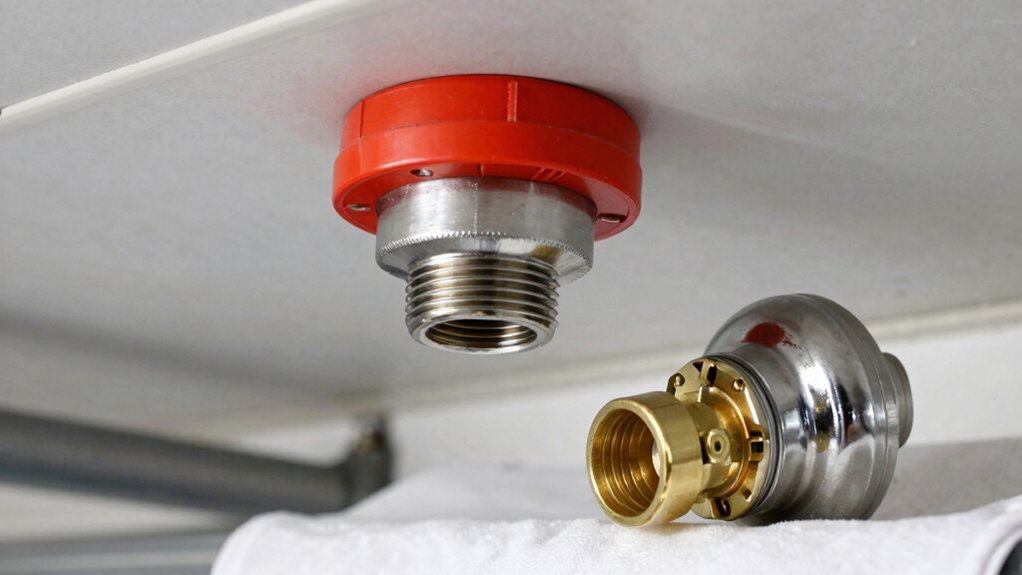
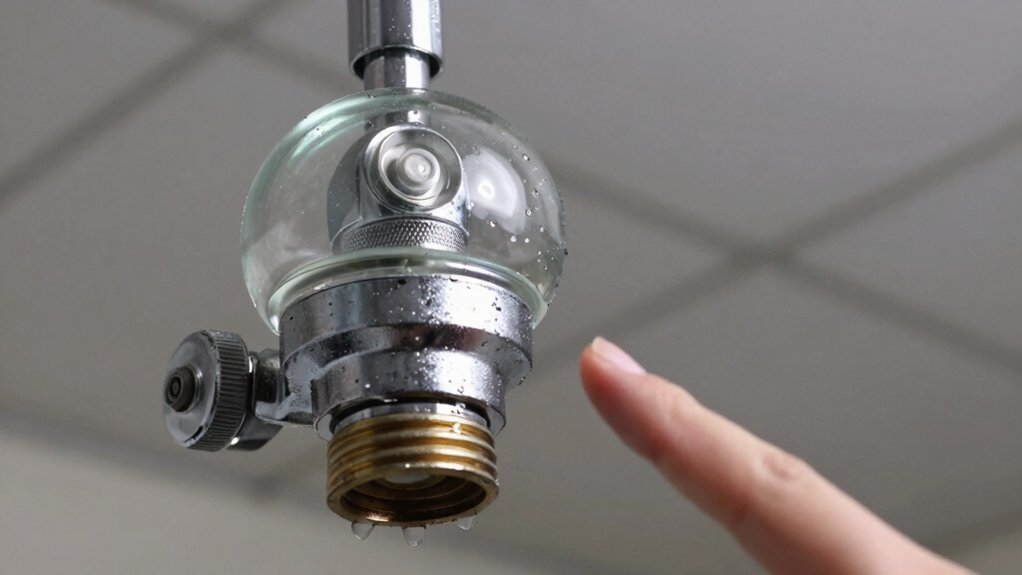
If you spot a smoldering trash can or a kitchen pan flare, you can grab the nearest class‑A or class‑B extinguisher and act within seconds, containing the fire before it escalates. Portable extinguisher deployment follows the 3 A’s protocol: activate the alarm, assist those in danger, then attempt suppression. You must confirm fire type, size, and that a clear escape route exists before discharging. Extinguisher training requirements mandate that only personnel who have completed certified instruction evaluate smoke toxicity, maintain low posture, and evacuate if the fire spreads or the extinguisher empties. These guidelines guarantee the incipient‑stage fire is extinguished safely, preserving life and property until fire‑department arrival. Properly installing a new sprinkler head requires shutting off the water supply and using a wrench to remove the old fitting safety valve before attaching the replacement. The valve’s transparent cover lets you inspect the diaphragm for wear. Regularly checking the valve’s water resistance can prevent moisture‑related failures.
Designing an Integrated Fire‑Safety Plan
Portable extinguishers complement sprinkler coverage by handling incipient fires that the system’s temperature trigger may miss, so an integrated fire‑safety plan must map each suppression tool to its best/most suitable role. You’ll start by inventorying all hazards, classifying them, and assigning the appropriate extinguisher type—A, B, C, or K—to each zone. Then you align sprinkler heads, alarms, and kitchen‑specific systems to create layered redundancy. Follow compliant documentation procedures: record device locations, maintenance schedules, and inspection results in a central log that meets NFPA 13, NFPA 25, and OSHA requirements. Incorporate life safety considerations by ensuring egress paths remain clear, water damage is minimized, and response times meet occupancy‑classification standards. Finally, conduct quarterly drills to verify that personnel understand the coordinated deployment of each suppression method. Sprinkler systems become mandatory when a building exceeds square‑footage thresholds set by the International Building Code and NFPA 13. Maintaining a minimum distance of 12 inches between smoke detectors and sprinkler heads helps prevent false alarms caused by spray interference. Understanding heat‑sensitive glass bulbs is essential for recognizing how automatic activation occurs.
Practical Checklist for Sprinklers and Extinguishers
Most facilities can streamline compliance and safety by following a concise, step‑by‑step checklist that aligns sprinkler coverage with extinguisher placement, verifies that each fire‑hazard zone has the correct class of extinguisher, and documents inspection dates, refill intervals, and pressure readings in a centralized log that satisfies OSHA, NFPA 13/25, and IBC requirements. First, map sprinkler heads to zones and confirm they meet NFPA 13 spacing and discharge criteria. Next, assign at least one 2A‑rated extinguisher per 3,000 ft², selecting Class A, B, C, or K agents where appropriate. Record early fire detection system integration and guarantee extinguishers serve as backup safety measures for small‑scale incidents. Finally, schedule quarterly inspections, verify pressure gauges, and log refills, retaining records for audit and insurance purposes. Regularly inspect sprinkler wiring for moisture‑induced corrosion to prevent electrical hazards. Testing solenoid continuity can also help identify hidden electrical failures before they affect system performance.
Case Studies: Extinguishers Preventing Damage When Sprinklers Activate
Typically, extinguishers serve as the critical backup when a sprinkler system activates, ensuring that residual heat or flame pockets are fully suppressed before they can reignite. In the Manchester Mill warehouse fire, three sprinkler heads limited the blaze, but you deployed a portable extinguisher to achieve immediate extinguishment of a lingering hot spot, preventing re‑ignition and eliminating the need for structural repairs. A comparative assessment of the Retail Stockroom incident shows that a handheld extinguisher sealed a small flame pocket after sprinkler activation, confining water damage to the stockroom and allowing 95 % of the facility to resume operations within 48 hours. Similar outcomes appear in the Shopping Mall storage fire, Industrial Manufacturing fire, and Apartment Kitchen fire, where extinguishers complemented sprinkler action, reduced secondary damage, and facilitated rapid business continuity. Wet‑pipe systems provide continuous water availability, allowing extinguishers to target remaining heat sources efficiently. Properly calibrated hydrostatic testing confirms system integrity before deployment, further enhancing safety.