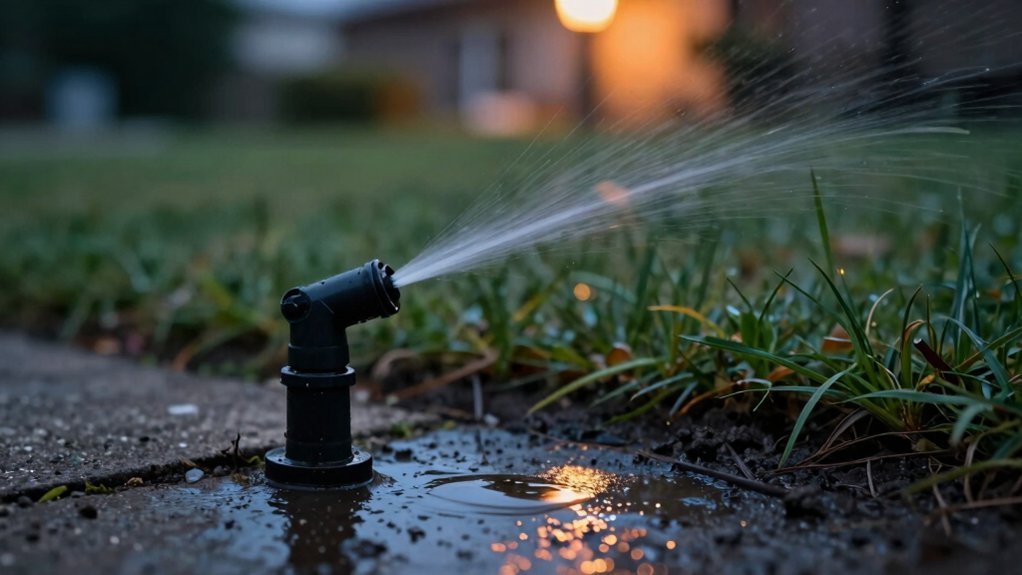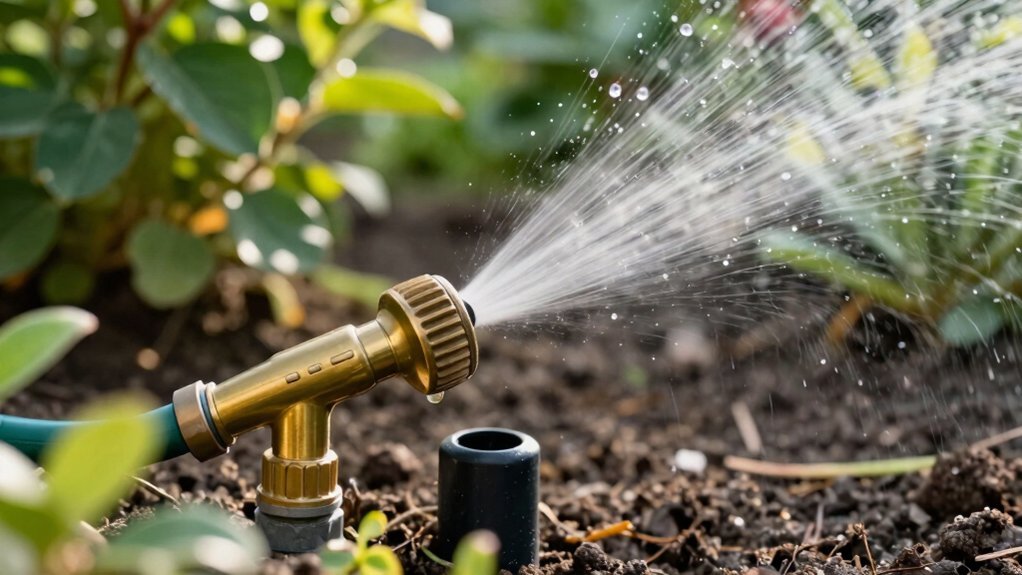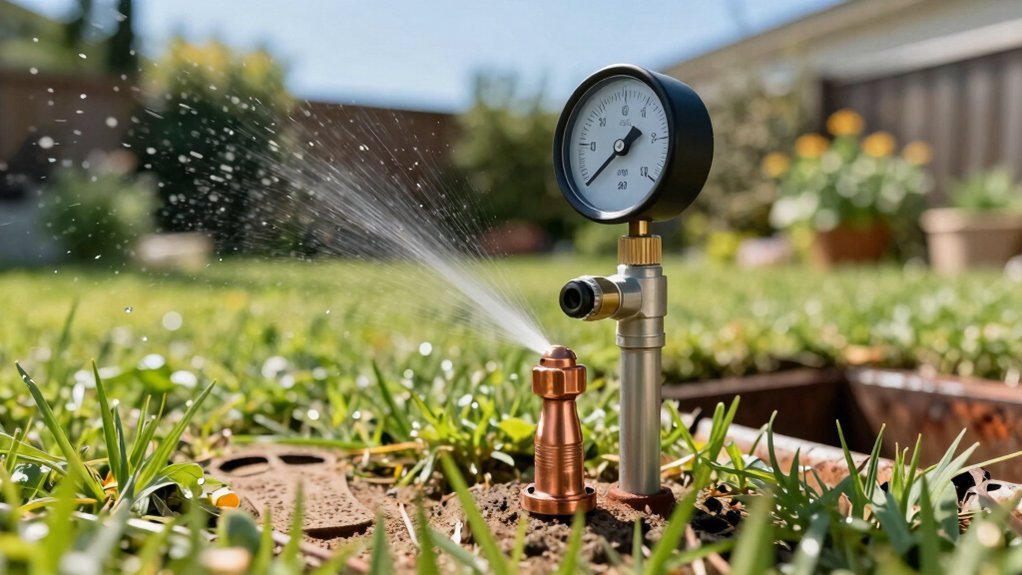
A sprinkler tool is a pressure‑driven irrigation device that atomizes water into a controlled spray pattern, delivering precise, uniform moisture to lawns and garden beds while conserving water and cutting manual effort. It connects to your hose or pump, uses a nozzle or rotating head to create rotary, oscillating, impact, or stationary patterns, and can be programmed for zone‑specific watering based on soil moisture and weather data. Adjusting pressure and flow matches the tool to your landscape, and the right setup guarantees even hydration and reduced waste, leading you to deeper insights on ideal selection and maintenance.
Why Every Gardener Should Have a Sprinkler
When you automate watering, you instantly gain convenience and time savings: the timer schedules eliminate manual intervention, letting you focus on other tasks while the system delivers precise, zone‑specific irrigation. Integrated moisture sensors and weather‑responsive algorithms adjust flow rates, ensuring efficient water coverage and minimizing runoff. This consistency drives lawn health improvement by providing uniform hydration, fostering deeper root development and reducing disease susceptibility. Programmable zones let you tailor delivery to varied plant types, preventing over‑watering and conserving utility costs. The in‑ground architecture reduces evaporation compared to handheld hoses, and the system’s ability to pause during rain events further curtails waste. Overall, the technology delivers a reliable, low‑maintenance solution that enhances landscape vigor and operational efficiency. Automated sprinklers also support soil moisture optimization by delivering water only when needed. Modern timers often incorporate rain‑sensor integration to automatically suspend watering during precipitation. Adding a rain sensor can detect precipitation and trigger immediate shut‑off, preventing unnecessary water use.
Compare Pros and Cons of Rotary Sprinklers
Automated irrigation gives you consistent timing, but the real performance difference shows up in the nozzle type. Rotary sprinklers deliver rotational consistency, creating a multi‑stream pattern that yields 20‑30 % lower water use than traditional sprays. Their low precipitation rate (0.5‑1 in/hr) minimizes runoff, especially on sloped or clay soils, and the heavier droplets improve wind dispersal, reducing blow‑off. Coverage uniformity spans medium to large lawns, with long‑range throw and reduced dry spots. Maintenance is straightforward; you can open, wash, and reuse the rotor, and clogging is rare. However, the slow application rate extends run times, and in high winds you may still see overspray onto hardscapes. Balance these trade‑offs to match your garden’s topology and climate. Modern systems often incorporate soil moisture sensors to further reduce waste. Choosing the right sprinkler head can also enhance efficiency by matching flow rate and coverage pattern to your garden’s specific needs. The psi range of a system directly influences the achievable throw distance and uniformity.
Compare Pros and Cons of Oscillating Sprinklers
Oscillating sprinklers can cover up to 4,000 sq ft. with sufficient pressure, delivering a fan‑shaped spray that spreads evenly across medium‑sized rectangular lawns. You’ll appreciate the adjustable width and length, which enable precise even lawn coverage while minimizing overlap. The gentle, non‑continuous flow mimics rainfall, yet the airborne spray reduces water usage efficiency and heightens evaporation loss, especially in windy or hot conditions. Edge‑to‑center distribution can be uneven, applying more water to perimeter zones and wetting foliage, which may foster disease in vegetable plots. On the plus side, the units are affordable ($6‑$25), low‑maintenance, and portable, requiring 40‑80 PSI. However, clogging from grass clippings and reduced performance on irregular or circular areas limit suitability. Even root development is promoted by the gentle, consistent moisture that mimics natural rain patterns. Proper soil moisture levels are essential for sustaining photosynthesis and healthy growth. Adjusting watering time based on soil type helps prevent runoff and ensures deep root penetration.
When to Use an Impact Sprinkler for Big Circular Lawns
An impact sprinkler shines on expansive circular lawns because its rotary head delivers a uniform, high‑volume spray that can cover up to 5,670 sq ft. with a single unit. You should select the ideal sprinkler size for expansive lawns by matching the 5,670 sq ft rating to your plot’s diameter; a 24‑inch radius works well for 5,000‑6,000 sq ft areas. Adjust the collar to 360° for full‑circle coverage, then fine‑tune the diffuser pin to achieve the desired jet range. When terrain is slightly uneven, mitigate sprinkler performance on uneven terrain by using the brass‑weighted arm to control stream trajectory and setting the deflector shield to a narrower arc. This reduces overspray, maintains consistent water depth, and prevents runoff on slopes. Soil type also influences the optimal spray radius and water pressure settings. Properly accounting for soil moisture retention can further optimize water distribution and plant health.
Stationary Sprinklers for Small Beds and Tree Watering
Looking to irrigate a tight flower bed or a newly planted tree without the hassle of moving a sprinkler around? A stationary sprinkler offers a fixed, elevated discharge head that projects water in circular or square patterns, ideal for compact zones. Its user‑friendly setup involves mounting a pole on a base, then attaching a hose with a metal filter to prevent clogging. The unobtrusive appearance blends with garden architecture while delivering gentle, targeted irrigation at 15‑30 PSI. Adjustable width and range let you fine‑tune coverage up to 30 feet, and the lack of moving parts minimizes mechanical failure. Choose fan‑like or full‑circle configurations for even wetting of shrubs, borders, and young trees, ensuring efficient water use and rapid discharge. Water efficiency can be further enhanced by selecting a model with a built‑in pressure regulator. The system’s flow dynamics are optimized through precise nozzle design, which maintains consistent pressure and reduces overspray. Proper sprinkler spacing ensures uniform coverage and minimizes water waste.
Key Sprinkler Parts to Check
Stationary sprinklers keep the discharge head fixed, so any performance drop points directly to the hardware. First, examine each sprinkler head for physical damage, corrosion, or paint buildup that can obstruct activation. Remove the head, pull the filter, and rinse it to eliminate filter clogging issues; a clean screen restores flow. Inspect the nozzle for clogs and verify nozzle maintenance requirements by checking the rotating stream and stem attachment. Next, test valves: disassemble the bonnet, inspect the diaphragm, spring, and support ring for cracks or leaks, and confirm the valve stays fully open. Finally, audit pipes and fittings for corrosion, improper support, or hidden damage that could restrict water travel. Replace any compromised component to preserve system efficiency. Clogged heads can waste water and reduce coverage. Observe the spray pattern for irregularities to detect a partial blockage early. High water pressure can also cause leaks; consider installing a pressure regulator to protect the system. A common cause of leaks is a worn seal that allows water to escape even when the valve is closed.
Match Water Pressure & Flow Rate to Sprinkler Type
A proper match between water pressure and flow rate is essential for each sprinkler type to perform efficiently. You must match pressure demands to sprinkler type by first measuring the gauge reading at the outdoor faucet, typically 30‑50 psi. Use the K‑factor equation Q = K × √P to calculate flow requirements for sprinkler design, where Q is gallons per minute. For spray heads, keep pressure near 30 psi; exceeding 40 psi triggers misting. Rotors need above 30 psi, while drip emitters operate best at 20 psi and fail above 40‑45 psi. Adjust pipe diameter and fittings to prevent pressure drops, and install regulators to sustain a steady 30‑40 psi range. This guarantees uniform coverage and protects head integrity. Static pressure should be measured close to the planned irrigation time to reflect actual available pressure. The nozzle’s design leverages Bernoulli’s principle to convert pressure energy into kinetic energy, boosting fluid velocity as pressure drops. Proper nozzle sizing also ensures that the pressure reduction follows the continuity equation for consistent flow distribution.
Set Spray Patterns for Efficient Water Use
When you align the spray arc with the garden’s geometry, you prevent water from hitting hardscapes and structures while maximizing coverage. Use the arc screw to set the left edge clockwise or counter‑clockwise, then fine‑tune the radius screw for throw distance. Choose a pattern—full, half, quarter, strip, or cone—that matches the planting layout, and verify that adjacent heads achieve head‑to‑head overlap within two feet. Perform flow adjustment by reducing pressure 5 psi to cut use 6‑8 % and guarantee each nozzle operates at its rated precipitation rate. Maintain precipitation rate balancing across the zone by selecting matched‑rate nozzles; this yields uniform distribution, shortens run times, and eliminates overspray on pathways or structures. Overlapping spray patterns ensure uniform lawn coverage and prevent dry spots. Proper pressure settings also help avoid unefficient water distribution and reduce overall consumption.
Fix Common Sprinkler Problems
Aligning spray arcs eliminates waste, but even a perfectly set pattern can falter if the hardware degrades. When you notice heads that won’t rise, water sputters, or brown patches appear, start a detailed inspecting sprinkler system. Remove each nozzle, brush out debris, and use a cleaning tool to dissolve mineral deposits; replace any head that remains clogged. For broken or cracked heads, shut off the line, unscrew the damaged unit from the riser, and install a matching replacement. Examine valve fittings for looseness and tighten them; if leaks persist, replace the valve assembly. Test zone pressure, and if it stays low, trace the line for hidden pipe cracks. When DIY fixes fail, schedule professional sprinkler system repair to diagnose root‑cause failures.