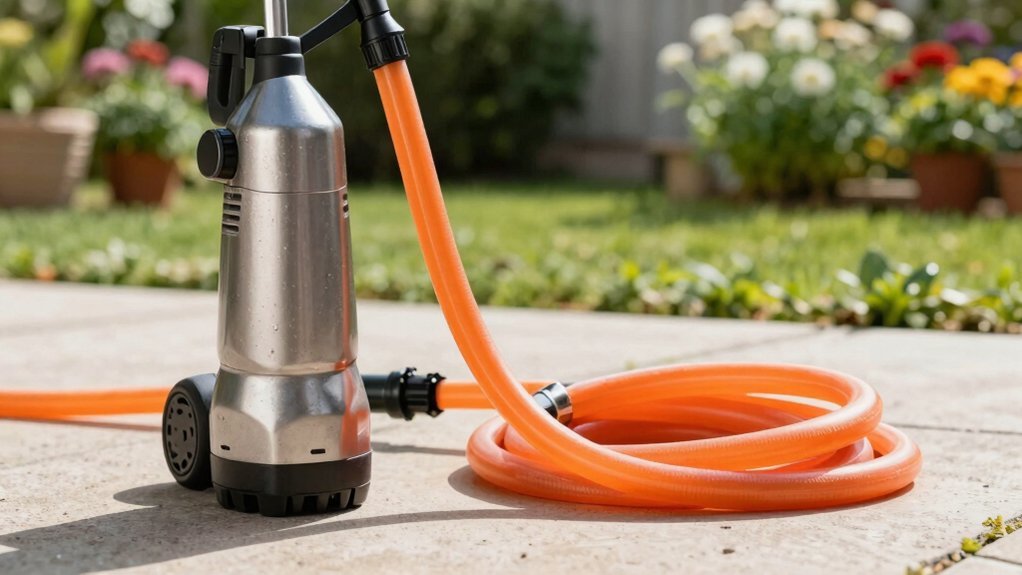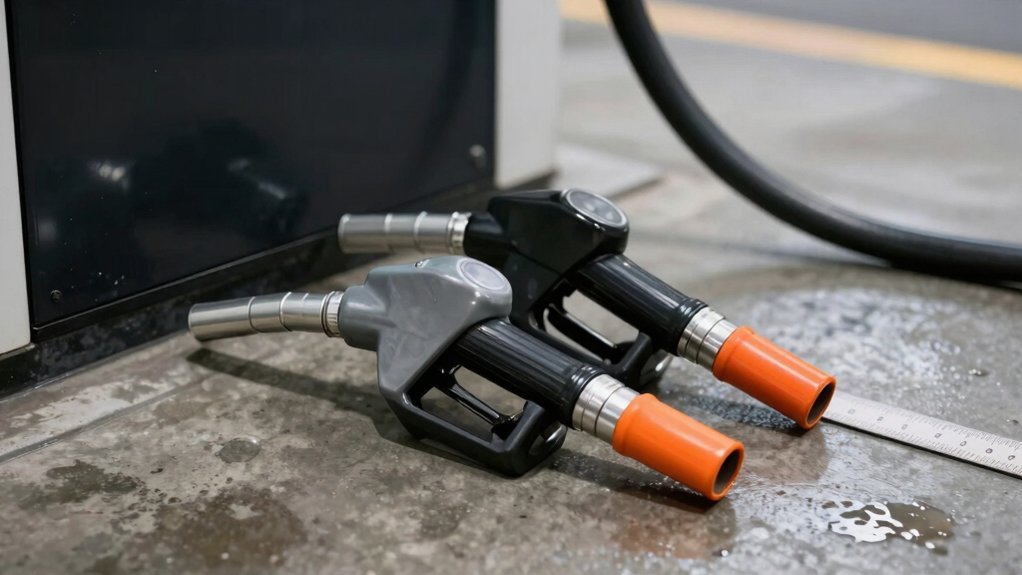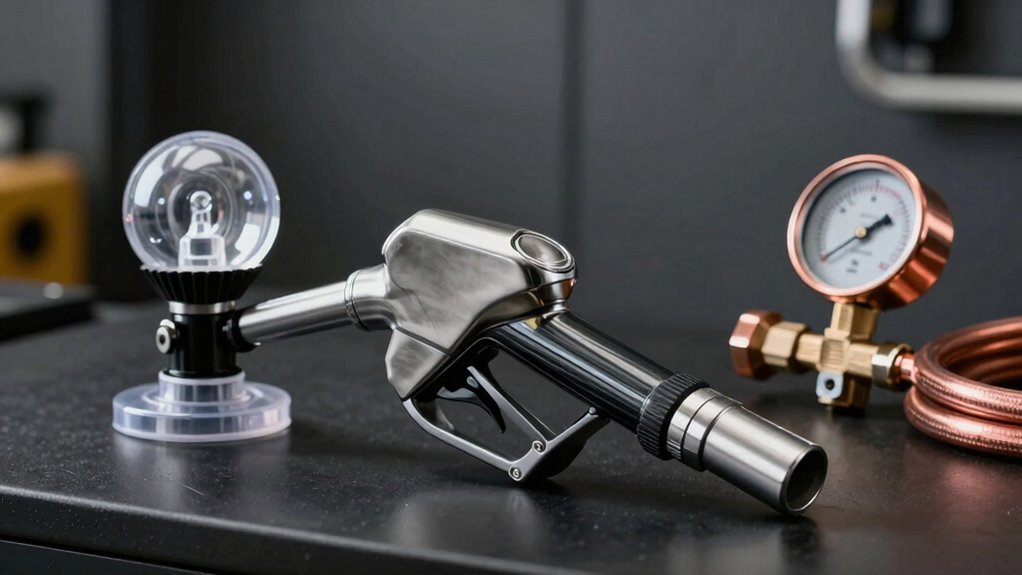
Pick a washer that matches your hose’s material and pressure rating: brass outperforms plastic for high‑psi jobs, while aluminum offers a lighter, still durable option for moderate pressure. Guarantee the thread type (NPT, IPT, or NPSH) aligns with your hose’s standard garden thread and size the interior diameter—½‑inch for typical taps, ¾‑inch for larger setups. Use washers in female couplings, tighten until the washer seats, and favor crimped or 90‑degree brass joints. Continue for’ll identify the top models and detailed comparisons.
How to Choose the Ideal Hose Length and Diameter
You’ll want to match hose length and diameter to your garden’s size and water‑flow needs. For a small patio, a 25‑foot, 1/2‑inch hose gives adequate water flow rate while maximizing handling maneuverability; its lighter weight lets you coil it easily. Medium lawns (500‑2,000 sq ft) benefit from a 50‑foot, 5/8‑inch hose, which balances pressure loss over distance with a manageable heft. Large yards (2,000‑5,000 sq ft) require 75‑100 feet of 3/4‑inch hose to sustain high flow rate for sprinklers, though the bulk reduces maneuverability. Measure from spigot to farthest point, add 5‑10 feet for obstacles, and consider terrain that cuts effective reach. If uncertain, start with a 50‑foot hose and extend later with connectors, keeping pressure loss and storage weight in mind. The flow rate is directly proportional to the hose’s inner diameter and the water pressure supplied by your home. Selecting the proper hose diameter helps maintain consistent water pressure throughout the system. Most residential hoses perform best within the 40‑80 psi range, aligning with typical household water pressure.
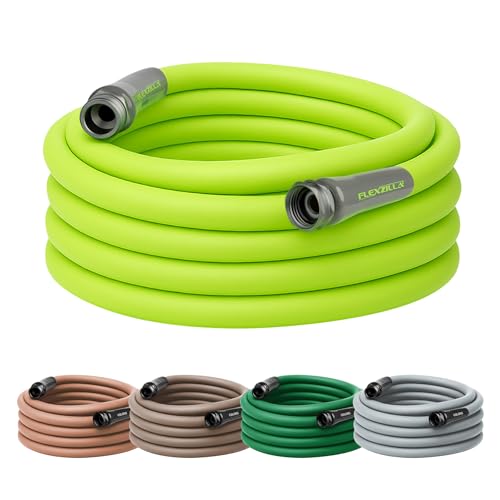
AWARD-WINNING: HGTV, USA Today and Best Reviews voted Best Overall Garden Hose

RUST-PROOF 304 STAINLESS STEEL HOSE THAT OUTLASTS RUBBER: Built from commercial-grade 304 stainless steel, this metal garden hose never rusts, cracks, or rots like ordinary hoses — so you replace it far less and save money season after season.

LIGHTWEIGHT AND FLEXIBLE: Made of innovative rubber and polymer mixed materials, our water hose 50 ft is 30% lighter than traditional rubber hoses and super flexible to use
Which Pressure‑Washer Hose Material Handles Your PSI?
Choosing the right pressure‑washer hose hinges on matching the hose material’s PSI rating to your washer’s output while balancing weight, flexibility, and durability. Rubber hoses cover 2,000–4,000 PSI, offering strong hose durability considerations, heat‑cold resistance, and a heavier feel that may scuff surfaces. Polyurethane hoses sit at 2,500–3,500 PSI, lightweight with a non‑marking exterior, but they’re less abrasion‑resistant and a bit stiffer, making them ideal for indoor detailing. Steel‑braided hoses push 3,500–5,000 PSI (or 6,000 PSI with double braids), delivering industrial‑grade strength and superior burst protection, while still retaining synthetic rubber durability. Light‑duty hoses, rated 1,000–2,500 PSI, suit home electric units but demand a 25‑30 % safety margin. Heavy‑duty hoses handle 3,500–6,000 + PSI, feature neoprene inner layers, and also require a 25‑30 % safety margin for commercial use. Selecting a hose with an appropriate pressure rating ensures both performance and safety.

[M22-14mm Connection Fit] Mismatched fittings can cause leaks or failed setups, so both hose ends use M22-14mm female brass fittings for matching M22-14mm male pressure washer outlets and spray gun inlets.

[25FT 1/4" 3200 PSI PRESSURE WASHER HOSE] 25FT pressure washer hose with 1/4 inch inner diameter, rated up to 3200 PSI working pressure for most residential car, driveway and patio cleaning jobs (cold water only). Designed specifically for gas and electric pressure washers, it works as a replacement or extension hose to give you more reach for outdoor power washing.

Fully Equipped: The package comes with a power washer hose and 5 adapters to handle a wide range of applications. Included are 2 x M22-14mm female to 3/8" plug, 2 x M22-14mm male to 3/8" quick connector, and 1 x M22-14mm male to M22-14mm male
How to Pick Leak‑Proof Couplings for Your Hose
A solid coupling starts with the right material: brass outperforms plastic by handling higher pressures and resisting corrosion, while aluminum offers a lighter yet still durable alternative for moderate‑pressure tasks. Choose brass when you need the highest pressure rating and UV resistance; opt for aluminum if you prioritize weight without sacrificing durability. Verify hose thread compatibility: match NPSH, IPT, or NPT stamps on the fitting to your hose’s standard garden thread, and avoid mixing American and British standards. Size the interior diameter to the hose—½‑inch for typical taps, ¾‑inch for larger gardens—to keep water flow optimization intact. Use washers in female couplings, tighten just enough to seat the washer, and prefer crimped or 90‑degree brass joints for the strongest, leak‑proof seal. Garden hose threads differ in pitch and seal mechanism from NPT, making them unsuitable for high‑pressure applications. Properly inspect the connection after installation to catch any early leaks, checking for drips before regular use. Remember that the common ¾‑inch garden hose thread is the most widely used size in residential watering systems.

Package Include: 2 pcs 3/4 inch double female garden hose connector, 4 pcs spare hose washers.
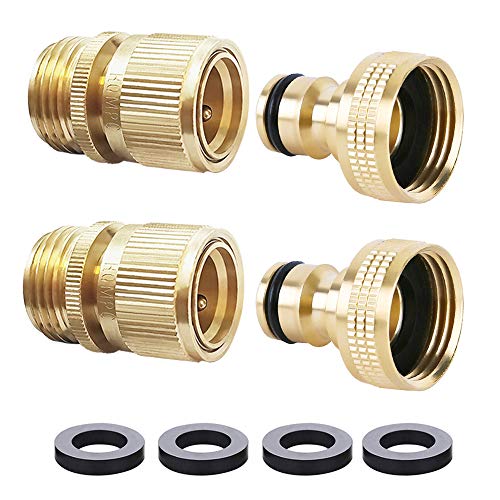
★【Standard 3/4 Inch GHT Garden Hose Quick Connect】-This garden hose quick connect sets including 2 brass female connectors + 2 brass male connectors+4 free washers.Use this hose quick connect fittings You can enjoy it work perfectly with any standard garden hose,faucets,hose bibs and watering devices.

Heavy duty -- Made of solid brass for maximum durability and strength
When to Replace Your Pressure‑Washer Hose
When does a pressure‑washer hose truly need replacement? You’ll know it’s time when cracks appear on the exterior, the metal braid shows exposure, or bulges develop—each sign of hidden damages that weaken the hose wall. If kinks never straighten, the material’s lost flexibility and can burst under pressure. Watch for unexpected leaks at connections even after installing new fittings; they indicate internal wear. A pressure drop exceeding 10 % or a noticeably weaker water stream also signals degradation. Compare rubber and braided stainless‑steel models: rubber typically lasts 300‑500 hours or 3‑5 years, while stainless steel endures 5‑8 years. Conduct yearly full‑length inspections, feel for soft spots, and replace the hose before a rupture occurs. Inspect the hose for any flat spots that may indicate underlying damage. Understanding Bernoulli’s principle helps explain how pressure changes affect flow through the hose. For light cleaning tasks, a garden‑hose pressure system can be sufficient when the hose length is short and the nozzle is properly sized.

4 FT SET of BRAIDED STAINLESS STEEL - Washing Machine Hoses. Each package includes both a hot and cold, easy to see, color coded hose.

【2Pcs 6ft Stainless Steel Braided Washing Machine Hose】:The package includes 1 x Blue colored for cold Water, 1 x Red colored for hot water, 4 x black gasket.►The diameter of the washer hose body is 0.513 inches and the inner diameter of the connection port is 0.983 inches.►The black gasket has an inner diameter of 0.5in and an outer diameter of 0.94in. Universal connector fits all standard U.S. washers with industry standard and the 3/4" NPT connections on either end are a perfect fit for your washer and supply tap,Easy for for installation.

IMPORTANT NOTE: 3/8 pressure washer hose is only compatible with high-pressure washers and spray guns that have 3/8" quick connect plugs (male). Both ends of the high pressure washer hose 50 ft features 3/8" female quick connectors, and the inner diameter of the hose is 1/4 inch
Best Pressure‑Washer Hoses for 2024‑2025
Your pressure‑washer hose is the weak link that determines whether you’ll face a sudden burst or a steady, high‑flow clean, so picking the right model for 2024‑2025 matters. For budget‑conscious users, Sun Joe SPX‑25HD offers thermoplastic construction, kink‑resistance, and a low price point while maintaining adequate PSI for residential tasks. BluShield’s 100 % rubber hose, though pricier, wins on design aesthetics with a sleek, lightweight profile and a 10‑year warranty; its aramid‑braided core is 10× stronger than steel yet 35 % lighter. Simpson Cleaning 40223 delivers industrial‑grade 4000 PSI burst pressure and steel‑braid durability for heavy‑duty cleaning. YAMATIC balances flexibility and strength at 3200 PSI, ideal for typical home use. Greenworks 25‑foot universal hose rounds out the lineup, offering high‑pressure compatibility and a compact look that fits tight storage. When comparing, weigh price considerations against durability, burst rating, and design aesthetics to match your washer’s specifications and your aesthetic preferences. The Tool Daily High‑Press Washer Hose provides a budget‑friendly option with a 50 ft length that handles up to 3600 PSI and 140°F hot water. Longer hose runs can cause noticeable pressure drop, so selecting a hose with an appropriate diameter helps maintain performance. Connecting multiple hoses can further reduce pressure, so limit the length to three or four standard 5‑inch hoses for optimal flow. Proper hose material selection ensures resistance to UV degradation and chemical exposure.

3/8" SWIVEL QUICK CONNECT: The brass socket rotates 360° as you move the spray gun, helping reduce twisting at the connection when you change direction. Fits matching 3/8" QC systems used on many Simpson, Dewalt, Generac, Rigid, MTM, Champion, and Powerstock.

[TOUGH STEEL-WIRE BRAIDED] This abrasion-resistant rubber cover with tensile steel-wire braided for pressures up to 4000 PSI(12000 PSI burst pressure), supporting repeated home cleaning on concrete and other rough outdoor surfaces.

【M22 to 3/8'' Quick Connector Adapter Kit】The package includes a power washer hose and 5 adapters: 2 × M22-14mm female to 3/8" plug, 2 × M22-14mm male to 3/8" socket, and 1 x M22-14mm male to male. It's fits most power washers and guns.