You’ll spend roughly $0.50–$2.50 per square foot for a professional install, which means a 1,000‑sq‑ft yard runs $750–$1,650 and a 5,000‑sq‑ft DIY system costs $4,400–$8,500. Expect $600–$2,000 per zone, with heads ranging $1.50–$35 each, and add $590–$1,340 per zone yearly for maintenance. Terrain, labor rates, and permits can push the price up, while portable units or hose‑timer setups stay far cheaper. Keep reading to uncover how to size zones, choose heads, and spot hidden fees.
How Much Do Sprinklers Cost? Quick Pricing Guide
Understanding sprinkler costs starts with the basics: you’ll spend roughly $0.50–$2.50 per square foot for installation, which translates to $600–$2,000 per zone and $3,000–$10,000 for a typical 1/4‑acre lawn. If you opt for a DIY sprinkler installation, you can shave a few hundred dollars off the $0.88–$1.65 per square foot range, especially on a 5,000‑sq‑ft yard where total spend drops to $4,400–$8,500. Expect sprinkler maintenance costs to be modest—typically $590–$1,340 per zone annually for routine head replacement and valve checks. Pop‑up heads run $3–$15 each, while rotary heads cost $5–$40. Budget for 1–5 zones, and you’ll keep the whole system under $8,000, even on larger properties. Complex design requirements also contribute significantly to overall expenses. Smart valve technology can further affect pricing depending on integration features. Proper water pressure ensures even coverage and prevents system strain.
What Are the Main Sprinkler Cost Drivers?
Your earlier cost breakdown shows that a typical 1/4‑acre lawn runs $3,000–$10,000, but the exact price hinges on a few key drivers. Yard size dictates pipe length and head count, so a 1,000‑sq‑ft lawn costs $880–$1,650 while a 10,000‑sq‑ft area jumps to $8,800–$16,500. Sprinkler head type adds variance: cheap bubblers at $1.50 each versus impact rotors up to $35. Zone count follows water pressure requirements; each zone costs $590–$1,340, and extra zones add $500–$2,000. Soil and terrain affect trenching labor, especially on slopes or rocky ground. Regional labor rates and permits shift the base price, and custom installations for complex layouts further increase expenses. Properly sizing each zone also ensures balanced water distribution and prevents over‑ or under‑watering, which can be calculated using the flow‑rate formula from sprinkler design guidelines. Understanding average repair costs helps homeowners budget for unexpected issues.
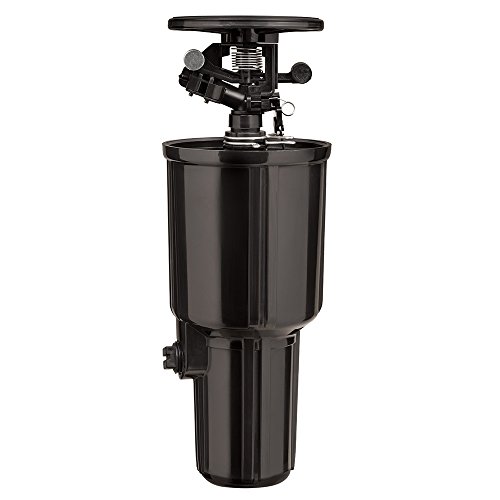
For watering areas with up to 35 feet of spacing between sprinkler heads; 3-inch pop-up riser height ensures that the nozzle clears medium grass

Excellent choice for hard water, "dirty water", or reclaimed water irrigation systems
Which Sprinkler System Type Has the Lowest Cost?
So, which sprinkler system will save you the most money? The portable design of above‑ground units beats inground options because you skip trenching, labor, and pipe hazards. A simple oscillating model like the Melnor MiniMax costs $28.99 and covers up to 4,000 sq ft without any digging—perfect for rocky or vegetated yards. If you prefer a semi‑automated setup, hose faucet timers such as the Orbit 2‑Zone system connect directly to your faucet and run under $30, delivering basic zoning without excavation. These hose‑faucet timers are the cheapest in‑ground starter, offering automated watering while keeping upfront costs low. Both portable designs and hose faucet timers give you immediate, budget‑friendly irrigation with minimal installation hassle. Manual hose bib issues can be resolved by using a dedicated timer that bypasses the leak.

ULTIMATE FLEXIBILITY FOR ANY GARDEN SHAPE – Place sprinklers exactly where you need them- Perfect for lawns, flower beds, raised gardens, and more.

EFFORTLESS ABOVE-GROUND SPRINKLER SYSTEM: Create a custom sprinkler system for your lawn without the hassle of underground installation; no digging required
How Does Lawn Size Influence Sprinkler Cost?
When your lawn grows beyond a few hundred square feet, the price per square foot drops but the total bill climbs because you need more pipe, heads, and labor. For a 1,000‑sq‑ft yard you’ll spend roughly $750‑$1,650; a 5,000‑sq‑ft space jumps to $1,400‑$8,250, depending on design and region. Medium lawns (10,000‑sq‑ft) range $2,200‑$16,500, while large properties (20,000‑40,000 sq‑ft) can exceed $12,600. Bigger yards demand longer runs, extra zones, and higher sprinkler head quality, which inflates labor costs during sprinkler system installation. Shape and landscaping quirks add pipe and head quantity, so budgeting for material and labor spikes as acreage climbs. Lot size influences the number of zones required, impacting overall cost. Focus on per‑square‑foot averages and zone requirements to keep costs transparent. Proper head spacing ensures adequate coverage without overloading the water pressure. Installing an efficient system also supports fire risk reduction by maintaining a well‑watered landscape. Understanding code compliance requirements can prevent costly redesigns later.

Effortless Yard Irrigation Setup: The Orbit All-in-One Automatic Watering System simplifies yard irrigation with a complete 2-zone automatic sprinkler system designed to deliver consistent watering

WATER YOUR YARD WITH EASE - Our Easy Set Logic sprinkler timer is the perfect choice for your yard, controlling up to 12 zones/stations for efficient irrigation.

PREVENT WATER BACKFLOW - Our automatic anti-siphon valve with an atmospheric vacuum breaker protects your irrigation system and culinary system from water contamination.
What Are Typical Sprinkler Zone and Head Prices?
Zone and head pricing drive the bulk of a sprinkler system budget, so knowing the typical ranges helps you plan accurately. A single zone usually falls between $585 and $1,335, with most projects hovering around $650‑$1,000. Adding zones costs roughly $750‑$1,000 each, and multi‑zone totals climb quickly: two zones $1,165‑$2,665, three zones $1,875‑$5,000, and five zones $3,125‑$8,000. Zone pricing variations also appear per square foot—automatic systems $0.88‑$1.65, in‑ground $0.90‑$1.70—so regional rates like Seattle’s $1.02‑$1.95 affect the final tally.
Sprinkler head style comparisons show a wide price spread. Bubbler heads start at $2.50 and can reach $25, pop‑up and stationary heads range $3‑$15, rotary heads $3‑$20, while gear‑driven and impact heads climb to $10‑$40 and $20‑$35 respectively. Choosing the right head type balances cost with performance, keeping your overall budget on track.
Understanding flow rate is essential for sizing the system to meet water demand. Proper fire code compliance for walk‑in coolers often requires a sprinkler system to protect both equipment and inventory. Pop‑up sprinklers also offer seasonal efficiency by reducing evaporation during hot months.

Approved for sale/meets pressure regulation legislation requirements in: CA, CO, HI, VT, MA, ME, NY, OR, RI, WA, and Washington DC

Smart Irrigation Starts Here - The Rain Bird 1806VAN 1800 Series Pack of 5 features 6-inch pop-up sprinkler heads with a fixed spray, variable arc nozzle and 1/2 in. female threaded inlet, made in the USA and built for precise irrigation in lawns, garden beds, and landscaped areas in residential and professional systems.

ADJUSTABLE ARC & SPRAY DISTANCE: Includes a preinstalled 3.0 GPM nozzle with an arc that adjusts from 40° to 360°, ideal for both full and part circle coverage. Delivers a spray distance of approximately 22 to 52 feet, with optional nozzles (sold separately) allowing further customization.
How to Estimate Your Sprinkler Cost and Spot Hidden Fees?
Understanding the price of a sprinkler system starts with breaking down the yard’s size, the number of zones you’ll need, and the hidden fees that often pop up after the initial quote. First, calculate square‑footage; a 5,000‑sq ft yard runs $4,400–$8,500, while a quarter‑acre needs 4–7 zones at $2,340–$9,340. Next, factor water pressure considerations: low pressure may force extra zones, raising the per‑zone cost of $585–$1,340. Then, run layout optimization to minimize trench length—each linear foot costs $9–$20.70, and digging 417 ft can hit $1,670–$5,000. Add permits ($35–$200) and inspection fees, plus hidden charges like backflow preventers, advanced controllers, and specialty piping. Sum all items for a realistic budget. The main pipe carries water from the source to the valve manifold. Your sprinkler system will rely on either a municipal supply, well system, or rainwater harvesting setup, so confirm the water source type before finalizing installation.

Intelligent Irrigation Control: The Orbit Smart Sprinkler Controller manages watering with a powerful smart sprinkler that supports a completely automatic watering system

WATER YOUR YARD WITH EASE - Our Easy Set Logic sprinkler timer is the perfect choice for your yard, controlling up to 12 zones/stations for efficient irrigation.

Smart Irrigation Control Anywhere: The Orbit B-hyve Indoor Smart Sprinkler Controller provides smart sprinkler timer functionality for efficient yard irrigation