You’ll pick a nozzle by matching droplet size, pattern width, and pressure to your task. For fine lines, go with a Level 2 (20‑30° fan) or Needle nozzle; for medium coverage, choose Level 3 (30‑40° fan) with 20‑inch spacing. Wide areas need Level 6 (40° fan) or Fats (110° fan) for high volume. Specialty work uses Ultra Liner for skinny lines or Effect Caps for flat patterns. Pair the nozzle with the right PSI, distance, and cap type to keep performance consistent, and the next section shows how to fine‑tune those choices.
How to Identify the Right Spray Nozzle Pattern for Your Project
Where do you start when matching a nozzle to your task? First, assess the required spray droplet size. If you need medium to large droplets for cooling or washing, a full‑cone pattern works; its conical spread delivers even coverage over circular areas. For the smallest droplets that can infiltrate foliage, choose a hollow‑cone pattern, which concentrates droplets at the spray edge. Next, consider nozzle corrosion resistance—materials like stainless steel or coated brass survive harsh chemicals and UV exposure, preserving performance. Examine spray angle: wide angles (65‑110°) give shallow, broad coverage, while narrow angles focus power for distance. Finally, match the pattern to the application—flat‑fan for conveyor washing, misting for humidification—ensuring the nozzle’s design aligns with your project’s precision and durability needs. The flat‑fan pattern creates a line‑shaped spray that concentrates fluid into a smaller area, making it ideal for high‑impact cleaning tasks. Selecting the appropriate straw holder ensures a secure connection between the nozzle and the canister, preventing leaks and maintaining consistent flow. Regularly clean the nozzle after each use to avoid spray blockages and maintain optimal performance. Understanding the coupling mechanism helps ensure reliable installation and optimal performance across diverse systems.

Material: 316 Stainless steel.
Material: Stainless steel.

Compare Detail‑Focused Spray Nozzle Patterns (Levels 2, 3, Needle, NY Outline)
After you’ve sized the droplet and spray angle, the next step is to compare the detail‑focused patterns that actually shape your line work. Level 2 gives a narrow fan (20‑30°) with tapered edges, requiring 50‑60 % overlap for uniform, super precise details. Level 3 widens the fan to 30‑40°, preserving a flat oval shape and 50 % overlap at 20‑inch spacing, delivering a slightly broader focused line width while still controlling edge definition. Needle nozzles eliminate fan spread, producing a pencil‑thin, 0° stream that maximizes detail focus and offers a scraping‑like edge for intricate outlines. NY Outline narrows further to 0‑15°, optimized at 60‑70 PSI, delivering ultra‑fine, consistent line width ideal for New‑York‑style lettering. White/40° nozzle provides wide coverage for larger background areas. For safety, always vent the can before cleaning to prevent pressure buildup. Selecting the proper nozzle size can also affect material compatibility and overall print quality.
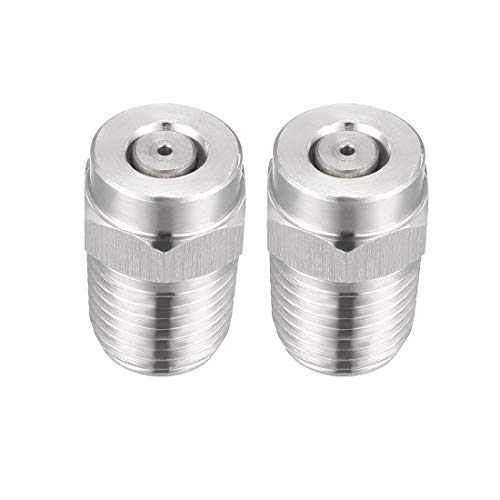
[TECHNICAL PARAMETERS] - 1/4NPT Male Thread Fitting, orifice diameter is 1.2mm, spray angle is 0 degree.

PRECISION DESIGN: 0-degree spray nozzle tip delivers a concentrated stream for maximum cleaning power in hard-to-reach areas

Size - Degree: 0; Orifice Size: 0.977mm; Thread Size: 1/4" NPT Male; Thread Length: 10mm / 0.39"; Max Pressure: 4000 PSI; Package Content: 2pcs x Surface Clean Tips.
Select the Best Wide‑Coverage Spray Nozzle Patterns (Level 6, Fats, Super Fats, Rusto Fat)
Choosing the right wide‑coverage nozzle hinges on the size of the area you need to fill and the level of overlap you can tolerate. Level 6 offers a 40° medium‑wide fan, balanced droplets, and 40‑60 PSI operation, ideal for medium‑size graffiti patches where material compatibility with acrylics or inks matters. Fats deliver a 110° fat fan, high volume, and large passages that resist clogging, perfect for quick, broadcast‑style coverage of walls or trucks. Super Fats expand the fan to 73°‑153°, maintaining uniform flow up to 110 GPM and protecting the orifice for horizontal mounting; they excel when you need massive swaths with minimal nozzle maintenance. Rusto Fat pushes angles to 110°, using rounded passages for corrosion resistance and 100 % overlap, suited for heavy‑duty paint jobs where durability and material compatibility are critical. Proper nozzle selection also ensures optimal atomization and reduces waste by controlling droplet size and spray pattern spray performance. The nozzle’s design leverages continuity to convert pressure energy into kinetic energy, increasing fluid velocity while lowering static pressure. Understanding the distinction between a nozzle and a valve clarifies that the nozzle shapes flow rather than merely controlling passage fluid control.

Package Included: You will receive 10pcs Female Spray Can Nozzle. 10 kind different of spray paint nozzles of different sizes and shapes can depict various spray patterns and coverage ranges, meeting your various daily creative needs.

Spray Bottle Size: 10oz (300ml) capacity, approx. 7 x 2.3 inches, perfectly designed to fit in your hand and large enough that you won't have to fill it as often.

Adjustable Coverage Control - Customize watering with a 0–360° adjustable pattern designed to match the exact shape of your lawn. This 10-pack of pop up spray nozzles helps reduce overspray while delivering targeted, efficient coverage for lawns, garden beds, and irregular landscape areas.
Understand Specialty Spray Nozzle Patterns: Ultra Liner, Fan‑Spray, and Effect Caps
When you need pinpoint control or a distinct visual effect, specialty spray nozzles—Ultra Liner, Fan‑Spray, and Effect Caps—each deliver a unique pattern. The Ultra Liner’s tiny orifice creates super‑skinny lines for customized spray effects, but you must address tip performance considerations like frequent unclogging and duct‑tape access. Fan‑Spray offers a 0°‑65° fan‑type distribution, giving uniform coverage from a V‑shaped tip; its tapered edge reduces overspray while maintaining consistent tip performance. Effect Caps use air directors to expand ultrasonic spray into flat, rectilinear patterns, achieving up to five‑times width with feathered edges; tip‑to‑substrate distance governs pattern width, so monitor tip performance closely. Choose the nozzle that aligns with your project’s precision, coverage, and durability needs. The air‑induced design of many low‑drift nozzles helps maintain coarse spray quality even at higher pressures. Understanding the pressure‑velocity relationship is key to optimizing nozzle performance. Properly managing pressure loss in the nozzle can significantly improve energy efficiency and spray consistency. A well‑designed nozzle can also reduce flow resistance to achieve smoother operation.

For use with all Vaper 32oz non-aerosol spot sprayers

Featuring a deflecting design that creates a 140 degree wide angle spray that reduces drift when laying chemicals

8-PIECE NOZZLE SET: Includes 1 elbow flat fan spray nozzle and 7 interchangeable spray tips, covering all your spraying needs in one complete kit.
Match Pressure, Distance, and Cap Type to Your Spray Nozzle Pattern
Specialty nozzles give you the pattern you need; now you must align pressure, spray distance, and cap type to keep that pattern consistent. Choose a flat‑fan nozzle at 20‑30 psi for medium droplets; raise to 30‑60 psi only if you accept the droplet size impact and increased drift. For longer reach, select a pneumatic full‑cone atomizer, which maintains uniform circular impact at higher flow rates. Match cap type to pressure: hydraulic caps handle 10‑100 psi while pneumatic caps require 60‑70 psi internal mixing. Verify that the cap’s valve fits the spray can’s thread to avoid leaks. Finally, schedule equipment maintenance requirements—clean orifice, check swirl chamber, and replace worn caps—to preserve droplet size control and pattern fidelity. Selecting the correct nozzle also helps prevent excessive surface wear during high‑pressure cleaning. When the pressure ratio exceeds the critical value, the flow can become sonoked leading to a sudden drop in downstream pressure. This illustrates how a nozzle converts pressure into velocity, following Bernoulli’s principle.

【Size】Our flat fan spray tip is designed with the perfect size. It has a thread size of 1/4"NPT, an hex width of 0.55"/14mm, a height of 1"/26mm.

Technical Specifications: Flat fan spray tip features a 6 mm inner diameter, 15 mm maximum diameter, 11 mm height, 110° spray angle, 0.18-0.37 GPM flow rate, and 30-60 PSI operating pressure for consistent performance

Flat fan design that creates a 80-degree spray angle for medium droplet size