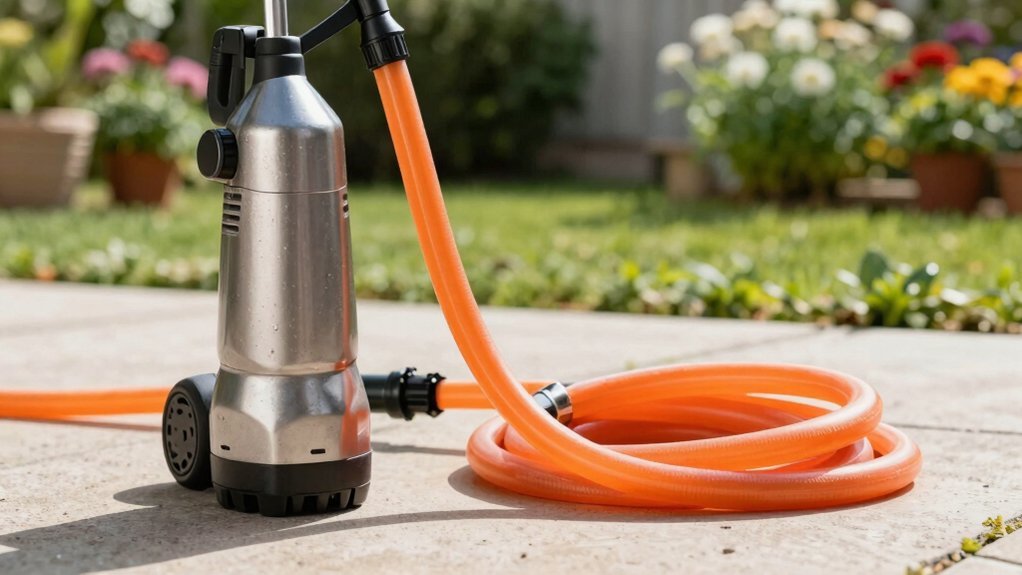
A nozzle doesn’t boost static pressure; it transforms the pressure you already have into kinetic energy, so the fluid speeds up as the cross‑section narrows. Bernoulli’s equation shows that as velocity rises, static pressure falls, and continuity forces the flow to accelerate when the area shrinks. If the throat reaches Mach 1, the flow chokes and further pressure drops become limited. Keep exploring to see how this principle powers fire‑hoses, jet engines, and even garden sprinklers.
How a Nozzle Reduces Fluid Pressure
How does a nozzle actually lower fluid pressure? You watch the cross‑section shrink, and the fluid’s potential energy converts to kinetic energy. As the area contracts, Newton’s second law tells you the net pressure force accelerates the mass, raising velocity while static pressure drops. Because fluid compressibility is low, density stays nearly constant, so the pressure reduction follows the momentum equation rather than volumetric expansion. Thermal effects appear: the rapid acceleration cools the stream (Joule‑Thomson effect) and may generate local temperature spikes where shocklets form. The pressure gradient drives flow toward the exit, and the boundary layer thins, minimizing viscous losses. Ultimately, the inlet gauge pressure supplies the discharge, and the exit pressure matches the back‑pressure condition. The nozzle’s mass flow of 59.9 kg/s contributes significantly to the momentum change. The Bernoulli principle explains how the sum of pressure, kinetic, and potential energy remains constant along a streamline. This illustrates how a converging nozzle transforms static pressure into kinetic energy. Proper selection of a sprinkler nozzle ensures even water distribution for irrigation.
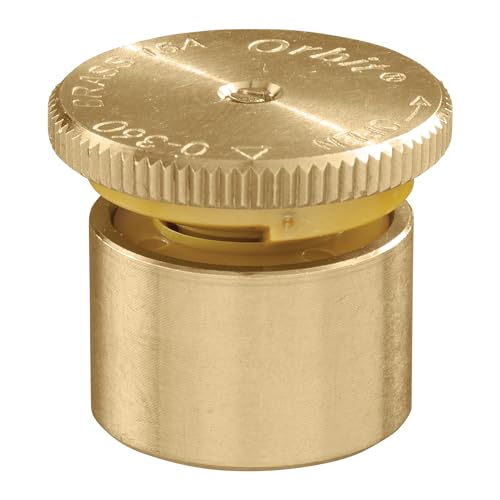
UNIVERSAL COMPATIBILITY: Designed to fit all major brands of pop-up spray heads, making it easy to replace existing nozzles and maintain your irrigation system. Delivers up to a 15-foot spray distance for efficient landscape watering (distance may vary based on PSI and other factors).

PRECISION ADJUSTABLE ARC, 0° TO 360°: Set exact spray angles for any landscape layout, from tight corners to full circle zones, with simple top adjustment

PRECISION ARC CONTROL FROM 0° TO 360°: Get pinpoint accuracy for any zone shape or edge. Whether you're watering a narrow walkway or full lawn circle, fine-tuned arc settings ensure no water is wasted.
Bernoulli’s Principle: Converting Pressure to Velocity
When fluid speeds up in a streamline, its static pressure drops because the kinetic energy rises at the expense of pressure energy, as described by Bernoulli’s equation \(P+rac12\rho v^2+\rho gh=ext{constant}\). You’ll notice that as velocity climbs, the term \(rac12\rho v^2\) grows, forcing static pressure to fall. In a converging nozzle, continuity forces \(v\) up, and the reduced density ratio of the fluid (if compressible) accentuates the pressure loss. Downstream pressure recovery occurs once the area expands again, allowing kinetic energy to reconvert into pressure. This exchange obeys energy conservation, assuming steady, frictionless flow and negligible elevation change. Your calculations should pair Bernoulli with continuity to predict pressure‑velocity profiles accurately. In a diverging nozzle beyond the throat, the expanding area causes the supersonic flow to further accelerate as its pressure and density continue to drop, illustrating the Mach‑1 transition effect. For irrigation systems, selecting the proper nozzle size ensures the desired inches per hour flow rate while maintaining adequate pressure. Understanding flow rate differences among nozzle types helps engineers choose the most efficient design for a given application.
Why Nozzle Pressure Drops as Area Shrinks
Because the nozzle’s cross‑sectional area decreases, the fluid must accelerate to keep the mass flow rate constant, and that acceleration converts static pressure into kinetic energy, so the pressure drops as the area shrinks. You observe this by applying the conservation of momentum: the momentum flux must increase to match the higher velocity, and the excess static pressure supplies the required kinetic energy. Simultaneously, fluid friction losses grow with velocity, converting additional pressure into thermal energy. The narrowing section forces the same mass throughput through a smaller conduit, so the velocity rises proportionally to the area reduction. As velocity climbs, viscous shear at the wall intensifies, further reducing pressure. This dual mechanism—energy conversion and friction—explains why pressure falls when the nozzle area contracts. The mass flow rate remains constant because continuity ensures ρA v is invariant throughout the nozzle. The thrust can be estimated using the momentum‑change formula F = ṁ(V_out – V_in). Understanding thespr of sprinkler spray patterns helps in selecting the appropriate nozzle for efficient irrigation.

【66FT 5/16 inch Irrigation Tubing Hose】: Mornajina 50FT Irrigation tubing hose, inner diameter 6mm/0.24inch & Outside Diameter 8mm/0.31inch, made of High quality material, high temperature resistance, durable, explosion-proof and rust proof, can be cut into any length with pipe cutting. And our upgraded automatic irrigation system kit replaces traditional socket connections, allowing to insert the pipes and fittings into the tee without heating. It effectively increases the water pressure and helps solve the problem of lack of water at the end of the irrigation system.

Home High Pressure Car Wash Water Gun: This high pressure hose nozzle can achieve impressive spray distances of up to 20 meters, significantly enhancing your cleaning efficiency and saving you time. High pressure water gun easily blasts away tough dirt, grime, fish scales, and stubborn stains well for washing cars, cleaning patios, driveways, and decks with minimal effort

Easily converts a 1/2" riser or existing shrub spray to low volume Drip watering system
When a Nozzle Chokes: Sub‑sonic vs. Supersonic Flow
If the pressure ratio across a converging‑diverging nozzle exceeds the critical value, the flow will choke at the throat, reaching Mach 1 there; you then observe a distinct shift between sub‑sonic and supersonic regimes. In the converging section, sub‑sonic flow accelerates as area shrinks, but once Mach 1 is attained at the throat, further pressure reduction cannot increase velocity upstream. The throat geometry fixes the mass flow regulation, setting a maximum mass flux that depends only on upstream stagnation conditions. Downstream, the diverging section expands supersonic flow, raising Mach number while static pressure and temperature fall. If the throat is too large, choking never occurs and the nozzle remains sub‑sonic, delivering low exit velocity and minimal thrust. The subsonic flow accelerates as the area decreases. Understanding energy conversion helps explain how fluid energy becomes mechanical rotation. This process exemplifies the thermal‑to‑kinetic conversion that powers turbines and jet engines.
Firefighting, Jet Engines, and Household Hoses: Real‑World Nozzle Pressure Uses
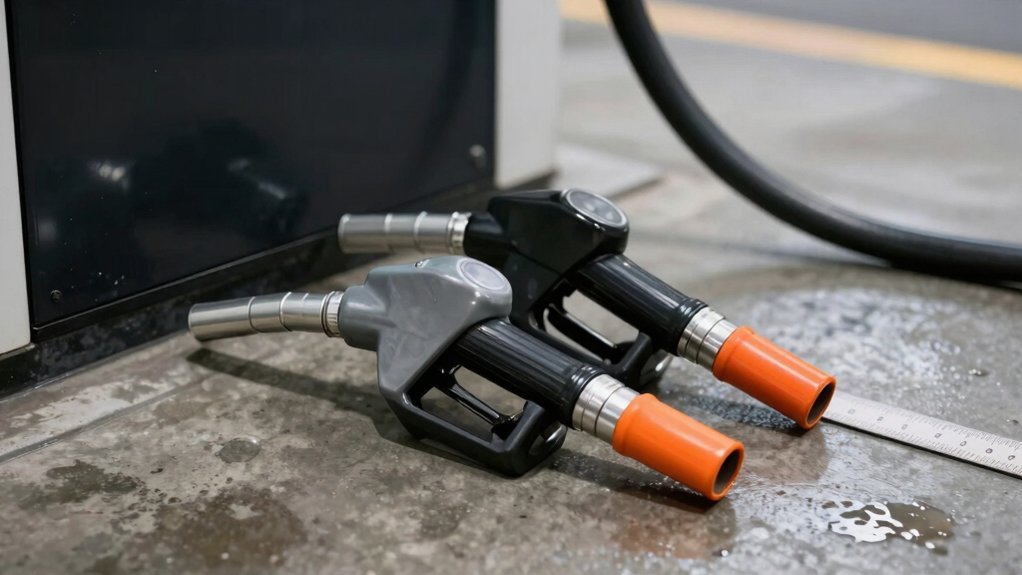
How does nozzle pressure translate into real‑world performance? You’ll see that fire‑fighting, jet propulsion, and household hoses all rely on the same physics: pressure drives velocity, which dictates impact force and reach. In fire‑fighting, a 75 psi nozzle yields an 80 mph stream that penetrates a fire seat; automatic orifices adjust to maintain ideal pressure, balancing flow rate against nozzle mechanical durability. Jet engines convert high chamber pressure into exhaust velocity, producing thrust regardless of nozzle shape, while smooth‑bore and fog designs share identical impact at equal pressure. Household hose nozzles restrict flow, invoking Bernoulli’s principle to boost speed; you can switch from fan to straight stream, optimizing flow pattern for distance up to 80 ft. Reaction forces rise with PSI and GPM, so designers embed relief features to protect operators and preserve nozzle mechanical durability. Nozzle pressure directly determines the stream’s kinetic energy. Properly designed fog nozzles achieve uniform droplet distribution even at low flow rates. Selecting the correct nozzle size ensures optimal flow‑rate efficiency for each cleaning task. Using a pressure washer hose rated for higher PSI can prevent premature failure when high‑pressure demands exceed standard garden hose limits.

Water hose nozzle comes with an adjustable head to easily change spray from powerful jet stream to light rinse

HEAVY DUTY FIREMAN HOSE NOZZLE: Constructed with a premium aluminum alloy core and wrapped in TPR rubber, the AUTOMAN garden hose nozzle is sturdy enough to withstand daily drops, rust, corrosion, and wear. It's a reliable tool you can trust for years.

UNRIVALED DURABILITY: Crafted with top-tier materials, FANHAO firemans hose nozzle is built to last. The water nozzle is equipped with premium chromium-plated copper, steel, brass and high-density rubber for unmatched resilience against corrosion, rust, drops, and wear, robust much more durable than other plastic nozzles. It is designed to last for years of reliable us.
Testing Nozzle Pressure‑Velocity Relationship and Debunking Myths
Typically, you’ll measure nozzle performance by recording the static discharge pressure and the resulting jet velocity, then compare the data against Bernoulli’s and isentropic‑flow equations. You set up a calibrated pressure transducer upstream of the throat and a high‑speed anemometer at the exit, ensuring the flow remains steady and the nozzle stability is not compromised by vibration. Vary the back‑pressure to span sub‑critical and critical regimes, noting the discharge coefficient (Cₙ) at each point. Plot velocity versus pressure; the curve should follow V = √[2 η cₚ Tₜ(1‑(pₑ/p₀)^{(γ‑1)/γ})] until choking limits further rise. Verify that Cₙ stays near 0.98 for clean, convergent geometry, confirming the myth that pressure alone dictates speed is false. Proper nozzle selection also enhances uniform droplet distribution and reduces waste. Understanding surface roughness impact helps explain why wear can increase pressure loss and degrade performance.

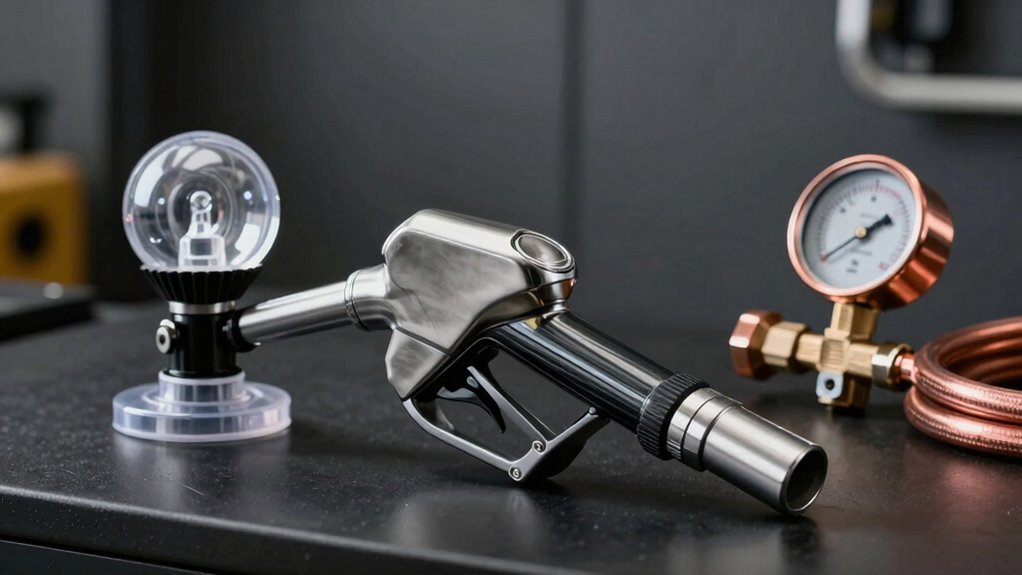
A-SHA ADAPTER: Underhill Adapter connection for female nozzles; ideal for connecting to a water pressure test gauge to measure dynamic pressure; gauges sold separately; from a trusted USA-based company

Used to test leak of needle valve on small engine carburetor;

MEASURE STATIC AND DIFFERENTIAL pressure from two ports in air and gas systems